Archive for category Personal memory
E-mails, history and diplomats
Posted by John Dickson in History ahead, International, Personal memory on March 17, 2015
Imagine the conversation that Hillary Clinton had with her Information Technology people when she started her job as Secretary of State. First of all, she probably didn’t have one, but her staff did, on behalf of her wishes. “The Secretary does not want to have an official account on the State Department system,” they would have said. “She will use her own private e-mail and server for her electronic communications.”
Loyally, like most in the Department, the professional IT folks nodded and went to work to MAKE IT HAPPEN. Their concerns, if they voiced any at all, would have fallen in the security arena. What they likely did not say was anything about the need to keep a historical record.
The reality is that for most of the communications coming from the Secretary’s office, she relied on her staff who probably all had official accounts, as well as their own private mail. As Gail Collins points out in her op-ed in the New York Times, the former Secretary’s reference to 60,000 e-mails during her tenure turns out to be roughly 40 a day. It’s not inconceivable that her many staff churned out more than that on her behalf in ten minutes. All of those messages are, we can assume, on the official system.
The problem with the exclusive use of private e-mail that many of her would-be detractors are focusing on is, incredibly, Benghazi, and then security. However, by deciding what the public should and should not see, the former Secretary simply leaves to the imagination what will not see the light of day. Ms. Clinton says it is personal material, and undoubtedly there are plenty of those. Likely there are also messages related to her past and perhaps future status as a politician, interacting with the large retinue of friends and donors, responding to their requests for favors, small and large. Not unusual for any politician holding any government office.
Surely Ms. Clinton or someone on her staff must have realized the historic value of her documents, if only for her memoir that she was sure to (and did) write. Why save documents only for her book? She makes the claim that her business e-mails to those in the Department could be accessed through the recipients, but she did not send e-mails to just other State Department officials. Further, if her staff were using official accounts in sending e-mails to carry out her instructions, it is unclear who would know which of these messages were valued for the historic record.
It’s not just the absence of the former Secretary’s communications that presents a challenge to future historians. While no one is suggesting this as a reason for her foregoing the State Department server, the chilling effect of leaks (such as Wiki-leaks or Snowden cases) on official communications is taking a toll on the written record. Rather than write cables, the use of e-mail is more pervasive and when the issue is very sensitive, phone calls are taking over as the medium of choice.
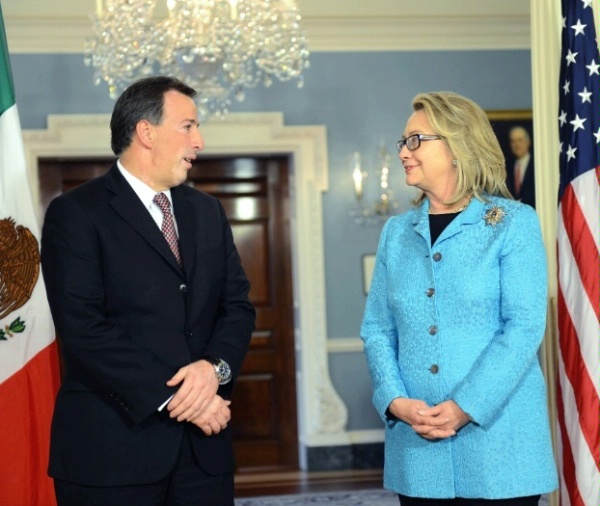
With Mexican Foreign Secretary Jose Antonio Meade in 2013. Photo, department of State
What Secretary Clinton’s private e-mail use also encapsulates is the broader issue of how the Department of State does not take full advantage of its own history in the conduct of the country’s foreign relations. To their credit, it was staff in the Office of the Historian that first brought this issue to light, in seeking to gain access for its archives to these documents. That Office and their on-line presence, through its series on Foreign Relations of the United States, has made available 450 volumes of primary source documents that have been declassified and, most recently, has begun to include material from other foreign affairs agencies. These represent an invaluable resource for scholars of U.S. foreign policy. However, it is mainly academics who mine these documents for their research. Based on my experience in the Department few of us working the multitude of issues confronting the nation in our overseas relations, drew on that resource. We did not have the time, the inclination, the skills to mine those documents as another source of “intelligence” to analyze the countries or the topics we were handling. The fact that the Historian’s Office is located in the Bureau of Public Affairs is a tip-off that its focus is external, not to inform current foreign policy issues. Perhaps the Bureau of Intelligence and Research where reports could be made for policy makers?
Our military devotes incredible effort and resources to learning its own history, and values history in its academies and its in-service training. They read the communications of soldiers in the preparations for battle as well as on the battlefield to understand the decisions taken. Our diplomats deserve the same attention to their history, to equip them to understand the complex, messy terrain of our relations around the world.
After Sonos, what’s next?
Posted by John Dickson in History in our surroundings, Personal memory on March 8, 2014
One of the running conversation games played in my house goes like this: which generation has seen the most amount of change in its lifetime? The discussion usually happens after watching some old episode of Seinfeld where Jerry’s doing body building by lifting his cell phone, or some photograph of a professional football player from the 1950s whose physique makes him look like a chess player, rather than a linebacker.
This time, though, it occurred when we bought the latest music delivery system, a Sonos system about the size of a shoebox with a speaker and no other components. No wires, no amp, no discs or tapes or records.
My own history with recorded and broadcast music starts with the small AM transistor radio and graduates to the Hi-Fi record player capable of playing both 33 rpm albums and 45 rpm singles. My grandfather had a contraption that could record voices on a disc, and he seemed to favor 78 rpm discs. There were several drawbacks to these, most notably that you had to stand up and walk over to the record player to turn the record over or to skip a song that you didn’t like.
That you had to listen to all the songs on a record or actually move to skip the one you hated helped sell me on my first tape recorder. It was a small reel-to-reel machine that could handle tapes of roughly 15 minutes. These I used and re-used for my own personal playlists. The low-tech way of recording was to stick the little mic up to the speaker of the record player, but that changed when we were able to master the wire audio in and out connections. But, I get ahead of myself as I haven’t even touched on cassette tapes or even everyone’s favorite anachronism, the 8-track cartridges.
One advantage of record playing albums still survives to this day. We pretty much learned how to read by poring over the album liner notes, that were actually written in a type size you didn’t need a magnifying glass for. You didn’t have to go to a screen to find information about the artist, and you could easily follow along with the lyrics that were often printed on the album cover or sleeve.
The transfer to stereo music — bigger and bigger speakers, with components for an amplifier and a tuner for radio — was about the last music technology that I actually cared to try to keep up with and understand. Hauling one of these to college or to yet another apartment required a small U-Haul. I can actually remember where I was when I heard my first compact disc, as if it was equivalent to remembering where I was when Kennedy was shot or when Neil Armstrong walked on the moon. The quality of sound, with no scratches or distortions, and the lack of a needle or tape head picking up the sound made this a true wonder.
To lose the needle was hard enough to fathom; to lose the actual physical thing the music was stored on came next as recorded music leapt from CD to IPOD and phone and file sharing. Hello Napster and ITunes, goodbye Tower Records.
It’s good business for the industry as people end up scrapping all the components and all the records and tapes they own every 5-6 years. Then as hip-hop music picks up on record scratching for its edgy, urban sound, we end up looking for the old records and players we used to own, and then going out to buy those again if we no longer have them buried away in our attic or storage units.
All this makes for pretty dramatic change in the course of one life. Still, my wife is not convinced that this is evidence of more change in our lifetime than in our great grandparents’ who witnessed the arrival of recorded music with the invention of the gramophone in the 1870s. This shift took a medium that could only be enjoyed live into one that allowed for repeat performances on demand. What my generation experienced was not so fundamental, since it just changed the nature of recorded music, its delivery system.
So, to ponder this more fully, I’ll go to my phone, find the Sonos App and decide whether to tap into my hundreds of purchased songs on my computer, my account with Pandora for their thousands of songs, or any of thousands of radio stations around the world.
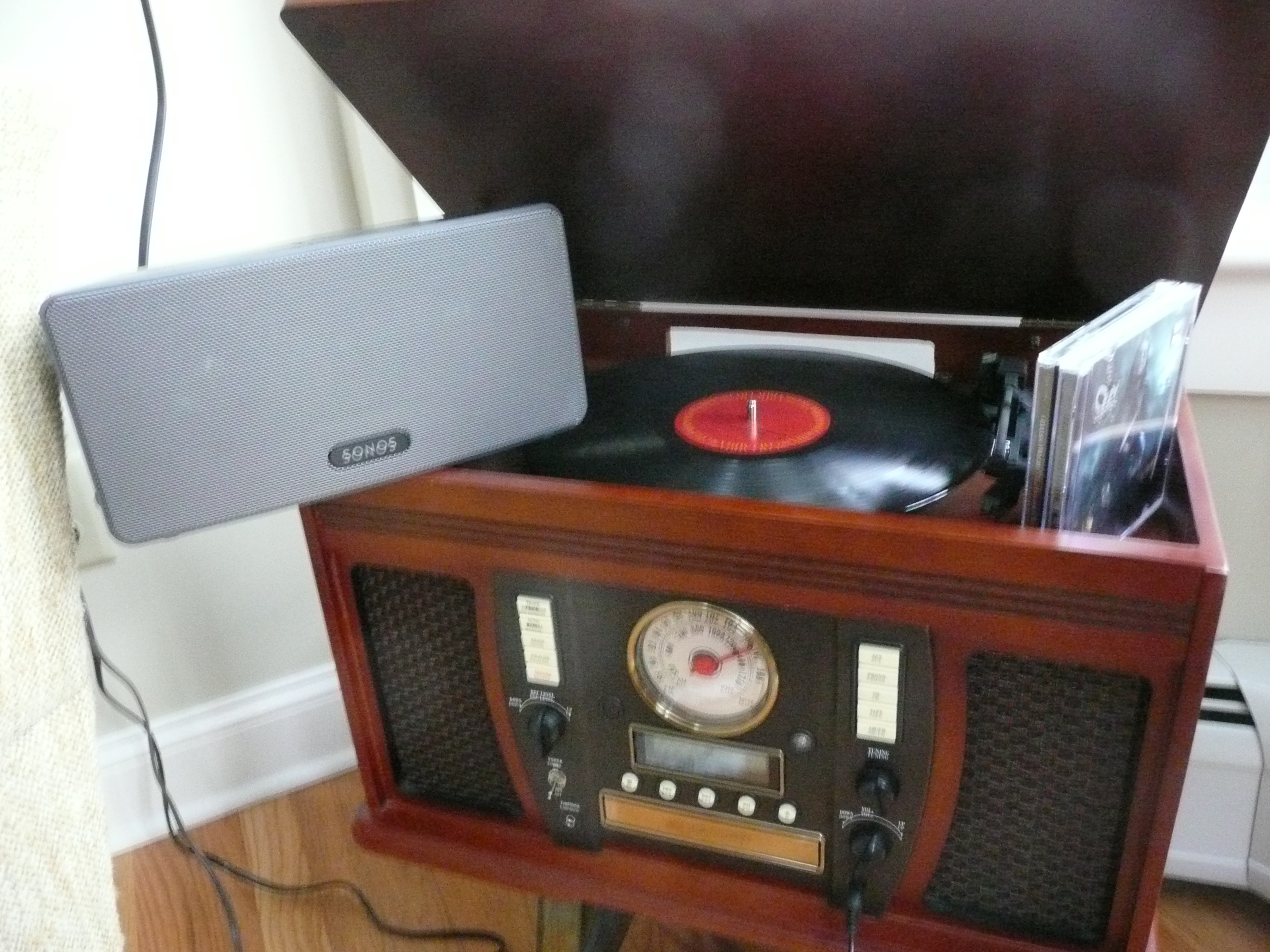
Several generations of music delivery; photo the author.
It’s a far cry from listening to Cousin Brucie on WABC-radio.
Turn, Turn Turn
Posted by John Dickson in Personal memory, Public Affairs, Public History on January 30, 2014
I feel like I’ve known Pete Seeger since I was 18, even though I never met him. So, when the news came that he passed away this week, memories of his music and social causes that inspired many returned easily.
A little about my connection with someone who was my idol. It was his integrity that drew so many to him, even though it’s the same integrity that would likely make him wince at the word “idol”
When I graduated from high school, I received a guitar as a graduation present from my parents. Odd, since I had shown no interest in playing the instrument. A few months later at Christmas, my brother gave me “The Incompleat Folksinger,” a book doubling as a songbook and autobiography. In it, Pete laid out his views on social and economic justice, his flirtation with popular music as a member of the Weavers in the early 1950s, and then his targeting as a Communist in the 1950s. All that, he interspersed with lyrics and tablature of many songs. His story, from his work with labor unions during the Depression through the McCarthy era and into the anti-war and civil rights movements of the 1960s, became the subject of a history thesis my senior year of college.
My thesis argued that the political left showed continuity, from its heyday of support for the working class in the 1920s and 30s, moving through the anti-Nazi era, then weathering the lean, red-baiting 1950s, only to emerge in the 1960s with new issues of peace abroad and racial justice at home. Through it all was music, the folk music of Pete Seeger and others that helped frame the issues, spread the word and unite the activists and supporters. Pete played with Woody Guthrie whose ballads touched a nerve for the mass of unemployed during the Depression; he played with Bob Dylan and Joan Baez, whose folk music in the 1960s addressed the Vietnam War and the Civil Rights movement.
Moving into the 1970s and 1980s (and beyond my graduation and focus of thesis,) the fervor of those movements was passing, even though goals connected to those movements had not been attained. Pete Seeger remained, while many in my generation moved on, to work and family, leaving behind those ideals for which we had once so passionately believed in. Pete (as if he were my best friend) stayed true, true to his music and to his ideals, finding the right balance to match his humble lifestyle. He was the thread to the next progressive movement, using his name and his music to advance environmental issues, specifically the cleaning up of the Hudson River.
I was not surprised to see Pete Seeger performing at President Obama’s inaugural in 2009. He was on the stage set up in front of the Lincoln Memorial, along with Bruce Springsteen. Springsteen had put out an album a few years earlier entitled The Seeger Sessions, where he adapted Seeger’s Americana songbook to his own band and style. Seeger again became the continuity, for the music and the politics, sharing his concern for the common man and woman, the working class squeezed out by an economy that catered to the wealthy few. Thus, it was not surprising to see Pete join the Occupy Movement. He was 90 then.
Much has been written of Pete Seeger’s affiliation with the Communist Party and with the resulting blacklist for ten years which kept him off the airwaves for ten years. Not his music, though, with its clear lyrics advancing causes which now seem mainstream. The blacklist became his badge of honor, one he didn’t thrust forward as a victim but one that kept him steadfast in his own view of the world. His life made it on to the front page of the New York Times, while those who tried to silence him have long been forgotten. His season had come, again and again.
The first and only time I saw Pete Seeger in concert was in 1975 when he performed with Brownie McGhee and Sonny Terry at Carnegie Hall. What was most memorable was Pete brought out a log and an axe for one song, and sang by himself, keeping beat with the swings of his axe hitting the wood. We will likely never see that again.
My last post was another obituary of sorts. Mandela and Seeger were the same age. And exhibited the same persevering commitment and passion for social justice.
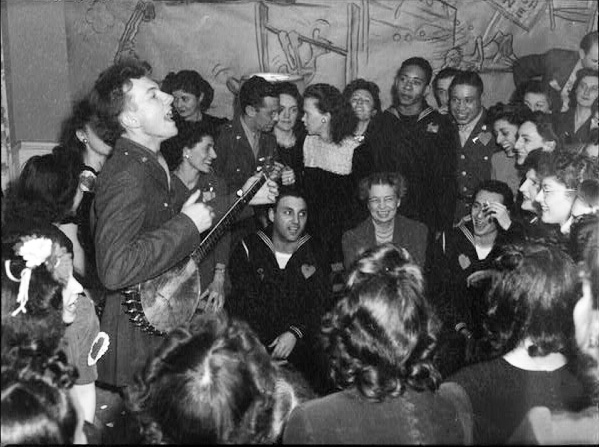
Pete singing with Eleanor Roosevelt listening (and singing along?) Photo: Photograph by Joseph A. Horne. Via Library of Congress site
Mandela and Kennedy
Posted by John Dickson in International, Personal memory on December 28, 2013
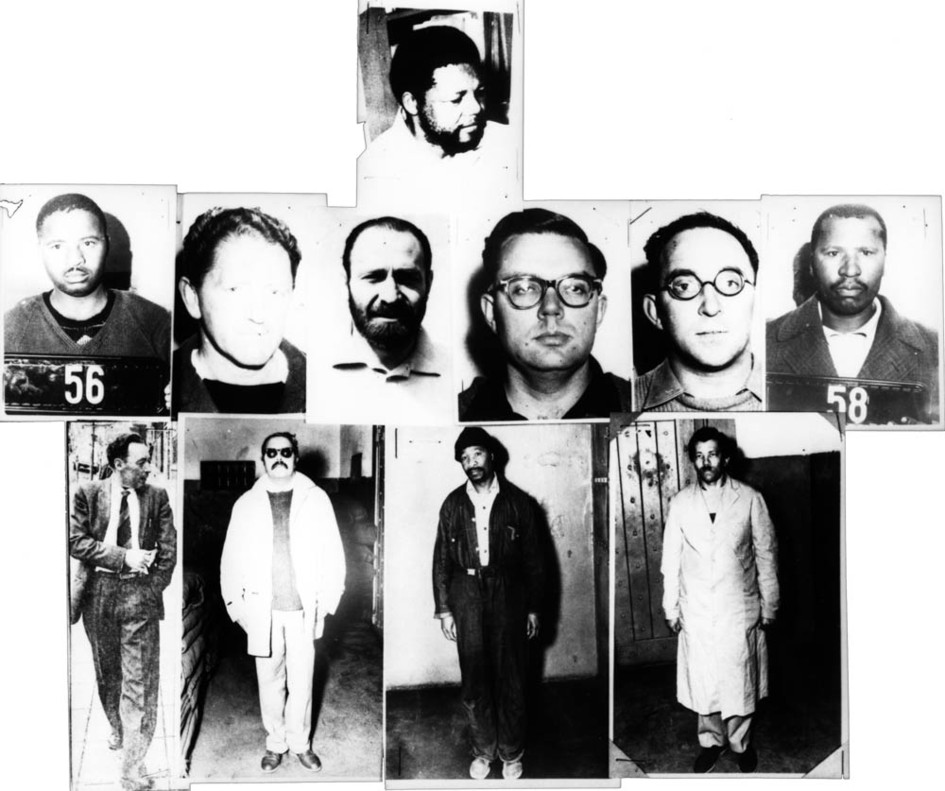
Mandela and fellow accused in 1962 at Rivonia trials. Photo, Wikimedia Commons
For several weeks, I have read and watched as much as I could on Nelson Mandela, his life and his legacy. This followed on the heels of several weeks of reading and watching as much as I could about the 50th anniversary of John F. Kennedy’s death. I surprised myself, since spending that much time on any one subject is increasingly hard, given the competing distractions for my own short attention span. With all the ink and celluloid given over to both men, it seems there is little else to add, except I did not see any commentary which connected the two men, and our fascination with both.
On almost all levels, it’s easy to understand the lack of side-by-side comparison of these two men. Mandela was an exceptional and exceptionally unique leader in this day and age. His own words of avoiding the mantel of prophet in lieu of being a servant, a humble servant, belied the global agreement that he stood above every other leader in our lifetimes. (The few detractors found themselves deservedly isolated and unworthy of any serious discussion, here or anywhere.) Mandela’s ability to find common ground, in a society deeply divided by class, race and culture and steer it towards a peaceful and democratic outcome was a legacy which nearly all praised.
Kennedy, on the other hand, never was able to match such an accomplishment. He never won the Nobel Peace Prize. Few would say that had he lived, he would have achieved the kind of legacy that Mandela built.
Still, I see three ways to connect the two men. First, both touched a global audience, in different ways. Kennedy stood less for accomplishment than for promise, albeit unfulfilled, and probably unlikely to be fulfilled. Mandela emerged from a personal sacrifice of 27 years in prison, full of promise, and was able to realize it, through the strength of his character, his integrity and his vision. Their funerals brought together more global leaders perhaps than any other in the intervening years.
The two men were born a year apart, and they departed the political scene a year apart, Mandela to prison in 1964, a year after Kennedy’s death. The absence of both men from the following decades of active political life left a void in each country. Yet, Mandela was able to emerge to steer his country away from the injustices of institutionalized racism. What has been missing in all of the commentary on Mandela is how his own survival was never guaranteed, especially in a society where so many anti-apartheid activists had been assassinated, exiled or marginalized. We will never know how Steve Biko or Chris Hani may have contributed to the transition from apartheid. Similarly, Kennedy’s absence has been the root of much speculation and debate over the course of U.S. behavior at home and abroad.
I am convinced that the course of both countries’ histories would have been starkly different if Kennedy had lived and Mandela had not survived. South Africa’s ability to steer a course different from Yugoslavia or Zimbabwe lay in the deep pool of human talent of the nation, which Mandela as its leader was uniquely able to tap into and inspire. Kennedy, based on his decisions during the Cuban missile crisis which were so different than the recommendations from his Vice-President and successor, Lyndon Johnson, most assuredly would have steered differently in Vietnam. Ironically, Kennedy’s death, much like Mandela’s survival in advancing the cause of civil and human rights in an unjust society.
Finally, the third area of comparison is personal, and I suspect is shared by more people than imagined. The recent coverage brought back intense personal memories. Like many, I remember the school ground I was standing on when I first heard of Kennedy’s death that Friday afternoon in 1963. The television in our household which we could watch only under the strictest of conditions, was kept on for hours through the funeral and the assassination of Jack Ruby, after church on Sunday.
Likewise, many around the world have memories of the anti-apartheid movement, either as protesters in their own countries or as observers of the visits by the recently released Mandela. I happened to be living in South Africa, working at the U.S. Consulate in Durban, with a front-row seat on the crumbling of apartheid. Like millions across the globe, I remember watching Mandela’s release that warm, sunny February Sunday. Memories of the thrill and the hope of his release were replaced by others of four years of effort, tragedy and turmoil to turn that hope into reality. Through all that was Mandela, his perseverance, his righteousness and his generosity.
The intensity of these memories of Mandela and Kennedy reached similar heights, keeping me in front of the television, tuned to the same radio station and reading to the end of articles and commentary. Both men triggered the memories of my youth, of my adulthood, of hope and inspiration, of a cause larger than oneself.
The day the last mill closed
Posted by John Dickson in Berkshires, History in our surroundings, Personal memory on August 14, 2013
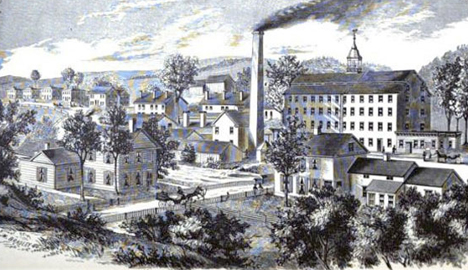
An engraving of the mill complex from an 1876 history of the city
The announcement did not make it on to the front page of the newspaper, but it should have. The final woolen mill in Pittsfield was closing. It was the longest continuous running woolen mill operation in a city which had once boasted 11 textile mills, leading a county which produced more wool than any other in the country.
It was October 26, 1963, when it was known as Wyandotte Mill. Over 100 workers walked and drove across the small bridges over the uppermost reaches of the Housatonic River that had once powered its predecessor, Pontoosuc Woolen Mill. It was not quite 140 years since that mill had been built, on the site of Keeler’s saw mill.
The story of Pontoosuc Woolen Mill tells the story of the county. It was the brainchild of Henry Shaw, the representative for the county in the U.S. Congress who hailed from Lanesborough. In politics that sounds more like our current Congress, Shaw had helped Henry Clay pass the Tariff of 1824, which placed large taxes on imported wool from England, thereby opening up a market for domestic wool. Shaw moved quickly on such an opportunity and brought together a group of investors to finance the purchase of the property and the construction of the original mill building, which is still standing today.
Pontoosuc was not the first mill in the county, but the site it was built on housed a workshop of Arthur Scholfield, a recent immigrant from England who snuck out of his home country with models of and experience in the new machinery of spinning wool. The English were desperate to prevent the loss of this know-how and hold on to their manufacturing advantage, but had already lost cotton processing technology through another emigrant, Samuel Slater, who helped build the first mills in the country in Rhode Island and Massachusetts.
Scholfield, who left England in 1793, moved north along the Housatonic, through Connecticut, and ended up in Pittsfield in 1800. Here, he built the first machine to card wool, a process of cleaning and preparing the cut wool. Since his machinery could complete the process several times faster than hand carding, he initially had a small operation to sell the cleaned wool to private individuals, spinning and weaving out of their homes. Scholfield then left woolen manufacturing and set up a small operation to build the machines to process wool, selling his equipment around the region. His special tooth-cutting machine was installed in the attic of Keeler’s saw mill at the southern tip of Pontoosuc Lake.
Scholfield’s inventions and the new protective tariff combined with the introduction of a new brand of sheep from Spain – merino – and the beginnings of an immigrant work force to bring all the variables together for the flourishing of industry which saw Pittsfield start the transition from an agricultural society to a center of manufacturing. Pontoosuc Woolen Mill initially employed 100 workers, a little less than half of whom were women and children. By mid-century, the mill had built a store, homes, townhouses and boarding houses for a growing workforce which would reach 500 employees by the 20th century.
The list of owners and managers over the course of the 19th century reads like a Who’s Who of Pittsfield. Besides Shaw, whose son took the pen name of Josh Billings and avoided the wool business for humor, names like Clapp and Kellogg, Campbell, Frances and Plunkett still grace the city’s streets, parks and schools. These individuals helped move the city forward on a path of progress which included setting up the first fire company (owing to the risk of fire in the mills,) and the first trolley (which ran from the city center to, you guessed it, Pontoosuc Lake.) Pittsfield’s first telephone call was place at Pontoosuc Woolen Mill, to a bank on North Street.
The mill filled the huge demand for kilt-like balmoral skirts and carriage blankets. When cotton became scarce during the Civil War, the demand for woolen textiles increased, creating enough demand for yet another woolen mill which opened in Pittsfield in 1863. Following the war, cotton production returned and the first mills in the city began to close. Pontoosuc Woolen Mill was able to keep open into the 20th century with lucrative government contracts, including the manufacture of military blankets during the first world war. A Maine firm bought the mill in 1928, just after its centennial, changing the name to Wyandotte Mill.
The Depression hit the wool industry hard with the closing of 4 rival mills in the 1930s. Gradually, new competition from England, caused production to start shifting south to reduce costs of labor. By the time of the second war, 100% cotton and wool textiles were replaced by synthetic fibers, further reducing demand. By the 1950s, just three mills in Pittsfield were still open. Wyandotte managed to stay afloat through production of woolen cloth which was distributed around the world as raw material for other factories to produce the finished products of clothing and blankets.
Organized labor had come to Wyandotte shortly after its purchase of the mill. By the 1930s Wyandotte Pittsfield workers joined a month-long textile strike in 1934 in 20 states. It was at the end of the Depression in 1939 that the Textile Workers Union of America organized Wyandotte. Additional labor actions took place following the Depression and the war when Wyandotte workers at all three of their mills struck in 1951 over the failure to make a pay raise retroactive. A few years later, when Wyandotte re-negotiated their contract, it included a far-reaching provision for equal pay for equal work by women. A general strike took place at Wyandotte in 1954, but the weakness of unions in mid-century America can be seen in the rehiring of only 50 of the 475 workers previously employed. In 1962, workers through the TWUA had signed a new contract with a wage increase. That same year, a new management team came to Pittsfield. Both the new contract and new leadership may have been part of a last ditch attempt to keep the mill open, but they failed; by October the mill had produced its last wool.
Today, the complex is home to a number of small businesses; neighboring buildings that once were stores, homes and boarding houses survive but are townhouses, a restaurant, single family homes and a homeless shelter. The canal through which ran a current of water strong enough to power the looms and machines has been diverted and covered over. Elevated walkways have been torn down, windows boarded to prevent vandals from breaking glass. What remains, though, is a brick monument, tall, solid and imposing and certain to outlive the prefabricated materials of modern box stores and warehouses and factories. It’s right there, hidden in plain sight and joined by 11 other mills across the city.
-
You are currently browsing the archives for the Personal memory category.

A memoir in letters. Excerpts from letters that a father wrote his children each week for almost 30 years, full of the mundane and poignant, the witty and wise. Stories from a different time, from a small town in Connecticut.
History Shock
 Pleased to announce the publication of my book in May 2021 by the University Press of Kansas. This collection of “stories with a history” narrates incidents over the course of my career in the Foreign Service when historical understanding – or lack of it – got in the way in the conduct of day-to-day diplomacy.
Berkshire County’s Industrial Heritage

Check out this book on the nineteenth century mills and those who owned and worked in them. Available through Arcadia Press or Amazon.
Slide Show – Getting to Yes, Woman Suffrage in the Berkshires and Beyond
-
Slide Show – Intersections, Pittsfield’s Neighborhoods
-
Slide Show – Turning Points


Slide Show – Preserving the old Berkshire Athenaeum
 Thomas Allen donated $50,000 to build the Athenaeum in 1876.
 A yong architect from New York, William Appleton Potter, had his design selected for the new Athenaeum.
 The original architectural drawing of the front elevation of the Athenaeum
 An early photo of the High Victorian Gothic building, pointed arches, twin gables, multi-color stone patterns,skylight, stained glass windows
 Majestic, quartered oak tresses in the addition built in 1896
 Proposed new library design, in 1944
 Bulging of stonework on from of building required drastic measures to shore up front, in 1979
 A restored skylight is returned to the roof in repairs undertaken in 2001
 Stained glass window on west gable, showing steel tie placed in 1979 stabilization repairs
 Masonry work begins on the Athenaeum in the deep of winter
 Removing the stained glass panels for repair
 Cracks in the masonry
 More cracks in the masonry
 Lifting the capstone off the east gable, the first stone removedd








 History All Around