This Place Really Matters – The Movie
Posted by John Dickson in Berkshires, History in our surroundings, Personal memory, Preservation, Public History on October 27, 2015
 You’ve read the thesis on preserving the old Berkshire Athenaeum in Pittsfield, Massachusetts, and the articles below. Perhaps you even saw the review in the Berkshire Eagle. Now the full-length movie.
OK, maybe you haven’t read them. But the film project took up a big chunk of the past few months when otherwise I would have been writing blog posts, about Iran or the Pope, gun control or incarcerations, trails or demolitions in the Berkshires.
The movie is complete so the plan is to pick up on these short pieces.
How did this involvement in a full-length movie (84 minutes) come about? Not that I knew anything about filming, certainly nothing more than home movies of children.
The e-mail requesting someone to document the preservation project of the 1876 Victorian Gothic public library building in central Pittsfield was copied to me. Had I known the full extent of what was involved I might have shied away, but a casual “yes, I’d be interested” turned into a Master’s Degree thesis and a movie.
The architects leading the project were interested in a film documenting the project, but I was interested in getting graduate credit. The breakthrough came from Pittsfield Community Television (PCTV) that offered equipment loans and training and a lot of storage space on their server.
The architects (Bill Gillen and John Krifka from Ford-Gillen in Amherst MA) and the contractor (Mike Mucci from Allegrone of Pittsfield MA) encouraged me to attend and even film their meetings, allowed me access to the worksite and repeatedly gave of their time and documents to understand as much as a layperson could the complexity of the work involved.
The movie, This Place Really Matters, has been broadcast on Access Pittsfield PCTV the past few weeks and is available through their on demand feature. And now you can watch it on YouTube right here: https://youtu.be/y6er6nz605k
If you can only watch a little, proceed to about minute 50 for dramatic footage showing the reason why the state went to such time and expense to fix the structural problems of the building.
When we think of preserving historic buildings, the first ones that come to mind are usually the buildings that we failed to save, that were demolished and lost to only the archives. Here, though, is a success story that deserves to be celebrated and remembered.
This Place Matters – the old Berkshire Athenaeum
Posted by John Dickson in Berkshires, History in our surroundings, Preservation on May 26, 2015

Right before construction started. Photo the author
Since September 2013, the yard in front of the Superior Court and the old Berkshire Athenaeum on Park Square in Pittsfield had a chain link fence, construction trailers, portable toilets and gravel. Much of that time, a green curtained scaffold blocked the public view of the majestic stone work and prominent stained glass windows behind it. And yet, in practically no time at all, the scaffolding and fencing have been taken down, and fresh green sod lies in their place. What we see now seems much the same as it looked before work started. According to the contractor, Mike Mucci from Allegrone, that’s as it should be. “People stop by,“ he told me, “and look up at the building and ask us, ‘What did you do? I don’t see any difference.’ We take that as a compliment.”
In fact, much has changed, and that should also be a compliment. A closer look will reveal the steel braces gone from the front façade, but still in place on the sides and the rear of the building. Some onlookers might detect gray mortar between the stone work on the front, as opposed to the red on the other three sides. Few passers-by would be able to remember the broken stained glass sections or the cracks in the wall. And only a trained eye with perfect memory from the summer of 2013 would be able to notice the front façade is straight. Gone is a bulge that protruded away from the building as much as five to six inches in places, that had been building for years and created an emergency safety concern for the staff inside the building and the many people coming into the building to go to the courts or the registry of deeds. So, almost five years ago, the state, which operates the courthouses and registry of deeds in the building now, took the first steps of what started as a “small repair,” according to architect John Krifka.
Because of the conditions of the building, though, what took place behind the green curtain over the last two years has turned into a monumental effort to secure the front façade and preserve a building almost 140 years old. This Victorian Gothic structure, unique in the downtown core, housed for 100 years one of the busiest libraries in the state. Bearing witness to the rapid economic growth of the city, it still stands, despite the flight of industry, and contributes to the city’s plans to attract new business and arts and tourism. But, it also carries for many residents the fond association of books and knowledge and community, lending a sense of dignity, pride and identity.
The project involved taking down almost every stone on the façade, and relaying each one, secured to the building to ensure they do not move again. That’s relatively easy and straightforward to say. But think about that for just ten seconds, and what that might entail.
Pause.
Each of the thousands of stones went back in exactly the same place.
One could liken it to a giant jigsaw puzzle except that the pieces weighed from 50 pounds to ten times that weight, and they had to run in straight lines, and they may have been chipped or cracked over the years, and they had to be affixed to a new concrete and steel structure behind that stones, and they needed new mechanical strategies to prevent water from working in behind the stones to cause the damage, and the stained glass windows and the surrounding forms also needed repair and the entire package needed to maintain the historic integrity and appearance of a building that is listed as a contributing feature to the original Park Square historic district. And, the building remained open to the public. And the work was completed in two of the harshest winters in recent memory.
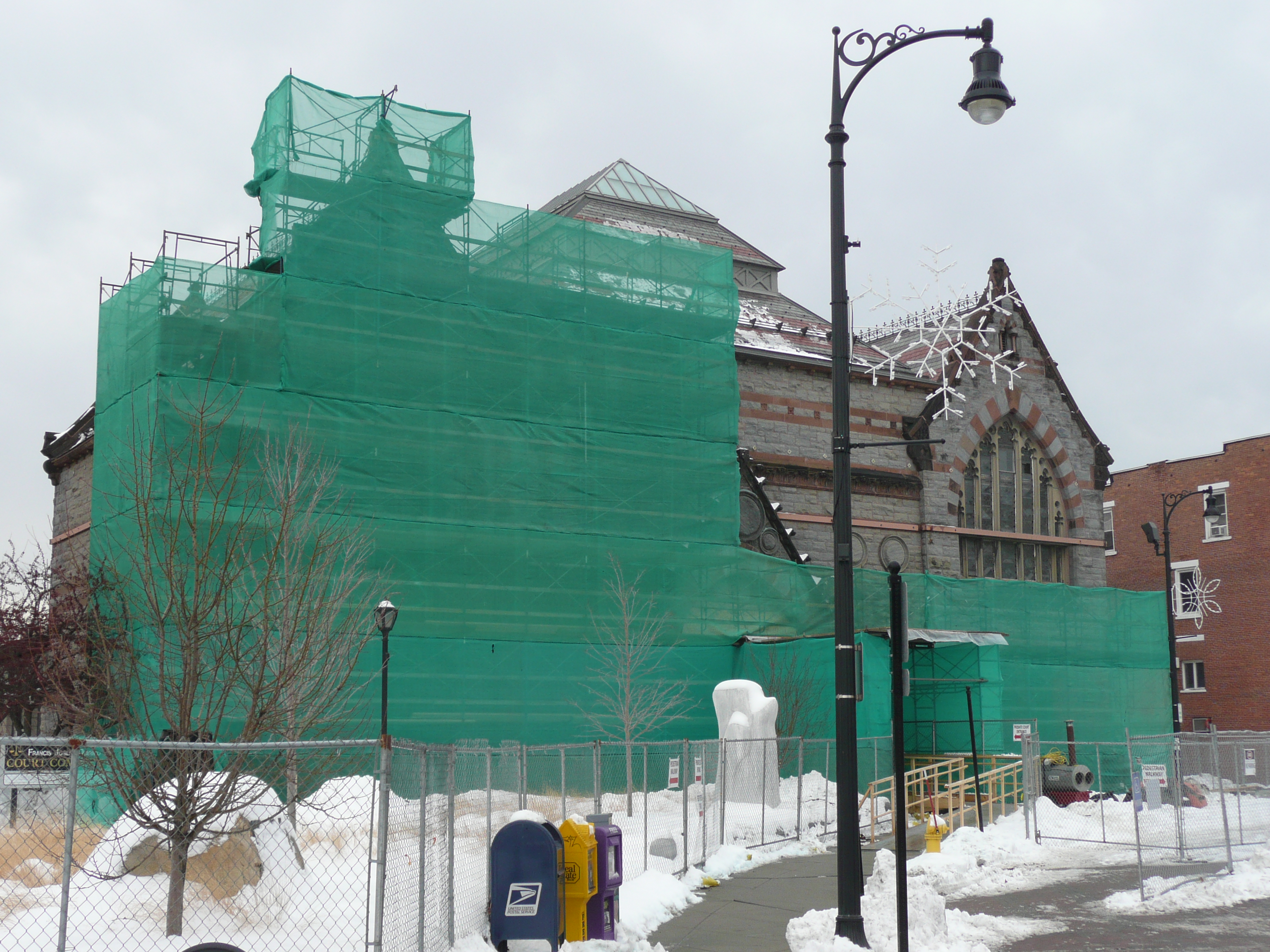
Working in the depths of winter. Photo, the author
An even greater appreciation for this effort emerges upon examining the historical record of the building, where this problem of shifting and bulging has plagued it for well over 100 years. A letter in 1897 from William Plunkett, the President of the Berkshire Athenaeum Board of Trustees, indicates the need to repair the leaks in the roof, just 20 years after the building opened. “No one can tell,” he wrote, when it may give out and cause serious trouble.” Water getting behind the stones, then expanding in the frozen winters and contracting and allowing more water to enter, pushed the stones away from the walls. Steel girders and reinforced foundations were put in place in 1945 to hold up the roof and stabilize the building. Then steel bands were installed around the building to hold the stones in place in the late 1970s when the building was re-purposed for the courthouse and registry of deeds.
Those steel bands are no longer needed. When the stones were re-layed, a new concrete wall, with steel reinforcement, was poured behind the stones each time a layer of 2-3 feet stones was put in place. Repairing stones and reshaping them to fit and align required a slow, precise care more akin to surgery, if the doctors were manipulating 50-300 pound organs or bones. Finally, flashing at both the roof line and at the base will prevent water from entering behind the stones. Hard to see, but along the base are small round “weeps” that serve as drains for any water that might be able to enter through the mortar during the storms that the northern façade bears the brunt of through the year.
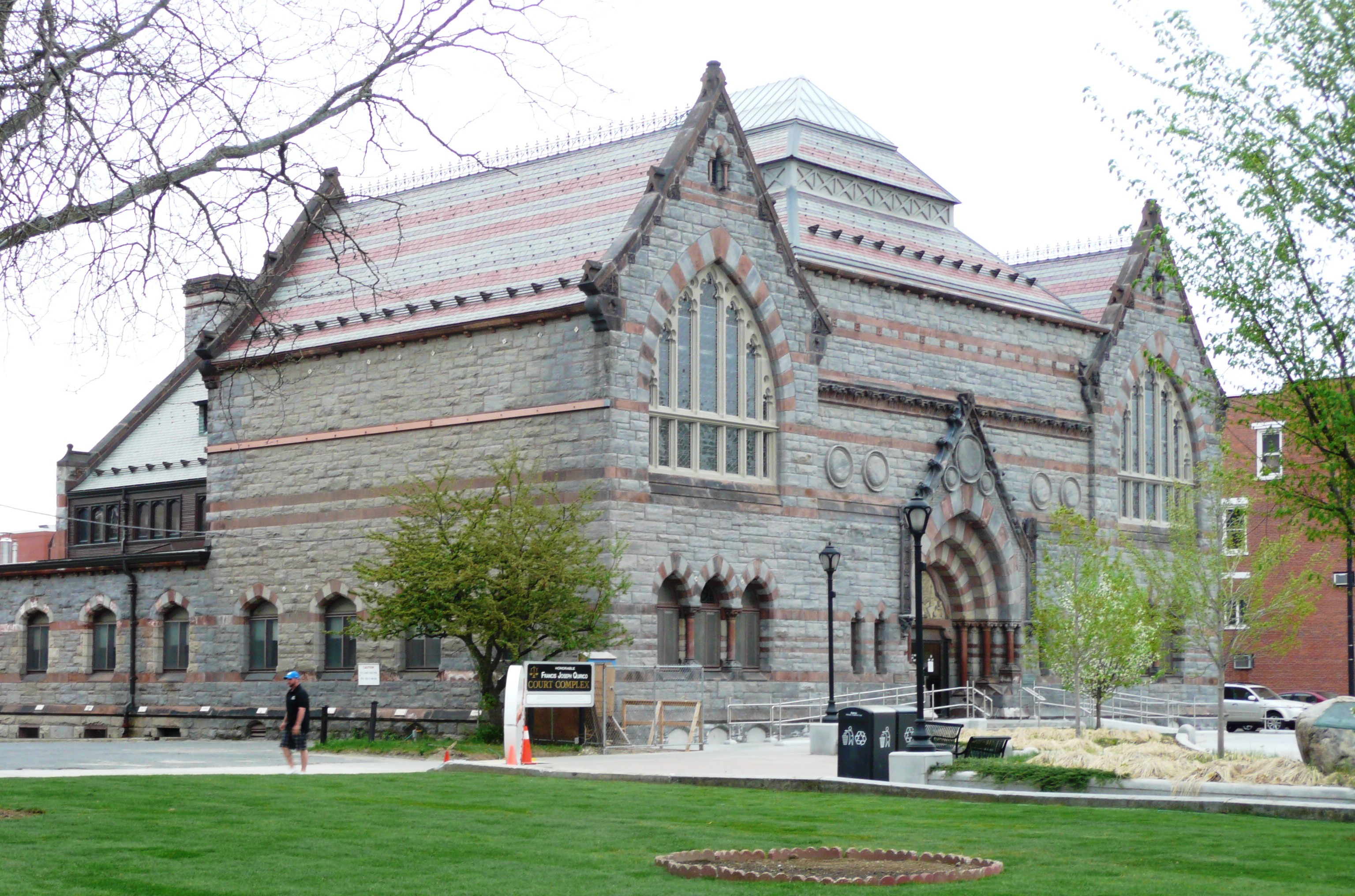
Ready for another 100 years. The old Athenaeum in May 2015. Photo, the author
Similar precision and care went into repairing the stained glass windows, the first comprehensive repair since the original construction. All the shifting over 139 years resulted in cracked and broken glass in the 46 panels on the two large windows on the front façade, with only small, colored pieces of plastic mounted as temporary replacements to keep out the weather and maintain a poor facsimile of the graceful windows. New concrete molds (or tracery) were produced to hold the repaired windows in place, and each section of this tracery was fastened securely to the surrounding stone work with metal anchors. The project’s architect. Bill Gillen, said that, despite the new sod and the removal of the scaffolding, the project will continue with small follow-up activities over the course of the year, ending, “with a whimper.” That would be too bad, as those many people who worked on this project over the past two years of active construction have saved a unique treasure for the city, its residents and its many visitors. The old Athenaeum, renamed the Bowes Building, for the County Commissioner who helped to save it after the library moved out, has been saved again. Most of us who will pass by it for years to come, will continue to pay the compliment to those many people involved in this effort: we won’t notice any difference. The wall is straight and will remain so.
See also: Behind the Green Curtain. This post originally appeared in the Berkshire Eagle.
E-mails, history and diplomats
Posted by John Dickson in History ahead, International, Personal memory on March 17, 2015
Imagine the conversation that Hillary Clinton had with her Information Technology people when she started her job as Secretary of State. First of all, she probably didn’t have one, but her staff did, on behalf of her wishes. “The Secretary does not want to have an official account on the State Department system,” they would have said. “She will use her own private e-mail and server for her electronic communications.”
Loyally, like most in the Department, the professional IT folks nodded and went to work to MAKE IT HAPPEN. Their concerns, if they voiced any at all, would have fallen in the security arena. What they likely did not say was anything about the need to keep a historical record.
The reality is that for most of the communications coming from the Secretary’s office, she relied on her staff who probably all had official accounts, as well as their own private mail. As Gail Collins points out in her op-ed in the New York Times, the former Secretary’s reference to 60,000 e-mails during her tenure turns out to be roughly 40 a day. It’s not inconceivable that her many staff churned out more than that on her behalf in ten minutes. All of those messages are, we can assume, on the official system.
The problem with the exclusive use of private e-mail that many of her would-be detractors are focusing on is, incredibly, Benghazi, and then security. However, by deciding what the public should and should not see, the former Secretary simply leaves to the imagination what will not see the light of day. Ms. Clinton says it is personal material, and undoubtedly there are plenty of those. Likely there are also messages related to her past and perhaps future status as a politician, interacting with the large retinue of friends and donors, responding to their requests for favors, small and large. Not unusual for any politician holding any government office.
Surely Ms. Clinton or someone on her staff must have realized the historic value of her documents, if only for her memoir that she was sure to (and did) write. Why save documents only for her book? She makes the claim that her business e-mails to those in the Department could be accessed through the recipients, but she did not send e-mails to just other State Department officials. Further, if her staff were using official accounts in sending e-mails to carry out her instructions, it is unclear who would know which of these messages were valued for the historic record.
It’s not just the absence of the former Secretary’s communications that presents a challenge to future historians. While no one is suggesting this as a reason for her foregoing the State Department server, the chilling effect of leaks (such as Wiki-leaks or Snowden cases) on official communications is taking a toll on the written record. Rather than write cables, the use of e-mail is more pervasive and when the issue is very sensitive, phone calls are taking over as the medium of choice.
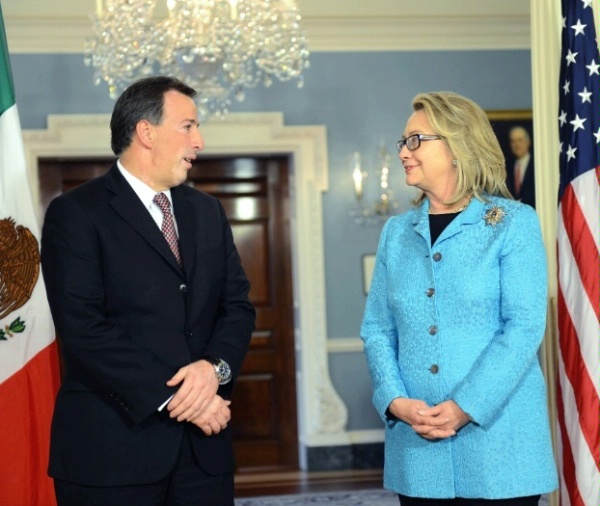
With Mexican Foreign Secretary Jose Antonio Meade in 2013. Photo, department of State
What Secretary Clinton’s private e-mail use also encapsulates is the broader issue of how the Department of State does not take full advantage of its own history in the conduct of the country’s foreign relations. To their credit, it was staff in the Office of the Historian that first brought this issue to light, in seeking to gain access for its archives to these documents. That Office and their on-line presence, through its series on Foreign Relations of the United States, has made available 450 volumes of primary source documents that have been declassified and, most recently, has begun to include material from other foreign affairs agencies. These represent an invaluable resource for scholars of U.S. foreign policy. However, it is mainly academics who mine these documents for their research. Based on my experience in the Department few of us working the multitude of issues confronting the nation in our overseas relations, drew on that resource. We did not have the time, the inclination, the skills to mine those documents as another source of “intelligence” to analyze the countries or the topics we were handling. The fact that the Historian’s Office is located in the Bureau of Public Affairs is a tip-off that its focus is external, not to inform current foreign policy issues. Perhaps the Bureau of Intelligence and Research where reports could be made for policy makers?
Our military devotes incredible effort and resources to learning its own history, and values history in its academies and its in-service training. They read the communications of soldiers in the preparations for battle as well as on the battlefield to understand the decisions taken. Our diplomats deserve the same attention to their history, to equip them to understand the complex, messy terrain of our relations around the world.
Obama and Netanyahu Differ on History, Not Just Iran
Posted by John Dickson in History ahead, International, Public Affairs on March 5, 2015
The differences between Israeli Prime Minister Benjamin Netanyahu and President Barack Obama extend beyond their views of the current negotiations to limit Iran’s capacity to develop nuclear weapons. The two leaders draw on fundamentally different lessons from history as they shape their country’s respective positions in regards to a nuclear Iran. In fact, their whole approach to using history in making their case on whether or not to engage Iran diplomatically differs.
Speaking before the Joint Meeting of Congress, the Prime Minister engaged in historical selection in looking backward to predict what might lay ahead. After the obligatory political thank you’s, Netanyahu started his speech by citing the Old Testament story of Esther, a “courageous Jewish woman” who warned the Jewish people of a plot to destroy them conceived by a Persian viceroy. He drew the direct line from the religious holiday of Purim commemorating the story of Esther to what he sees is yet another plot by a Persian ruler to destroy Israel and he cites the sitting Ayatollah’s tweets as evidence. Another Old Testament figure that Netanyahu chose to ignore is the Persian King Cyrus who ended the Babylonian captivity, called for the rebuilding of a “house of God” in Jerusalem and restored the religious vessels that his predecessor Nebuchadnezzar had taken when he destroyed the temple and the city.
Netanyahu also cites more recent history in highlighting the case of North Korea, when it reneged on its commitments to an international agreement hammered out through diplomatic negotiations to forestall the acquisition of a nuclear bomb. North Korea, like Iran, was a signatory to the Nuclear Non-Proliferation Agreement. To date, North Korea is the only country to have withdrawn from the agreement, and all obligations under it to limit nuclear technology to peaceful purposes and prevent the development and spread of nuclear weapons. Here again, another historical selection overlooked by Netanyahu is South Africa, which abandoned its nuclear weapon program and signed the non-proliferation treaty in 1993.
The point is not that the appropriate historical parallels ought to be Cyrus and South Africa, but that historical precedents abound and can land on any side of a political debate.
President Obama, on the other hand, uses his understanding of history not to find past precedents but to look for present, transformative opportunities that could reshape history, as understood only by looking backward years from now.
Obama certainly knows of such historic moments. It’s not hard to anticipate the histories 50 or 100 years from now, citing his election and re-election as the first African-American President. They may also include his willingness to open a new chapter in U.S. relations with Cuba or to tackle the issue of affordable health care in this country, just to mention two. In announcing the opening of diplomatic talks with Iran in September 2013, Obama looked ahead and envisioned the possibilities of not only “a major step forward in a new relationship between the United States and the Islamic Republic of Iran,” but also one that would “help us to address other concerns that could bring greater peace and stability to the Middle East.”
Obama also recognizes that individuals who seek such opportunities run enormous risks, not just for their own political careers but for their nations that they lead. It’s why he is leaving the door open for tougher sanctions and even the use of military options should Iran decide to use these negotiations as a cover to work towards producing nuclear weapons. He does not want those histories in the future to write of him as another architect of appeasement. The roads he has chosen to walk are littered with obstacles and critics. However, he also acknowledges that the alternatives on Iran, however politically expedient they may be in dealing with crises, do not offer to resolve them, simply delay them, perhaps for another President or Prime Minister. His model, after all, is Lincoln, not Buchanan.
Both leaders take a long view of history, but while Netanyahu’s view goes backward, Obama’s looks forward. When Netanyahu looks forward, he sees only weeks, to the next election in Israel on March 17, or to inject himself into the current political stalemate in Washington. David Remnick’s profile of Obama in the pages of the New Yorker in January 2014 quoted aides repeatedly discussing Obama’s sense of understanding his actions under the long telescope of history. Obama told Remnick that “at the end of the day we’re part of a long-running story. We just try to get our paragraph right.”
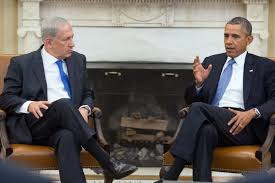
The two leaders in the Oval Office, September 2013. Photo, White House
There is a great distance to go before reaching any accord with Iran over its nuclear program and its commitments under the Non-Proliferation Treaty and an even greater distance to restoring diplomatic relations with Iran. But history is the story of change, and that change does not happen without taking the first steps, as risky as they might seem. Netanyahu uses history to avoid the first step; Obama looks way down the road to see where that first step might lead.
This post originally appeared on History News Network.
Opening to Cuba, Opening to Latin America
Posted by John Dickson in International, Public Affairs on December 23, 2014
President Obama’s announcement of steps to open up diplomatic relations with Cuba this week was, as nearly every media outlet has called it, historic. A State Department official remarked to me that it felt a little like the fall of the Berlin wall all over again. Quite right.
The problem is that the history commonly cited goes back no further than 54 years. That may seem like a logical point since diplomatic relations were broken in January 1961, in the weeks before John Kennedy was sworn in as President. Three months prior, the U.S. had imposed a trade embargo. Such isolation has been the cornerstone of U.S. policy to Cuba ever since. Obama’s announcement starts a process to restore diplomatic relations, but it will require Congress to repeal legislation to end the embargo. With a Republican Congress, that is unlikely.
The importance of this week’s announcement, though, extends beyond U.S.-Cuba relations, and can be seen best from a historic vantage point further than 54 years. It is a history that is better known on the island, and throughout the hemisphere.
That extended history places Cuba front and center in a broader context of U.S. predominance in the hemisphere, with a recurring number of military interventions to protect business interests and to install friendly governments. It dates back to the early 1800s with calls in Congress to annex Cuba and an overture from President Franklin Pierce to purchase Cuba from Spain in 1853.
Going back further than 54 years would naturally include competing versions of the U.S. declaration of war against Spain in 1898 to liberate Cuba. Most Americans know only the sinking of the USS Maine and Teddy Roosevelt’s Roughriders, without reference to relegating Cuban independence fighters to the periphery of the treaty ending the war or to the imposition of the Platt Amendment in 1903 that restricted Cuban independence. Drafted at the State Department, this law included seven provisions that were to be incorporated in the new Cuban constitution. These included clauses that prohibited foreign powers from using the island for military purposes, reserved the right of the U.S. to intervene to protect life, liberty and property, and established an indefinite lease of coaling stations and a naval base at Guantanamo Bay. The provisions of the Platt Amendment stood until 1934 when President Franklin Roosevelt signed a Treaty of Relations with Cuba as part of his new approach to the region. That treaty, though, left in place the arrangement to continue the lease of Guantanamo Bay as a U.S. naval base.
It was this history that Castro referred to in a speech on January 2, 1959 in Santiago de Cuba, the day after overthrowing the dictator Fulgencio Batista. Castro told a crowd of 200,000: “This time, luckily for Cuba, the Revolution will truly come to power. It will not be like 1898, when the North Americans came and made themselves masters of our country.”
In his early speeches following his ascent to power, Castro continued this theme, pronouncing repeatedly, “Cuba is not Guatemala.” He was referring to 1954 when the U.S. actively plotted to overthrow Guatemala’s democratically elected President, Jacobo Arbenz, who tried to institute land reform that threatened the large holdings of the United Fruit Company. Castro might have easily said, though, that Cuba would not be Mexico or Haiti or Nicaragua, or more than a half dozen other nations in the hemisphere that had fallen prey to U.S. adventurism, through military occupation and intervention.
This is the larger history that the rest of the hemisphere remembers in the wake of the announcement last week. For as much as the Cuba under Castro since 1959 trampled on the rights of its citizens, and used the economic embargo by the U.S. as a distraction from the real reasons for suffering on the island, Cuba proved it would not be Guatemala. Cuba would refuse to succumb to the pressures from the U.S. and chart a course of independence from the U.S. that was a point of pride throughout the hemisphere. From Canada to Chile, people saw David standing up to Goliath, repeatedly and enduringly. As long as the U.S. continued to pursue policies of regime change on the island, in this hemisphere and even beyond, leaders and their peoples were willing to overlook human rights in Cuba. They were cheering for Castro, to sustain his path of independence from the United States.
Seen from this broader perspective, President Obama’s announcement opening up of diplomatic relations with Cuba is of far greater historic significance than just its impact on bilateral relations. This step spoke to the entire hemisphere, and beyond. By acknowledging a new relationship with Cuba, Obama was stepping back from a broader history of foreign policy pursuits of regime change. This would allow the U.S. the room to engage Cuba on the broad expanse of the relationship; we will continue the cooperation on migration issues, but also address issues of human rights and economic trade, without being accused of seeking to overthrow its leaders.
In the rest of the hemisphere, where U.S. interests are actually much larger than what we have at stake on the island, the diplomatic move last week removes a long-standing sore point. We will have additional space in each of our bilateral relations across the region to discuss our major interests in reducing threats from transnational criminal organizations and building new trade partnerships. Obama’s steps also give us credibility to emphasize human rights in Cuba and, perhaps, actually gain support for a position that used to be seen as part of an overall plot to bring down the Castro government.
Five years ago, rumors of Fidel Castro’s death brought out celebrations in the streets of Miami, but they were the only people in the hemisphere celebrating. Premature eulogies for the man who had stood up to the U.S. for 50 years were appearing across the region. Some, like Alvaro Colom, the President of Guatemala, moved to atone for past actions, referring to the leader who replaced Jacobo Arbenz and who supported the U.S. in its plans for the Bay of Pigs: “I want to ask Cuba’s forgiveness for having offered our country, our territory, to prepare an invasion of Cuba.“
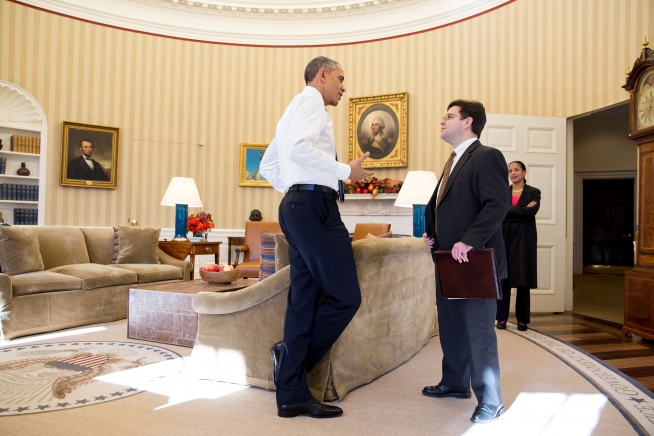
President Obama speaking with Ricardo Zuniga, NSC Director for Western Hemisphere, who negotiated Cuba opening. Photo, White House
Last week, Obama changed the nature of the discussion we have with not only Cuba, but with the entire hemisphere. Making such a move now will allow for the two years left in his term to show the results of this policy of engagement, not only in Cuba, but throughout the region.
This article originally appeared on History News Network.

A memoir in letters. Excerpts from letters that a father wrote his children each week for almost 30 years, full of the mundane and poignant, the witty and wise. Stories from a different time, from a small town in Connecticut.
History Shock
 Pleased to announce the publication of my book in May 2021 by the University Press of Kansas. This collection of “stories with a history” narrates incidents over the course of my career in the Foreign Service when historical understanding – or lack of it – got in the way in the conduct of day-to-day diplomacy.
Berkshire County’s Industrial Heritage

Check out this book on the nineteenth century mills and those who owned and worked in them. Available through Arcadia Press or Amazon.
Slide Show – Getting to Yes, Woman Suffrage in the Berkshires and Beyond
-
Slide Show – Intersections, Pittsfield’s Neighborhoods
-
Slide Show – Turning Points


Slide Show – Preserving the old Berkshire Athenaeum
 Thomas Allen donated $50,000 to build the Athenaeum in 1876.
 A yong architect from New York, William Appleton Potter, had his design selected for the new Athenaeum.
 The original architectural drawing of the front elevation of the Athenaeum
 An early photo of the High Victorian Gothic building, pointed arches, twin gables, multi-color stone patterns,skylight, stained glass windows
 Majestic, quartered oak tresses in the addition built in 1896
 Proposed new library design, in 1944
 Bulging of stonework on from of building required drastic measures to shore up front, in 1979
 A restored skylight is returned to the roof in repairs undertaken in 2001
 Stained glass window on west gable, showing steel tie placed in 1979 stabilization repairs
 Masonry work begins on the Athenaeum in the deep of winter
 Removing the stained glass panels for repair
 Cracks in the masonry
 More cracks in the masonry
 Lifting the capstone off the east gable, the first stone removedd








 History All Around