Saving Haiti’s Heritage
Posted by John Dickson in History in our surroundings, International, Personal memory on January 21, 2012
Last week, Haiti marked the second anniversary of the earthquake which devastated an already impoverished nation, resulting in an estimated 300,000 lives lost.
The rebuilding effort has put enormous strains on a government, itself devastated both in terms of physical buildings and human talent in the disaster. It has struggled to lead and coordinate a global army of government and non-government aid organizations.
At the same time, the character of the Haitian people known for their resilience, patience under suffering and independence has largely carried the country through this period.
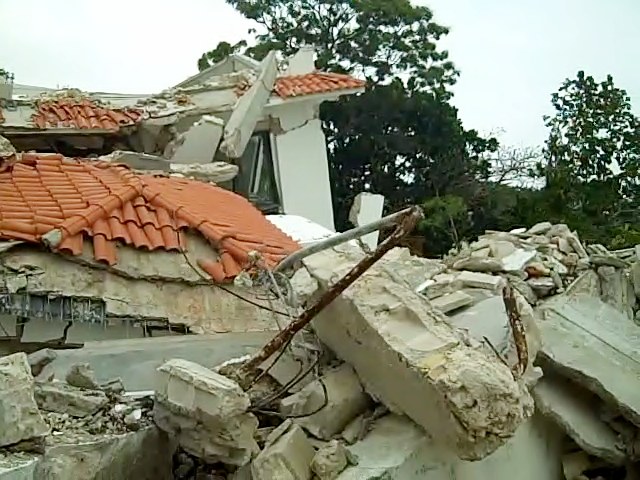
Quisqueya University after the quake. Photo: JDickson
This strength of character is rooted deep in Haiti’s heritage, based on a prolonged, violent struggle against slavery, then for independence and, in this century, against brutal regimes. African religious traditions combine with Christian missionary vestiges to forge a deeply spiritual people. These elements of a unique heritage are depicted in a vast, rich and diverse body of visual and performing arts, of libraries and archives. This art is a significant way of passing along to each generation their story as a nation and hence their identity.
The earthquake also struck these manifestations of Haitian identity. Cathedrals collapsed along with their murals. The national library, archives buildings and universities were destroyed. Art in private collections was lost.
Shortly after the earthquake struck, the image of postwar Iraq with looting and devastation of cultural and historic treasures mobilized an army of cultural experts around the globe. Smithsonian museum officials took the lead in this country to raise awareness. They were greeted with skepticism internationally as the heavy-handed Americans, but amidst the studies, conferences and promises, not much tangible was being done. Someone had to take the lead, and fortunately the Smithsonian, with its international reputation for excellence, persevered.
Not only did officials have to persevere internationally, but also against our own government. Recovery and restoration of cultural buildings and artifacts was not a priority, U.S. leadership in diplomatic, military and aid offices indicated. The Smithsonian led a coalition of concerned organizations to advance a relief and recovery effort for Haiti’s heritage. They put together a smart plan which not only restored and saved murals, paintings and artifacts, but also trained Haitians to do this very work, giving them employment in a wrecked economy.
How do you put a price or a priority on one’s identity? On one’s history? It is easier to attach such concepts to people’s emergency needs of health, food and shelter. Yet, what has really been important in seeing the nation through this crisis, is its heritage, its character of resilience and neighbor helping neighbor, in the absence of government or relief organization.
An interesting footnote to the Haitian anniversary came this week here in Washington following a much milder tremor last summer along the east coast. The only real damage to have taken place was sustained in the National Cathedral and the Washington Monument.
We as a country could not see our way to using public resources to restore our most recognizable feature on our capital landscape. This week, a billionaire equity magnate and lobbyist announced he was putting up the funding to fix the Washington Monument. The new Episcopal Bishop is seeking to raise private funding to restore the cathedral.
The U.S. earthquake proved, perhaps even more starkly, the Haitian and Iraqi experiences that the manifestations of a people’s heritage suffer in such natural and man-made disasters, and yet efforts to protect, preserve and restore evidence of a people’s contributions to human history are held in such low esteem.
Christmas in 1776
Posted by John Dickson in Brown Signs, Colonial on December 13, 2011
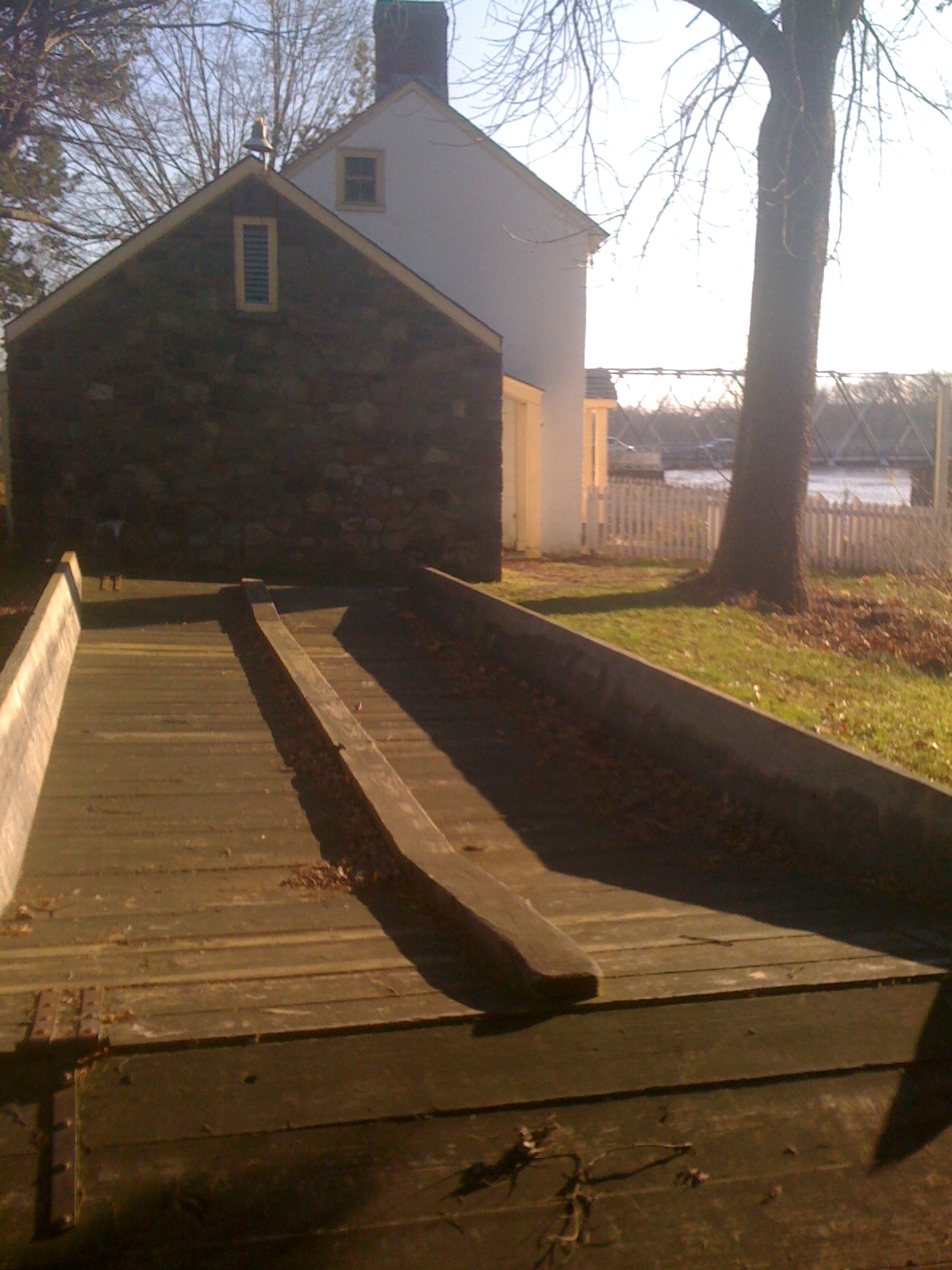
Order: "Hop on with cannons and horses...."
“The worst army in the world confronting the best.” That’s how the docent at the Johnson Ferry house at Washington Crossing State Park described the state of George Washington’s 2400 soldiers once they had landed and regrouped on the New Jersey side of the Delaware River.
The crossing of the Delaware on Christmas Day — really at night — has been labeled one of the “pivotal moments in American history.” You can see why. Had Washington failed, had his troops rather than the Hessian mercenaries in Trenton, been defeated, the revolutionary cause would have suffered a fatal blow.
In his book, Washington’s Crossing, David Hackett Fischer lines up all the disasters and problems which risked and forced changes into the plans for this bold three-pronged attack on Trenton. Starting with a driving sleet and snow storm and dangerous ice flows in the river, two of the three landing parties were unable to reach the other side of the river. Washington’s own crossing at Johnson’s ferry started late, took all night long, and lost him the element of surprise which a night-time 9-mile march to Trenton would have given him.
It was early December when I visited the site. The river was overflowing the banks with a current strong from a wet fall and previous days’ rains. Even with 45 degrees of daytime sun, no wind and REI clothing, I was cold. Replicas of the Durham boats (large canoes with high walls) and the ferry barges looked to be no match for the strength of that river.
Where I stood in the Johnson ferry house, next to the half-a-wall-length fireplace, was where the docent said Washington met with his aides to decide whether or not to continue on to Trenton. I thought they were the lucky ones, inside. It was easy for them to decide to keep going, especially when I learned some of the soldiers didn’t even have shoes.
I thought of taking mine off and walking around the grounds, but I was already cold. I walked down to the river in my Rockports, and tried to imagine the boatsmen – the Marblehead Massschusetts militia-sailors and the ferry operators – working all night long. They dragged their boats up the NJ side of the river; let the current take them down and over to the Pennsylvania side; and then after loading up with men, horses, cannons, they maneuvered their shaky vessels further down and back over to the NJ side. Then they did it again, and again over a ten hour stretch.
Ten minutes later I was back in my car. I figured out how Washington and his army, after so many things had gone wrong, was able to surprise the Hessians and then defeat them the next day at Trenton. No one, not the Hessians, nor I, 235 years later, could have imagined anyone undertaking a crossing march in such adverse elements.
Give Washington credit, even if he was warm. He could convince these soldiers, miserable and cold, after such a crossing to continue on, in the snow, for a nine-mile march and then attack and defeat the most formidable army the world knew at that time.
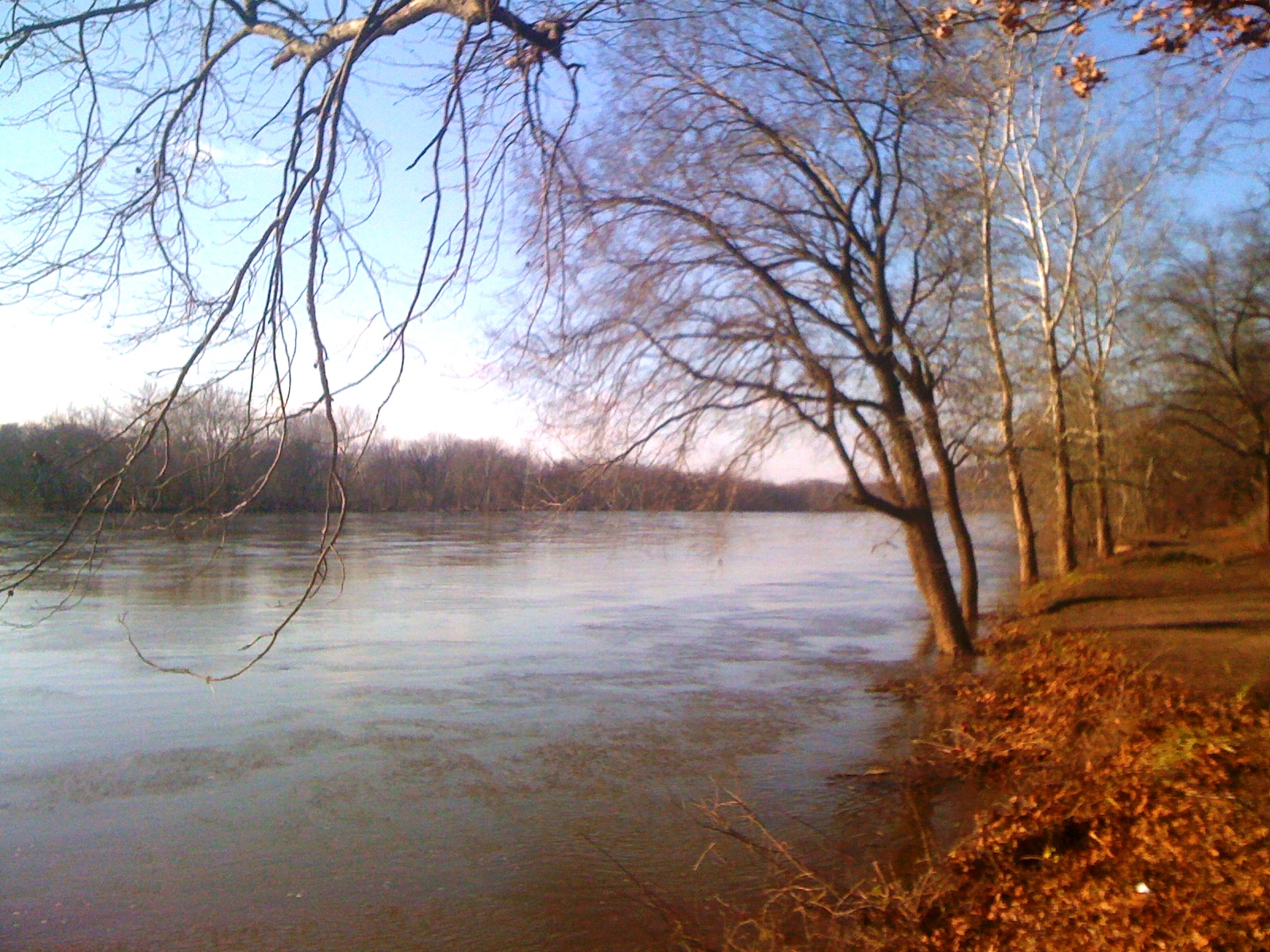
"and cross this, at night, in driving sleet. Then march 9 miles to Trenton and fight the best army in the world."
Brown Signs – Marine Corps Museum
Posted by John Dickson in Brown Signs on November 29, 2011
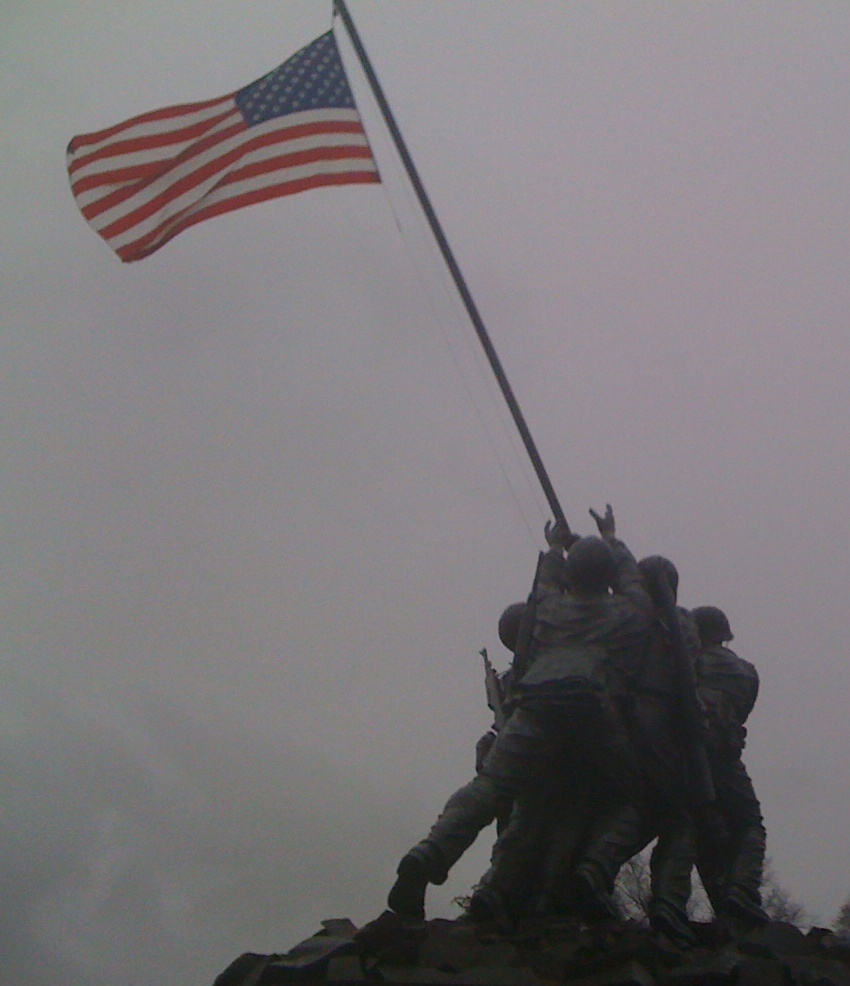
Iwo Jima Memorial. Photo: JDickson
How many times have I driven by the brown sign on US 95 going south out of Washington DC? The sign that says Marine Corps Museum.
There are other brown signs I drive by all the time as well. The FDR Library in Hyde Park is the one brown sign I drive by the most, but there are others, like Arrowhead, Herman Melville’s home in Pittsfield, Massachusetts and Washington’s Winter Headquarters in New Jersey.
So, my goal is to come back to those brown signs and report on what I saw.
The Marine Corps Museum has a story to tell. Many, in fact, but the one I left with was the flag-raising at Iwo Jimo. You know the one of the six soldiers raising the U.S. flag, later made into a statue near Arlington Cemetery. Six anonymous faces bravely raising the flag, seemingly after winning the battle.
Yet, the battle was far from won. Captured was Mt. Suribachi,the volcano on one end of the island, but there was more than a month and thousands of Marines dead left before the island could be claimed as safe.
Newspapers across the country carried the photo by AP photographer Joe Rosenthal as soon as it cleared military censors and distribution time. Shortly thereafter, so did a story that the event was staged.
That story still persists, even though the accusation was settled almost immediately. Those present do acknowledge that there were actually two different flags raised. The commander of the Fifth Marine Division, Lt. Gen. Keller Rockey ordered a larger flag to be found and raised since the first one was not visible.
Part of the controversy stems from professional rivalry as those present for the initial flag raising were annoyed that their effort at the tail end of actual combat to secure Suribachi went unnoticed. Another was a seemingly innocuous comment by the photographer himself who answered in the affirmative when asked shortly after the photo was taken if it had been staged. He, of course, had taken many pictures of that moment and didn’t know which one was on the front pages across the U.S. and now in doubt. In, fact, he had taken a staged photo, called a “gung-ho” shot, of all the Marines facing the camera at the foot of the flag, but that did not have the drama as the one we all know.
He had not positioned the six soldiers for the memorialized photo, and another cameraman with movie film footage proved what Rosenthal referred to as the luck of a photographer – timing and positioning. When asked about the photo later, he said, “I took the picture; the Marines took the hill.”
Kudos to the Marine from the Vietnam War who was volunteering and relayed the story in front of the Iwo Jima flag on display at the museum in Quantico, Virginia. He was the only docent in front of any display we saw in the museum the day we visited, which told us of the prominence of this in Marine history.
A couple of other tidbits on the museum.
— If the trend in museums is to engage the public interactively, war museums may have a harder time than others. One exhibit on Vietnam included walking through a helicopter into a gun position replete with battle noise and tropical heat. Uncomfortable.
The exhibit which was most crowded during our visit portrayed boot camp, from the arrival bus to uniform protocol and even a firing range. More fun and engaging, but not at all connected to the battlefield.
— I skeptically expected a museum extolling all our wars, but was surprised to see comments in the displays questioning decisions to go to war against Mexico in 1848 or calling the end of the Vietnam War “ugly.”
— Finally, it was reassuring to see uniformed Marines taking in their own museum, seeking a little background on their choice of service to country.
History Lessons for Occupy Wall Street
Posted by John Dickson in Public Affairs on November 5, 2011
I recently set out to see first-hand what the Occupy Wall Street protests were all about. As one of the 99%ers and, furthermore, one of the majority supporting this spontaneous groundswell against the financial greed that landed us in the current economic mess, I saw my trip to Lower Manhattan as part curiosity, part solidarity pilgrimage. What I found was a relatively small group of committed, albeit dirty (who wouldn’t be camping out in a small, two-block park in the city?) activists engaging in a sort of political street-theater designed to grab a slice of the media’s attention to raise awareness to a much larger group of homebodies like me. Give them credit: they have succeeded in capturing global and national attention, spawning copycat protests and making space in the limited minutes of tv coverage and inches of print news for views other than Republican Presidential campaigns and their populist tea-party supporters.
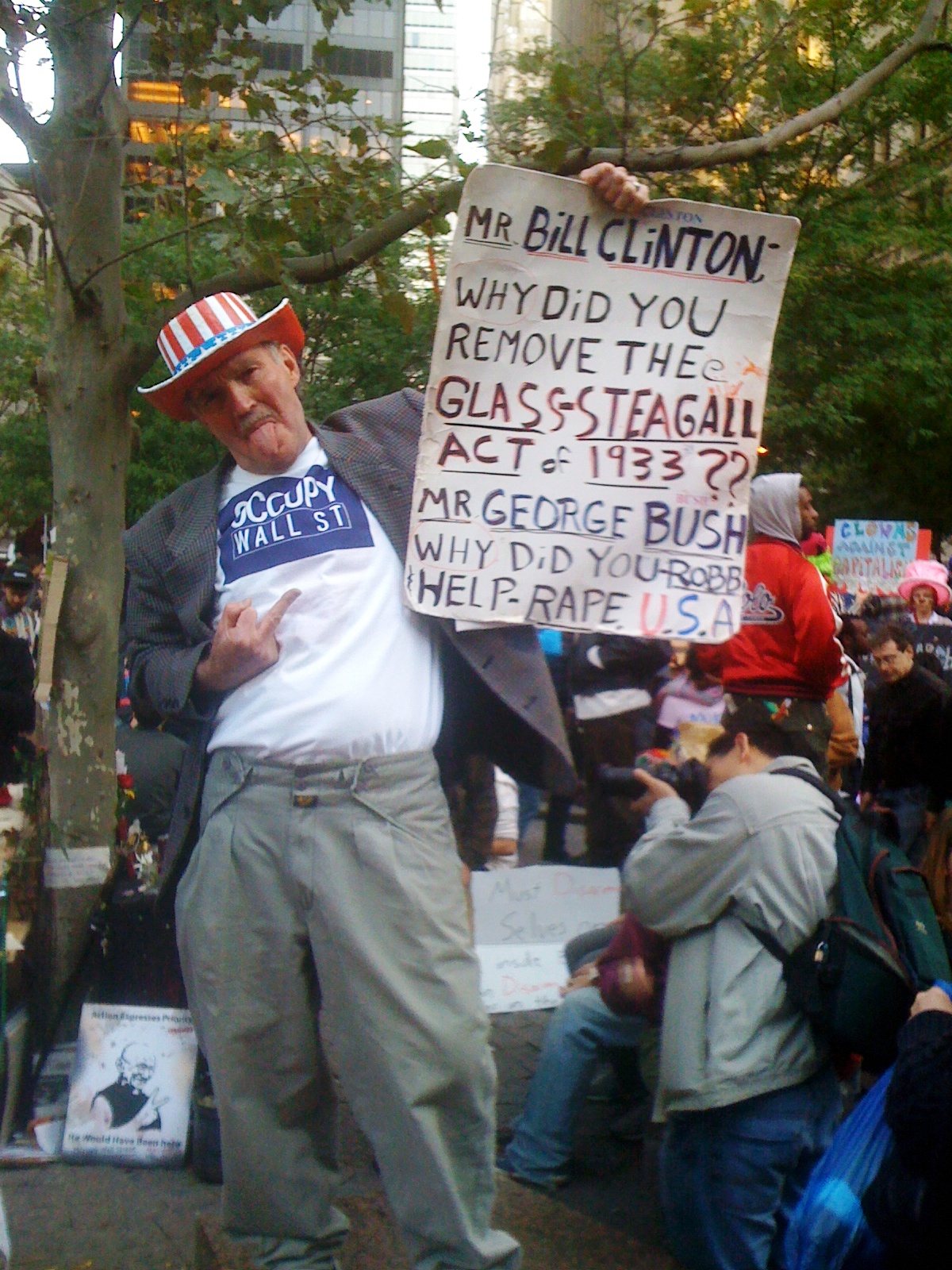
Occupy's History. Photo: JDickson
Yes, there is historic precedence in the U.S. for this kind of response to our current moment. The Occupy protests attack our financial institutions, much like those opposed to the national bank in first Jefferson’s and then Jackson’s presidencies or the populist agrarian protests against banks and debt burdens during the 1890s. Interestingly, one sign in Zuccotti Park demanding the Federal Reserve be abolished could have been borrowed from a Tea Party rally. Common threads of left and right wing populism?
Some see parallels to Coxey’s Army march by unemployed workers on Washington in 1894 or Shay’s rebellion, organized shortly after the Revolutionary War by veterans who could not pay their debts. Even the Whiskey Rebellion a few years later in the 1790s could represent another precedent in our history as farmers tried to prevent federal officials from collecting taxes. Seems more anti-government, like Tea Party than Occupy, though.
Like the unions in the early 1900s and 1930s and the civil rights and anti-war movements of the 1960s, there has been music and drumming at Wall Street. Even Pete Seeger, the voice and banjo threading the environmental activism of the 80s and 90s to the 60s and the 30s, showed up. Music helps pass the time, helps energize those sitting around and adds to the carnival flavor.
While these may constitute antecedents in our democratic tradition which allows for this kind of outburst of political passion, they probably did not spawn or inspire this current movement. Much more on the minds of organizers have been the taking of Tahir Square in Cairo, the “indignados” of Spain this past spring and even the anti-globalization protests of the 1990s. Certainly, the Occupy-ers have used the same convening power of social media forms like Twitter and Facebook to bring together a loose collection of activists over the summer for the original September 17 protest in New York.
I agree with their populist rage, but from the comfort of my own home. As much as I admire them for this small group’s willingness to undergo the hardships, I just don’t see myself giving up my routines to join this rag-tag group. Tahir Square was able to bring out people like me, members of the middle class or professionals in Cairo, average people who were so thrilled by having more a say in their daily lives that they gave up their home comforts and joined the protests. Maybe the difference is that democractic nations have a built-in means of change which was not open to those in Egypt.
So, while the Occupyers may have borrowed directly from Tahir Square, our historic precedent looks more like a small, energized group of people capable of shifting the mood of the broader body politic. In the 1950s and 60s, it was one woman who refused to move to the back of a bus, or four students who refused to give up their seats at a restaurant counter which captured national attention and ignited further protests. But it was a relatively small group of people who kept the up pressure to change, and had a decisive, lasting impact on the broader body politic. No permanent change came out of Shays Rebellion or even Coxey’s Army, even if they do get a mention in our history textbooks. It remains to be seen which route the Occupy-ers will settle for a mere mention, or a broader impact. That should dictate their strategy from here on.
If THESE Walls Could Talk
Posted by John Dickson in Berkshires, Colonial, History in our surroundings on October 26, 2011
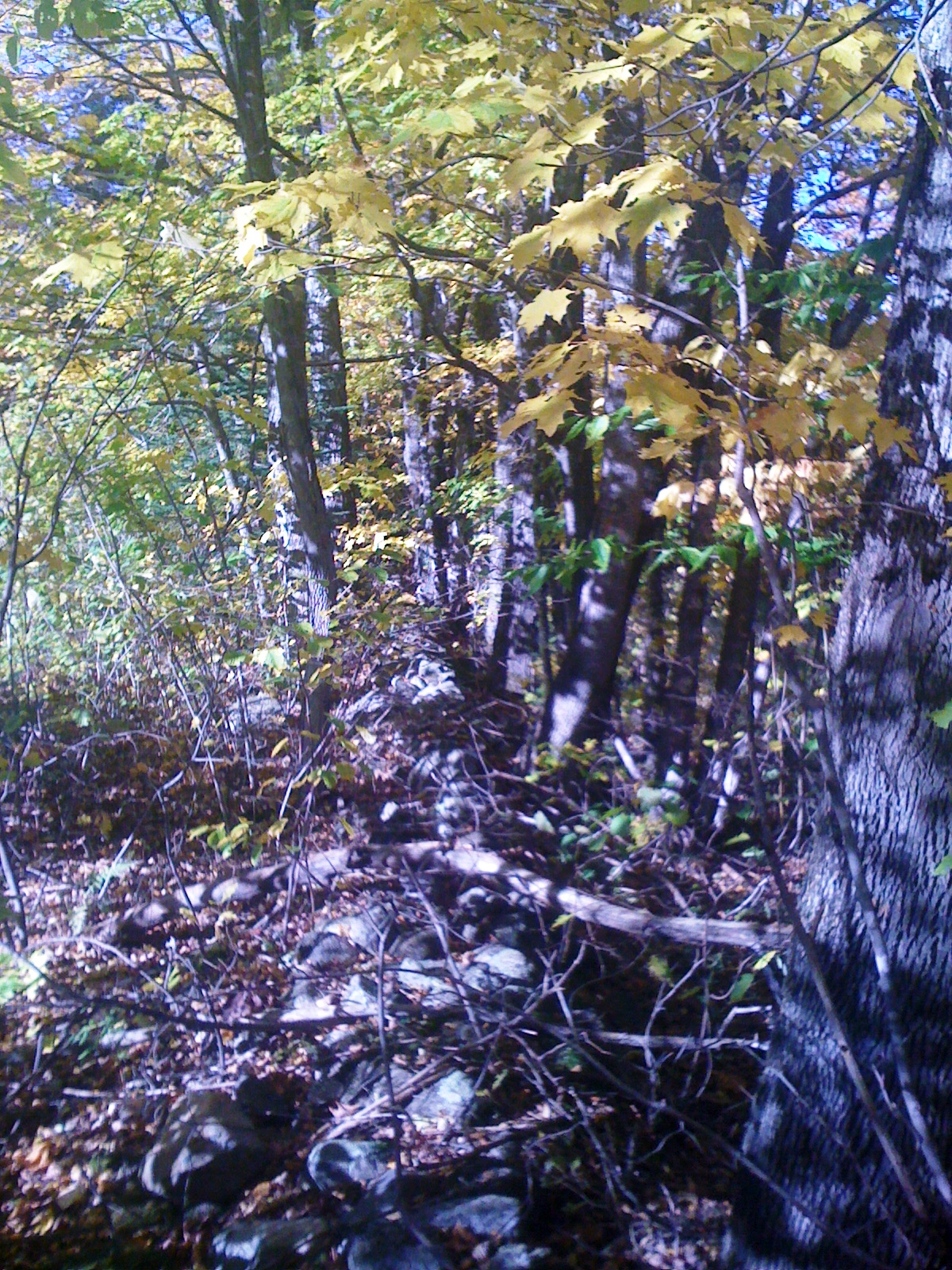
Can you find the stone wall? Photo JDickson
Walk in the woods almost anywhere in New England or drive along almost any road and you are likely to come across a stone wall. We take them for granted. We rarely pause to consider who built these walls, when were they built or even why.
Last summer, I did my own personal stone wall reenactment. I built a stone wall. Really it was just moving rocks which came out of the foundation for an addition on our house. I had the help of an excavator for three very large boulders. Other than that, it was a wheelbarrow and my own feeble arms carrying and placing these rocks. I got about to a length of about 30 feet and a height of 3 feet at most before I realized that I had bit off more than I could chew. While it looks nice, I have no illusions that it will last as long as the stone walls I saw recently walking up Mt. Greylock, or similar ones in the woods around Rangely Maine.
Several things leap to mind immediately on seeing these walls. First, they are now in the middle of woods. When they were built, they were most likely thrown together to demarcate fields and pastures. These thick woods were once pastures. How quickly have they reverted back to their natural state! These are small plots of farmland they mark off, probably accounting for why farming in this region lost out to the much larger, commercial and industrial farms of the MidWest.
Second, the walls go on and on, much longer than my miserable little 30 feet, extending along and breaking up 10 and 20 acre plots. This was a monumental exercise therefore, one which had to take place over many years. If one author estimated that it would take two men to lay 10 feet of stone wall in one day, why did it take me so long to go just 30 feet? Stone wall studies often cite an 1871 report undertaken by the Department of Agriculture, Statistics of Fences in the United States. There, it is estimated that Connecticut had 20,505 miles of walls, Massachusetts perhaps as much as 16,000 miles and New York 95,364 miles!! One author surmised that it would have taken 15,000 men 243 years to construct the stone walls in New York and New England. That may surpass the pyramids.
Next, just how many rocks could a farmer move from a field? He probably had help, in the form of oxen and wooden sliders, his sons, or tenant farmers or even slaves. The earth kept providing stones for the farmers to move, each winter would churn the earth to provide another crops of stones to be moved.
And, did he follow a technique that was widely accepted? The old adage of “one rock covering two and two rocks covering one” probably gave the wall its height, but not its broad width, without mortar? Perhaps, he just threw them in a pile.
These walls do speak. They take us back to a different life, a back-breaking life, of subsistence farming, of years of the same kind of drudgery, work with little change. And then it changed. Our human attempts to control our environment were in the end short-lived.

A memoir in letters. Excerpts from letters that a father wrote his children each week for almost 30 years, full of the mundane and poignant, the witty and wise. Stories from a different time, from a small town in Connecticut.
History Shock
 Pleased to announce the publication of my book in May 2021 by the University Press of Kansas. This collection of “stories with a history” narrates incidents over the course of my career in the Foreign Service when historical understanding – or lack of it – got in the way in the conduct of day-to-day diplomacy.
Berkshire County’s Industrial Heritage

Check out this book on the nineteenth century mills and those who owned and worked in them. Available through Arcadia Press or Amazon.
Slide Show – Getting to Yes, Woman Suffrage in the Berkshires and Beyond
-
Slide Show – Intersections, Pittsfield’s Neighborhoods
-
Slide Show – Turning Points


Slide Show – Preserving the old Berkshire Athenaeum
 Thomas Allen donated $50,000 to build the Athenaeum in 1876.
 A yong architect from New York, William Appleton Potter, had his design selected for the new Athenaeum.
 The original architectural drawing of the front elevation of the Athenaeum
 An early photo of the High Victorian Gothic building, pointed arches, twin gables, multi-color stone patterns,skylight, stained glass windows
 Majestic, quartered oak tresses in the addition built in 1896
 Proposed new library design, in 1944
 Bulging of stonework on from of building required drastic measures to shore up front, in 1979
 A restored skylight is returned to the roof in repairs undertaken in 2001
 Stained glass window on west gable, showing steel tie placed in 1979 stabilization repairs
 Masonry work begins on the Athenaeum in the deep of winter
 Removing the stained glass panels for repair
 Cracks in the masonry
 More cracks in the masonry
 Lifting the capstone off the east gable, the first stone removedd








 History All Around