Archive for category Public History
Who is Jenni Rivera?
Posted by John Dickson in History in our surroundings, Immigration, International, Public Affairs, Public History on December 24, 2012
A couple of weeks ago, Jenni Rivera died in a plane crash. If you are at all like me, you wondered who is Jenni Rivera. Then, you may have moved, like me, to a better question: how could I not know of Jenni Rivera?
It’s not age, but certainly there are a slew of boy bands and other pop culture icons who have just passed me by. This one, Jenni Rivera, had to do with our ethnic and racial, perhaps geographic bubbles we live in.
Jenni Rivera turns out to be a Mexican-American singer, and not just any singer, but one who sold upwards of 15 million albums. She started out singing banda and ranchera music, which, when I lived in Mexico, sounded like a form of Mexican country-western distinct from mariachi. She then moved on to greater popularity with her own reality show on Spanish-language cable television. She was due to break out with her own English-language TV series this coming year.
She was American, born, raised and resident in California, right in front of our eyes, but only if we looked in her direction. That direction includes Spanish language television, music, churches, radio, neighborhoods and schools.
It turns out her parents were immigrants, from Mexico. Her story sounds like it fits into the American immigrant pattern. It is a pattern which is not supposed to exist, which is supposed to have changed from the earliest Irish and German immigrants (not counting the early settlers as immigrants.)
Those patterns are changing: language and culture are held on to longer, because it is easier with bilingual education, mass media and telecommunications, and proximity to the border and the native land. School achievement is lower than for previous second generation immigrants, but not in comparison to the first generation of Mexicans who are coming here with barely a primary education. The Jenni Riveras could thrive on her side of the immigrant boundary, unknown to those of us on the other side, in the receiving mainstream.
These changing patterns have caused academics since at least the 1960s to re-think the “melting pot” and assimilation that we once thought characterized our nation of immigrants. Instead, they see segments of some immigrants assimilating and moving up the economic ladder, and others spiraling downwards. They see exclusion and separation, not inclusion and integration. They may be seeing, and trying to explain, the present, before it has a chance to become the past. We are still too close to the current immigrant wave to see it play out.
For example, the ethnic enclaves where Jenni Rivera thrived also existed before. The once dominant French, Polish and Italian churches hold special services in Spanish, Korean and even Khmer. Sports, culture and politics still remain avenues of economic mobility and acculturation; yesterday’s Joe DiMaggio and Jackie Robinson are today’s Alex Rodriguez and Pablo Sandovaal. The 2012 Presidential election saw, for the third straight time, the increasingly important Hispanic vote. And, of course, nativist reaction to immigrants still continues.
Despite the segmentation of our own cultural offerings, with hundreds of cable channels to allow us to stay in our own ethnic and political realms, Jenni Rivera made it, in death, on to both the front and op-ed pages of the New York Times.

Jenni in 2009 Performance. Photo: JEnriquez
Think I’ll go add Jenni Rivera to my playlist, and move the boundaries a little.
In plain sight
Posted by John Dickson in Berkshires, Civil War, History in our surroundings, Public History on December 18, 2012
It’s an invisible monument, in plain sight. The Soldiers Memorial sits in a prominent position on Park Plaza, the small, central park of Pittsfield, at the crossroads of main thoroughfares in western Massachusetts. Thousands of people pass by it daily, but I wonder how many are like my wife who grew up in Pittsfield but did not know there was a monument in Park Plaza. The last time the memorial appeared in the press was on the 110th anniversary of its dedication, in 1982.

On Park Plaza. Photo: JDickson
On the one hand, it’s hard to miss the 6-foot bronzed color guard soldier holding the flag, atop a 12-foot granite pedestal, dedicated just seven years after the end of the Civil War. Divided into their regiments, the names of 102 Pittsfield soldiers who died during the war are inscribed on plaques on the granite sides. Yet, so many of these statues of soldiers, or generals riding horses, populate our public places that they have lost meaning of memorializing the fallen, blending into the landscape almost like a telephone pole.
Each of the men on the plaque must have his own story worth telling, but lost now. The pamphlet[1] memorializing the dedication ceremony on September 24, 1872 adds a little flavor. The name of the conflict was “The Great Rebellion”, not the Civil War; the artist whose painting served as the model for the sculptor himself survived the Battle of Antietam but lost an arm. The booklet includes the names of the regiments of the Pittsfield volunteers, and their engagements, from the well-known Gettysburg or Chancellorsville to lesser known battles with names like Yellow River, Grim Swamp or Cane River Crossing. Soldiers “died from their wounds,” “killed in action,” “died in Libby Prison,” or simply “died.”
Reading from a 21st century perspective, several other story-lines with gender and racial overtones emerge. The original idea for a monument was floated shortly after the end of the war, studied by several committees, including one of women who went on to raise money when the town delayed pursuing a memorial so that it could pay off its war debts first. With $3000 in the bank, these women stepped aside (or were shunted?) when an all-male town council took over the plan, appropriated public funds, but still drew on the collected monies. In addition, four soldiers from the all-black Massachusetts 54th (highlighted in the film Glory) died during the war, but an additional ten from Pittsfield served, including the chaplain Samuel Harrison, whose names are all included in the booklet. An article from the local paper on September 25, 1872 which lists all the regiments of the 2000 soldiers who marched in the parade did not mention the 54th, leading to speculation on their absence – from the story or the parade?
An orator spoke at the dedication, a professional orator, winner of prizes and contests: a certain George William Curtis, from New York, who speculated on how posterity would interpret the war. Not once mentioning slavery, his reference was implicit but unmistakable: “equal rights of every citizen are the sacred care of the whole people.” Curtis thought to anticipate the day when a youth from Carolina or Georgia would stop at the statue and invoke that these “men died for me as well as for you. They saved Carolina as well as Massachusetts.” We’re not there yet.
How does this statue speak to us today? Hardly at all, unfortunately. This memorial invisible in plain sight, should tell us a lot, about a war which still divides us as it preserved and united, about the sacrifice it took to get to where we are, on race and gender, on patriotism, on loss.
[1] Proceedings of the Dedication of the Soldiers Monument, edited by J.E.A. Smith, Pittsfield MA, Chickering &Axtell, Steam Printers, 1872
- On Park Plaza. Photo: JDickson
Food, Luxurious Food
Posted by John Dickson in History in our surroundings, Personal memory, Public History on November 30, 2012
Thanksgiving has come and gone, now drowned out by the near-hysteria which television commercials promote to make us think we’re missing out if we don’t get out and shop.
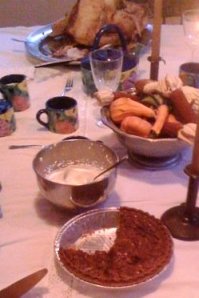
Last course. Photo: JDickson
Let’s rewind to last week and consider food, specifically how far attitudes toward food have traveled, in the past two generations.
There’s such a difference between producing and preparing food in a time period of limits than in our current experience with abundancy. Since food is so connected with family, let me fall back on my own to make the point. Sunday evenings, after my mother had toiled over a fairly elaborate family Sunday dinner in the middle of the day, she turned over food matters to my father for the evening supper. A child of the depression who had never eaten an egg before he was 18 (and a man), he served us graham crackers and milk. Right. Broken up graham crackers in a bowl with milk poured over. His goal was to fill up the stomachs of his hungry brood, with as little time and knowledge as he could muster up.
It should go without saying that my mother’s approach was quite different, but there, I said it. With a little more disposable income, a little more time and know-how, she had a dual track approach to organizing the food for the family. First, she had her box of file card recipes and cookbooks and drew from it to make regular, fulsome, varied dinners for us and for guests. Yet, she also seemed to be first in line for the latest trends of convenience coming our way in the 1950s and 60s, ranging from frozen food dinners (chicken pot pies), freeze dried, preservatives, or mix-with-water foods (powdered gravies.) Her goal was convenience, and freeing up her time for other endeavors, some leisure but mostly other pursuits, like parenting, volunteering or socializing around hobbies. Her goal was convenience.
Oh, one other thing. Even with disposable income, we ate out so rarely that I remember vividly the first time at a restaurant and, outside of travel, can count on one hand the number of restaurants we ate at before high school.
References to food in our histories calls to mind first, the amount of meat consumed by the men on the Lewis and Clark expedition, an average of 8 pounds of meat per day, per person! Compare that to the annual single serving of meat for the family in Ireland at the brink of desperation before sending waves of family members to the U.S. and beyond in search of income. Move temporally back to the present, but beyond our shores to large swaths of entire continents where all things food remain on the subsistence level.
When did our view of food go from filling up our stomachs or getting through the preparation time quickly to our current , near obsession with so many layers of food from production and handling all the way through preparation and consumption?
The changing roles of gender in the past 50 years must account for much of this. With stay-at-home women traditionally more responsible for all things food moving into the workplace, the emphasis on convenience has extended beyond frozen food aisles in grocery stores to eating out or at least taking advantage of the fully prepared meals taking up large sections of stores.
At the same time as we are seeking convenience due to hectic working lives, though, we, with our expanded incomes, are able to spend more on differentiating food, into categories like sources or quality, or preparation and handling. That means of course, spending a little more of our precious time to investigating and studying foods, which means full sections of newspapers and separate television channels dedicated to food. We even have graduate history courses in our universities on food.
In a very real sense, food has become the new luxury. Luxury in terms of money and in terms of time, even in the contradiction of having no time. The Starbucks principle of people spending a little more of their money for quality, but also to have the luxury, has expanded to all our food. For those with money and time.
I recently attended a workshop on Foodways, a history workshop. I entered the room, one of two men, as a dissident, bucking against the current trend of luxuriating what had always been for me barely more than a bodily function. I left with an appreciation for food as a window into our history, even in its current luxuriated stage!
Thanksgiving is part of that. It’s not just how food at the table has changed, but the social history of Thanksgiving, offering a window into the daily lives of ordinary people. When millions of those ordinary people do the same thing, as we do with infinite variations on the theme, then that’s another window. Almost unique in setting aside a holiday exclusively for a meal and family with overtones of sharing, the country may merit exceptionalism, at least on that basis.
In my mind I’ve gone to Ft. Ticonderoga
Posted by John Dickson in Brown Signs, Colonial, Personal memory, Public History on November 16, 2012
If people experience history best through personalizing it, then it is likely what we get out of a museum is something that connects directly to our personal experience.
That was the case during a visit this fall to Fort Ticonderoga on the New York side of Lake Champlain. The fort which occupies a strategic position on the southern tip of the lake played a role in both the French and Indian War and the Revolutionary War in the 1700s. The strategic part was made clear in a map at one of the displays showing the water route taken down the lake from Canada, and then across a brief stretch of land over to the Hudson River, which leads all the way to New York City.
So, how did my wife and I experience this personally?
For one, we skipped the musket demonstration which drew off the small crowd early on Sunday morning, leaving the rebuilt fort and room displays to ourselves (we hate crowds and are not too keen on guns either.)
Second, we lucked into the only tour available during our time frame, of the King’s Gardens on the property. The fort has succeeded in planning gardens and pasture which period soldiers may have used (albeit surrounded by electric fence at night.) The gardens we focused on, though, pertained to the private property owned by the Pell family, ancestors of Senator Claiborne Pell from Rhode Island. At the time, we had been busy re-landscaping our newly renovated house (on a much smaller scale, admittedly), so these beautifully cared for gardens and trees captured our attention.
Third, we were instinctively drawn to any connection to our home town of Pittsfield in the display. We skipped right past the names of Ethan Allen and Benedict Arnold and focused on a name neither of us had heard previously, a Pittsfield native, Colonel John Brown. We saw a plaque honoring him as we entered, and we spent more time in front of the displays explaining his leadership of a three-day assault on the fort in September 1777, which helped lead to the abandonment and subsequent destruction by British forces of the fort two months later. We learned John Brown was killed later in the war at the age of 36.
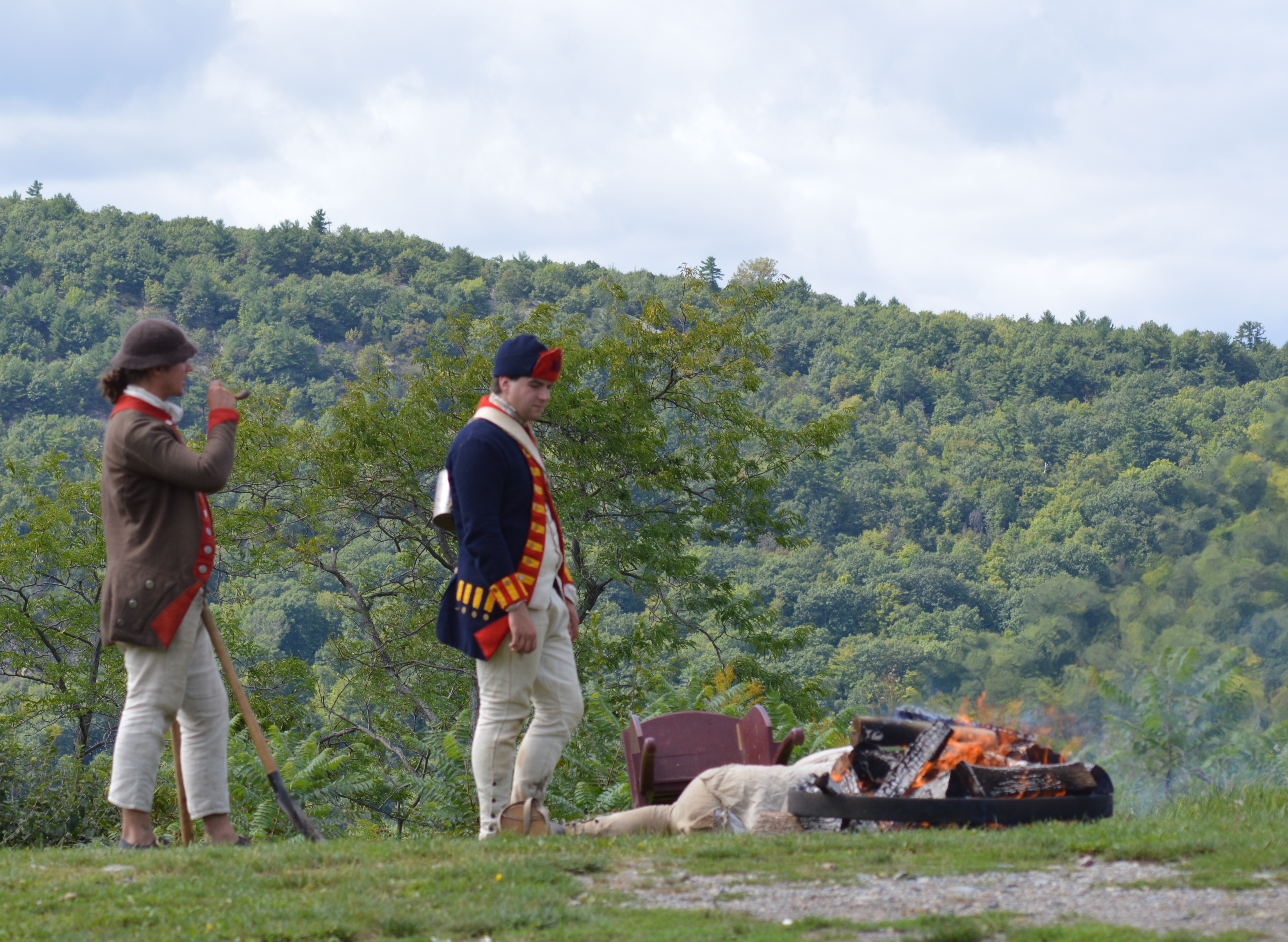
Soldiers at Ft. Ticonderoga. Credit: M. Dickson
Finally, we zoomed in on the motivations behind the tour guide/reenactors who, both paid and volunteer, filled the environs, even with their children. We assumed they probably had spent the night there, at least some of them. Our tour guide, in period uniform, explained he bought his uniform from a store in the U.K., with special wool and buttons and sewing techniques, all at a fairly expensive cost. We later overheard several of the uniformed guides discussing amongst themselves where they had procured various pieces of their outfit. Here again, we personalized, admitting this was not anything we would ever find ourselves doing, but frankly pleased the fort was able to attract people who put such time, energy and expense into this hobby.
As we were heading out, we noticed that others were studying in detail the musket displays, which we had zoomed right by, but stopped for an equally intent examination of the maps which showed prominently western Massachusetts, Pittsfield and even our neighboring lake.
What’s that?
Posted by John Dickson in Personal memory, Public History on September 4, 2012
In several days, I go to the first of my classes in the Public History program at the University of Massachusetts. It has taken me almost two years to get to this point, browsing through course opportunities, studying for the GRE, compiling an application, waiting to hear of acceptance, and then, once accepting opting to defer for a year.
Throughout this journey, the most frequent and, ultimately, the hardest question I had to answer about my choice of returning to the classroom to study Public History has been, “What is that?” Or, “Isn’t all history public?”
After a career in public diplomacy, I am used to people not understanding what it is that I do. I found it easiest to translate with a code of lay vocabulary, like “press and culture exchanges,” or refer to an activity we managed, such as “we ran the Fulbright exchanges.” That begged the question of why we didn’t just call the function “press and cultural affairs.”
So, I did develop a bit of shorthand for the “What is Public History?” question. “It’s history for museums.” Or, if I had 20 more seconds, “It’s making history accessible to a broader public, beyond academia, like in museums, or commemorative events and sites.” Even though it is more than that, that seemed to satisfy my family and friends who would then move on to talking about the hot weather this summer.
If it is more than that, then what is it? I suppose it may take two years of a Masters degree program to be able to answer this, but here are a few things which some of the practitioners say about it:
— making history relevant to social concern (Charles Beard)
— helping members of the public do their own history (Carl Becker)
— bringing state and local history into the academy, or co-opting state and local history (Grele)
— history beyond teaching and research, entrepreneurial, collaborative, engaging business, government and other entities (Bookspan)
— a people’s history, which fills in the gaps of what we have chosen to ignore (Frisch)
— uncovering the history of the “ordinary,” or history for the people, with the people; people seeking knowledge of the world they have made or that was made for them, shaping the way the present is viewed (Grele)
They all make sense to me, and are in many ways inspiring, but also lacking in answering the question, how? In museums, in preserving, in archiving, in writing, in interviewing, and yes, in teaching and even researching.
I’d still like to boil that all down to 20 words or less, that make sense to the ordinary person, with whom we are supposed to be collaborating.
-
You are currently browsing the archives for the Public History category.

A memoir in letters. Excerpts from letters that a father wrote his children each week for almost 30 years, full of the mundane and poignant, the witty and wise. Stories from a different time, from a small town in Connecticut.
History Shock
 Pleased to announce the publication of my book in May 2021 by the University Press of Kansas. This collection of “stories with a history” narrates incidents over the course of my career in the Foreign Service when historical understanding – or lack of it – got in the way in the conduct of day-to-day diplomacy.
Berkshire County’s Industrial Heritage

Check out this book on the nineteenth century mills and those who owned and worked in them. Available through Arcadia Press or Amazon.
Slide Show – Getting to Yes, Woman Suffrage in the Berkshires and Beyond
-
Slide Show – Intersections, Pittsfield’s Neighborhoods
-
Slide Show – Turning Points


Slide Show – Preserving the old Berkshire Athenaeum
 Thomas Allen donated $50,000 to build the Athenaeum in 1876.
 A yong architect from New York, William Appleton Potter, had his design selected for the new Athenaeum.
 The original architectural drawing of the front elevation of the Athenaeum
 An early photo of the High Victorian Gothic building, pointed arches, twin gables, multi-color stone patterns,skylight, stained glass windows
 Majestic, quartered oak tresses in the addition built in 1896
 Proposed new library design, in 1944
 Bulging of stonework on from of building required drastic measures to shore up front, in 1979
 A restored skylight is returned to the roof in repairs undertaken in 2001
 Stained glass window on west gable, showing steel tie placed in 1979 stabilization repairs
 Masonry work begins on the Athenaeum in the deep of winter
 Removing the stained glass panels for repair
 Cracks in the masonry
 More cracks in the masonry
 Lifting the capstone off the east gable, the first stone removedd








 History All Around