Archive for category Public Affairs
History Lessons for Occupy Wall Street
Posted by John Dickson in Public Affairs on November 5, 2011
I recently set out to see first-hand what the Occupy Wall Street protests were all about. As one of the 99%ers and, furthermore, one of the majority supporting this spontaneous groundswell against the financial greed that landed us in the current economic mess, I saw my trip to Lower Manhattan as part curiosity, part solidarity pilgrimage. What I found was a relatively small group of committed, albeit dirty (who wouldn’t be camping out in a small, two-block park in the city?) activists engaging in a sort of political street-theater designed to grab a slice of the media’s attention to raise awareness to a much larger group of homebodies like me. Give them credit: they have succeeded in capturing global and national attention, spawning copycat protests and making space in the limited minutes of tv coverage and inches of print news for views other than Republican Presidential campaigns and their populist tea-party supporters.
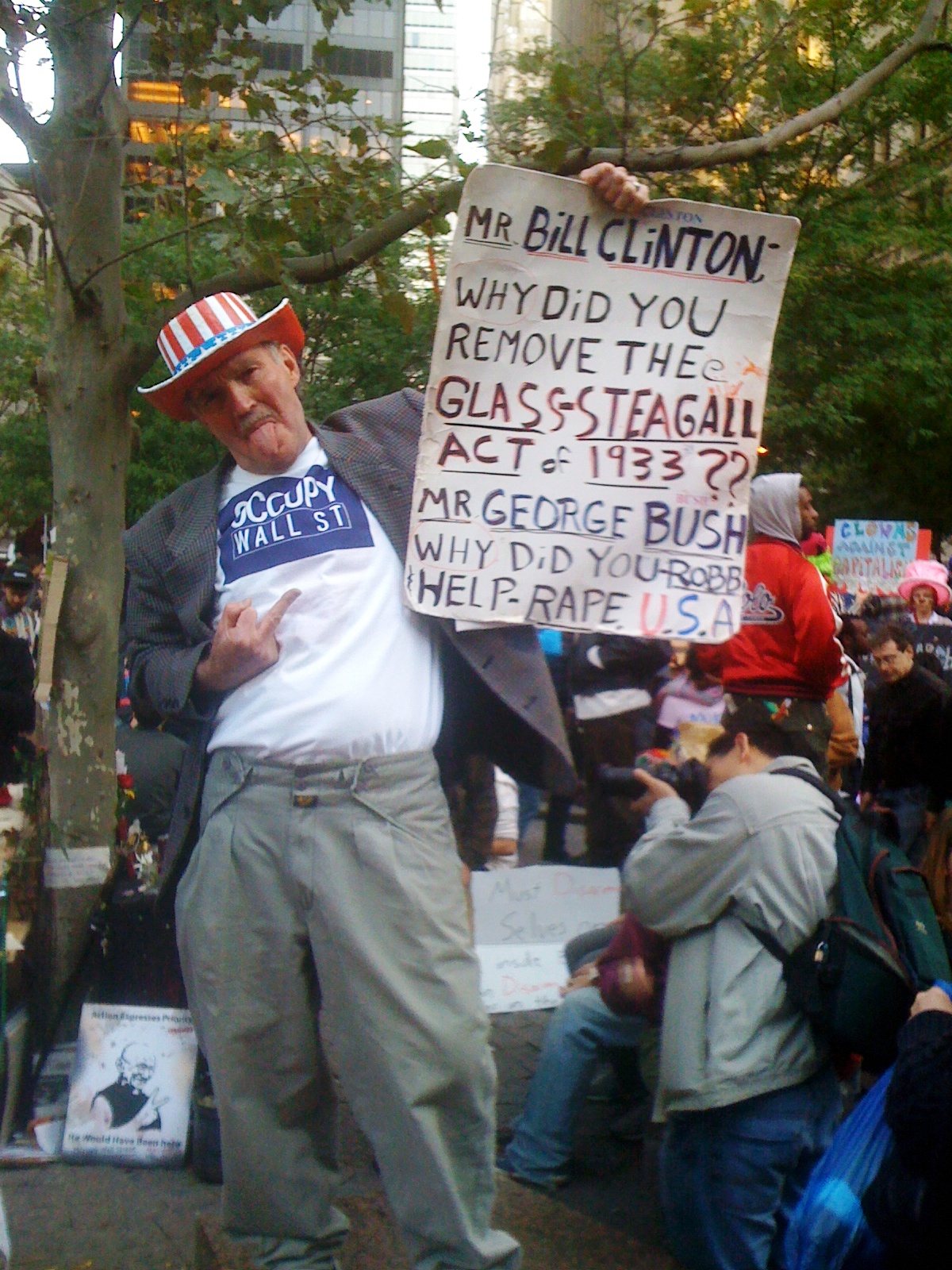
Occupy's History. Photo: JDickson
Yes, there is historic precedence in the U.S. for this kind of response to our current moment. The Occupy protests attack our financial institutions, much like those opposed to the national bank in first Jefferson’s and then Jackson’s presidencies or the populist agrarian protests against banks and debt burdens during the 1890s. Interestingly, one sign in Zuccotti Park demanding the Federal Reserve be abolished could have been borrowed from a Tea Party rally. Common threads of left and right wing populism?
Some see parallels to Coxey’s Army march by unemployed workers on Washington in 1894 or Shay’s rebellion, organized shortly after the Revolutionary War by veterans who could not pay their debts. Even the Whiskey Rebellion a few years later in the 1790s could represent another precedent in our history as farmers tried to prevent federal officials from collecting taxes. Seems more anti-government, like Tea Party than Occupy, though.
Like the unions in the early 1900s and 1930s and the civil rights and anti-war movements of the 1960s, there has been music and drumming at Wall Street. Even Pete Seeger, the voice and banjo threading the environmental activism of the 80s and 90s to the 60s and the 30s, showed up. Music helps pass the time, helps energize those sitting around and adds to the carnival flavor.
While these may constitute antecedents in our democratic tradition which allows for this kind of outburst of political passion, they probably did not spawn or inspire this current movement. Much more on the minds of organizers have been the taking of Tahir Square in Cairo, the “indignados” of Spain this past spring and even the anti-globalization protests of the 1990s. Certainly, the Occupy-ers have used the same convening power of social media forms like Twitter and Facebook to bring together a loose collection of activists over the summer for the original September 17 protest in New York.
I agree with their populist rage, but from the comfort of my own home. As much as I admire them for this small group’s willingness to undergo the hardships, I just don’t see myself giving up my routines to join this rag-tag group. Tahir Square was able to bring out people like me, members of the middle class or professionals in Cairo, average people who were so thrilled by having more a say in their daily lives that they gave up their home comforts and joined the protests. Maybe the difference is that democractic nations have a built-in means of change which was not open to those in Egypt.
So, while the Occupyers may have borrowed directly from Tahir Square, our historic precedent looks more like a small, energized group of people capable of shifting the mood of the broader body politic. In the 1950s and 60s, it was one woman who refused to move to the back of a bus, or four students who refused to give up their seats at a restaurant counter which captured national attention and ignited further protests. But it was a relatively small group of people who kept the up pressure to change, and had a decisive, lasting impact on the broader body politic. No permanent change came out of Shays Rebellion or even Coxey’s Army, even if they do get a mention in our history textbooks. It remains to be seen which route the Occupy-ers will settle for a mere mention, or a broader impact. That should dictate their strategy from here on.
Is 9/11 History?
Posted by John Dickson in History in our surroundings, Personal memory, Public Affairs on September 6, 2011
As we approach the tenth anniversary of the attacks of September 11, 2001, we find ourselves consumed with remembrances and interpretations of that day, and its impact on our lives since.

Smithsonian 9/11 Exhibit. Photo credit: J Dickson
We are as consumed with these as we were riveted to television that day, watching over and over again the unimaginable images of planes flying into the buildings and of buildings collapsing. So many of us have our own story to tell of that day, where we were, how we found out, and, incredibly, how we knew someone in the buildings, on their way to the buildings, or caught up in the rescue efforts.
My own story is set in an airplane, flying across the Atlantic with my son, landing in London to learn that something terrible had just happened by the mere question of the rental car agent who asked “Are you American?”
I have a family member who was an EMT who was in the area when the towers fell (and survived.) I have a colleague whose son was late to work that morning and never entered the building before it was hit.
We all have our own stories as well of our response to that day, of friends and family in combat missions in Afghanistan and Iraq, of being lied to, and in my case, trying to defend to foreign partners our government’s actions based on this misinformation.
We have lived with and adapted to the heightened security, most evident in our travel but also in and around our monuments and workplaces.
This is still not history, though, as we are still living it. We are still fighting wars as a consequence, we are still in a state of heightened security, and we are still living with the debt run up to fight those wars.
History will come when our soldiers have returned home, when our economy is responding to other challenges, when we are no longer x-rayed and photographed while trying to board planes. Historic understanding tells us that these realities will not endure. Just as the fall of the Berlin Wall signaled the end of the Cold War, this 9/11 chapter will also end, replaced by the next development, hopefully without the horrific or far-reaching consequences that those 20 hijackers unleashed ten years ago.
The Smithsonian Museum of American History has now an exhibit of 9/11. As the repository for all artifacts collected from New York, Washington and Pennsylvania, the museum has put a small sampling on display, on tables out from behind glass cases for people to see and read and experience the short stories of each item. We stood in line for over an hour to enter the small room, with four tables on which lay these artifacts – the cell phone used by New York Mayor Rudy Guiliani, a doll collected from the scene of the two towers, badges of office workers and rescue workers from all three sites or a door from a crushed fire engine.
The most powerful, though, remains the video of the television news, unfolding that morning, with Good Morning America starting off with the breaking news that Michael Jordan was considering a comeback to the NBA that season, followed by the initial reports of an explosion at the World Trade Center, and then the live coverage of the second plane flying into the second tower, the fire at the Pentagon, the crash in the Pentagon and the collapse of the two towers.
The anniversary will focus on the heroes, of the day and since. And there are many, and they deserve our gratitude and admiration. History will also record their actions that day, that year and the decade since. But what history will also have to try to capture was the sheer sense of disbelief, of paralysis as we sat and watched over and over again these images. That was our collective reality.
If Only the English Had Listened to Paul Revere
Posted by John Dickson in Colonial, Public Affairs on June 7, 2011
We all make mistakes. Some of us have an easier time admitting that we made them though. Some of us are in the national spotlight and are making mistakes to stake out an exclusive claim on our nation’s independence heroes for our own political ends.
Cue Sarah Palin and Michele Bachmann, two prominent political figures. Does it matter that they are on the right of the political spectrum? Actually, it probably does since they both channel the colonists who engaged in the 1775 tea party to demand liberty.
In mid-May, Minnesota Congresswoman Michell Bachmann was “not” campaigning in New Hampshire which traditionally holds the first Presidential primary elections, tried to ingratiate herself with the local crowd by saying “You’re the state where the shot was heard around the world in Lexington and Concord.”
A few weeks later, former Alaska Governor and VICE-PRESIDENTIAL candidate (!) Sarah Palin was also “not” campaigning in Boston when she tried to re-write the role of Paul Revere in claiming our liberty this way: “He who warned the British that they weren’t going to be taking away our arms, by ringing those bells, and making sure as he’s riding his horse through town to send those warning shots and bells that we were going to be secure and we were going to be free.”
It’s great material for John Stewart or David Letterman. They might even say it’s too easy for them.
Their followers try to deflect, by saying these missteps do not really matter; that the liberal media is out to “get” them while giving Barack Obama a pass. Most likely, colleagues on their side of the political aisle are fuming, as these gaffes detract from serious candidates who have announced they are running for President.
It would be interesting to imagine members of their staffs, trying to prep and brief them for their next non-campaign stops. They will either have bookmarked Wiki-Pedia to get the latest tidbits of history in each stop or they are carrying around with them a seventh grade U.S. history textbook, maybe even copies of Scholastic magazine.
And, it would be more than entertaining if the other Wiki (of leaks fame) could dredge up some of the cables from other countries’ embassies in the U.S. so that we could see how they are trying to interpret the politics of our next Presidential election.
Here’s how the cable might read from the UK Embassy: “So Paul Revere was warning us? If only we knew? Had we listened and just allowed them to keep their guns for hunting, North America still might be our colonial empire.”
The Lying Decade
Posted by John Dickson in History in our surroundings, Public Affairs on May 26, 2011
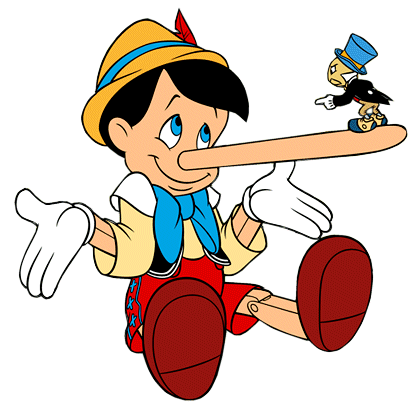
Our favorite liar
I want to go on record as being the first person to name the first decade of this century, this millennium even. The Lying 2000s.
Hopefully we won’t be lying for the entire millennium, but, unlike the 1920s or the 1960s, there’s no easy way to label those ten years where we ended up calling each year two thousand one, or two thousand eight.
We have other terms which have stuck for labeling decades, like “The Roaring 20s” or “The Me Decade.” We don’t even give a name to the 1960s other than “The 60s” because we all know all the connotations and references which the mere number elicits.
Historians will say it takes some time to label a decade. However, the “Me Decade” for the 1970s caught on after a Tom Wolfe article in 1976, well before the ten years were actually up.
What’s not hard though is to admit that it was a decade of lying. Lance Armstrong is the latest as new revelations have come out about his alleged use of performance enhancing drugs. Add his name to the list of Barry Bonds, Martha Stewart, Bernie Madoff, John Edwards, and so on. It’s not just Bonds and Armstrong in sports, but the list is long. Nor is it just John Edwards in politics, but how about John Ensign or Rod Blagoyovich or that deliciously wonderful Governor Sanford from South Carolina who went hiking on the Appalachian Trail….in Argentina? Or the Pat Tillman and Jessica Lynch stories out of our interventions in Afghanistan and Pakistan. Or how about weapons of mass destruction in Iraq?
There’s a new book out by James Stewart called Tangled Webs, where he reports in depth on four of the most famous liars. But to my knowledge, he doesn’t make the case that the decade be given this name. And, he only concentrates on these four cases.
Truth is (pun intended,) the lying epidemic does go back a ways. Watergate, Monica Lewinsky and even the steroids era started well before this decade. And the lying is not confined to this country, as we are now seeing with autocrats in the Middle East, like Ghaddafi, claiming that all is well in his country. The Soviets were masters of lying, about their economy, about the joys of their system, about their lack of knowledge of the huge Gulag system of prisons.
I was a naïve diplomat when I told an audience in Mexico that there was no reason not to believe Secretary of State Colin Powell as he made his case to the UN about weapons of mass destruction in Iraq. “We went through our period of lies in the 1970s,” I said. “We learned that lies will eventually be found out.”
I was right about one thing. The lies were found out.
In any case, let’s start a movement for calling the last decade the Lying 2000s. Maybe it will help shake us of that habit, so we could call the next decade something more inspiring. But that’s probably naïve.
Tear Down That Wall
Posted by John Dickson in International, Public Affairs on May 7, 2011
Is there information overload on Bin Laden’s death? Well, here’s another thought, looking at the last ten years with an eye to future history.
First, let’s not forget the last ten years. Let’s not forget what it has been to live with a Bin Laden at large, with a huge impact on our lives, from direct trauma to major inconvenience. One of the most frequent questions heard in interviews this past week on the talk shows was “Did you ever think we would see this day (when Bin Laden was eliminated?)” I bet a poll would show that most people thought that we would never find him. And still, most people think his demise will have little influence and that we are going to live with terror and our heightened state of alerts from now on.
Yet, years from now, it may look like it was foreordained that we would capture Bin Laden and that his reign of terror would naturally come to an end, but when we are living in the middle of it, it is hard to imagine such an outcome.
Second, let’s hope that his demise has the same impact that capturing Abimael Guzman, the leader of Shining Path in Peru, had on that country emerging from decades of terrorist attacks and a resulting “under siege” mentality. I moved to Peru just several years after his capture and over the following couple of years saw the country transform itself, and gradually return to normal living. Yet, the mark remains, as Peruvians lived through the worst and fear developments which could constitute a return.
A similar transition occurred in South Africa, where I also witnessed first-hand the demise of apartheid and the violent resistance to it. Almost overnight, following the release of Mandela and the unbanning of the African National Congress, the security at airports, movie theaters and shopping malls came down, curfews were lifted and troops left the townships.
The fall of the Berlin Wall also ushered in a more relaxed atmosphere, an unthinkable event just a few years earlier. Prior to 1989, many of us thought we were living in a permanent state of tension, between East and West.
Is it too much to think that one day the security at our airports will also be removed? Relaxed? That our troops will come home from Iraq and Afghanistan and that we could enjoy the same kind of peace dividend we earned during the 1990s?
Tear down those walls, those jersey barriers, those screens, those magnatometers!

Photo taken from christyclark.ca, via debateitout.com
-
You are currently browsing the archives for the Public Affairs category.

A memoir in letters. Excerpts from letters that a father wrote his children each week for almost 30 years, full of the mundane and poignant, the witty and wise. Stories from a different time, from a small town in Connecticut.
History Shock
 Pleased to announce the publication of my book in May 2021 by the University Press of Kansas. This collection of “stories with a history” narrates incidents over the course of my career in the Foreign Service when historical understanding – or lack of it – got in the way in the conduct of day-to-day diplomacy.
Berkshire County’s Industrial Heritage

Check out this book on the nineteenth century mills and those who owned and worked in them. Available through Arcadia Press or Amazon.
Slide Show – Getting to Yes, Woman Suffrage in the Berkshires and Beyond
-
Slide Show – Intersections, Pittsfield’s Neighborhoods
-
Slide Show – Turning Points


Slide Show – Preserving the old Berkshire Athenaeum
 Thomas Allen donated $50,000 to build the Athenaeum in 1876.
 A yong architect from New York, William Appleton Potter, had his design selected for the new Athenaeum.
 The original architectural drawing of the front elevation of the Athenaeum
 An early photo of the High Victorian Gothic building, pointed arches, twin gables, multi-color stone patterns,skylight, stained glass windows
 Majestic, quartered oak tresses in the addition built in 1896
 Proposed new library design, in 1944
 Bulging of stonework on from of building required drastic measures to shore up front, in 1979
 A restored skylight is returned to the roof in repairs undertaken in 2001
 Stained glass window on west gable, showing steel tie placed in 1979 stabilization repairs
 Masonry work begins on the Athenaeum in the deep of winter
 Removing the stained glass panels for repair
 Cracks in the masonry
 More cracks in the masonry
 Lifting the capstone off the east gable, the first stone removedd








 History All Around