Archive for category History in our surroundings
Did Anyone Die in the War of 1812?
Posted by John Dickson in Brown Signs, History in our surroundings, International on June 24, 2012
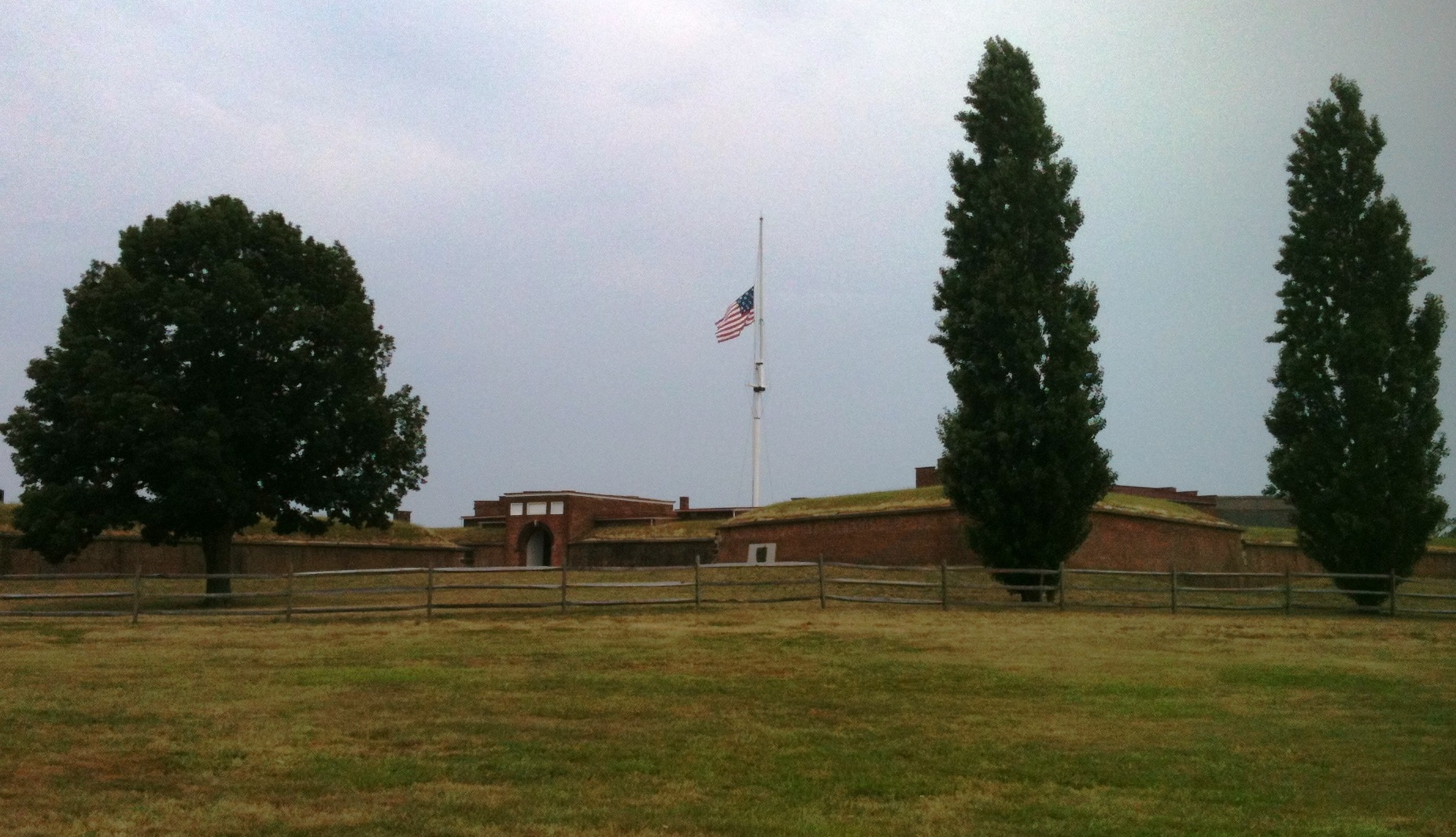
Proof through the night
A week after the tall ships descended on Baltimore for the bicentennial of the beginning of the War of 1812, and the city’s historic landmarks related to that event had returned perhaps to our national forgetfulness of that war. A few visitors to Fort McHenry made our tour relaxed and free of mobs. The Inner Harbor was back to paddle-boat dragons, summer-time outdoor live music and smoothies.
Two things struck me about the exhibits at Fort McHenry, where Francis Scott Key’s view of the flag still waving after a night of British bombardment is memorialized, quite informatively and attractively. 1500 shells. Four people died. In fact, little mention was made of any casualties in the entire war.
It is hard to go to a battlefield or memorial of the Civil War, or any American military engagement since, and not be confronted with a narrative of death and casualty. But in the War of 1812, and to a lesser extent, our Revolutionary War, the notion of soldiers dying in action is not central to the historic narrative. Certainly, today, following the mass casualties in the Vietnam War, news coverage from both Iraq and Afghanistan has been dominated by our losses. Did these soldiers die in vain without their remembrance?
The second missing item was the burning of York (present-day Toronto) by Americans. Much emphasis was placed on the burning of the White House and the Capitol, but with no mention of the previous sacking of Toronto. In Canada, the battle in Toronto and subsequent defense of territory captures the story line and aligns with their national identity as non-Americans.
The question we have to ask, with our emphasis on our loss in Washington, and Canadian’s emphasis on their loss in York, do we choose to hold to the painful remembrance of loss inflicted on us, on our tragedies, rather than on the tragedies we inflict on others?
Walking around Ft. McHenry, I imagined 5th graders on class trips running around the premises, looking in on rooms where soldiers slept four to a bed, or climbing on the huge cannons, or trying to imagine a harbor full of tall warships firing relentlessly at the fort. Would they make the connection between the smoothies in the Inner Harbor and the sacrifices 200 years earlier at that fort?
In fact, many died in this war. An estimated 15,000 U.S. soldiers.
When Video Takes Over History
Posted by John Dickson in History in our surroundings, Personal memory, Public Affairs on March 10, 2012

NYFD Door Panel from 9/11. Photo: Smithsonian Museum
In connection with the tenth anniversary of the attacks on New York City and Washington DC, the Smithsonian Museum of American History put together an exhibit commemorating that history-changing day. My wife and I stood in line for 90 minutes to enter the small room, which contained four tables of artifacts, one each for New York, Washington, Pennsylvania and the Transportation Security Administration. Yes, the last one seemed oddly lacking the parallelism of the first three.
Firefighters’ equipment, a beeper, survivors’ photograph from the stairwell, an ID tag, a firetruck door twisted by heat and , a uniform were among the items I vaguely remember displayed. More clear was the reverent, bordering-on-sacred hushed tones from the long line of people slowly winding their way around the room. We were told of the uniqueness of these displays, on tables with no glass between the viewer and the artifact.
Yet, the most memorable display was a television set, re-running the morning’s news clips, starting with the pointless chatter of Michael Jordan’s comeback to the NBA and winding through to the almost off-handed announcement of a plane crashing into the World Trade Center all the way through the lead anchors getting to the station and taking over the non-stop news through the rest of the day.
This television reel portrayed better than any artifact on the tables our journey that day, passing from our innocence to the emergence of a changed world. It was certainly more emotional, more riveting. We wanted to hit the pause button and reclaim that lost epoch; we wanted the rest of Good Morning America to continue as planned, with stories about new diets or small-town oddities.
What brought this to mind now, six months later, was a recent re-playing on National Geographic of “The Lost JFK Tapes.” Re-watching the motorcade winding its way through Dallas, with Jackie and JFK transported me back to the nine year-old riveted to the television that fall weekend, wishing that the motorcade would make its way to the luncheon where he was to speak before the assembled business elite of Dallas.
It reminded me of my visit last month to Atlanta and the Martin Luther King National Historic Site. The humble wagon which carried King’s casket through Atlanta, the pictures of his childhood, the civil rights walk of fame, the Ebenezer Baptist Church all paled in contrast to two videos – his Dream speech in Washington DC and, especially, his Promised Land speech the night before he died, where he predicted his end.
Do other film moments evoke such instant, emotive history? Perhaps the Challenger liftoff or the first moon landing. Certainly the tsunami disasters are best portrayed by video. And, what does this mean for museums, seeking to tell a story, if visitors could just as easily have stayed at home and watched the moment from their living room flat screen or laptop or mobile phone? Or for historians trying to write the story when the video allows the viewer to see for themselves, not through the words of an interpreter?
Saving Haiti’s Heritage
Posted by John Dickson in History in our surroundings, International, Personal memory on January 21, 2012
Last week, Haiti marked the second anniversary of the earthquake which devastated an already impoverished nation, resulting in an estimated 300,000 lives lost.
The rebuilding effort has put enormous strains on a government, itself devastated both in terms of physical buildings and human talent in the disaster. It has struggled to lead and coordinate a global army of government and non-government aid organizations.
At the same time, the character of the Haitian people known for their resilience, patience under suffering and independence has largely carried the country through this period.
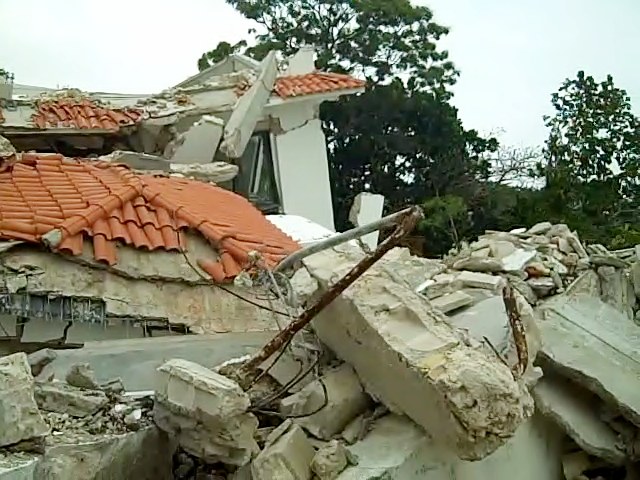
Quisqueya University after the quake. Photo: JDickson
This strength of character is rooted deep in Haiti’s heritage, based on a prolonged, violent struggle against slavery, then for independence and, in this century, against brutal regimes. African religious traditions combine with Christian missionary vestiges to forge a deeply spiritual people. These elements of a unique heritage are depicted in a vast, rich and diverse body of visual and performing arts, of libraries and archives. This art is a significant way of passing along to each generation their story as a nation and hence their identity.
The earthquake also struck these manifestations of Haitian identity. Cathedrals collapsed along with their murals. The national library, archives buildings and universities were destroyed. Art in private collections was lost.
Shortly after the earthquake struck, the image of postwar Iraq with looting and devastation of cultural and historic treasures mobilized an army of cultural experts around the globe. Smithsonian museum officials took the lead in this country to raise awareness. They were greeted with skepticism internationally as the heavy-handed Americans, but amidst the studies, conferences and promises, not much tangible was being done. Someone had to take the lead, and fortunately the Smithsonian, with its international reputation for excellence, persevered.
Not only did officials have to persevere internationally, but also against our own government. Recovery and restoration of cultural buildings and artifacts was not a priority, U.S. leadership in diplomatic, military and aid offices indicated. The Smithsonian led a coalition of concerned organizations to advance a relief and recovery effort for Haiti’s heritage. They put together a smart plan which not only restored and saved murals, paintings and artifacts, but also trained Haitians to do this very work, giving them employment in a wrecked economy.
How do you put a price or a priority on one’s identity? On one’s history? It is easier to attach such concepts to people’s emergency needs of health, food and shelter. Yet, what has really been important in seeing the nation through this crisis, is its heritage, its character of resilience and neighbor helping neighbor, in the absence of government or relief organization.
An interesting footnote to the Haitian anniversary came this week here in Washington following a much milder tremor last summer along the east coast. The only real damage to have taken place was sustained in the National Cathedral and the Washington Monument.
We as a country could not see our way to using public resources to restore our most recognizable feature on our capital landscape. This week, a billionaire equity magnate and lobbyist announced he was putting up the funding to fix the Washington Monument. The new Episcopal Bishop is seeking to raise private funding to restore the cathedral.
The U.S. earthquake proved, perhaps even more starkly, the Haitian and Iraqi experiences that the manifestations of a people’s heritage suffer in such natural and man-made disasters, and yet efforts to protect, preserve and restore evidence of a people’s contributions to human history are held in such low esteem.
If THESE Walls Could Talk
Posted by John Dickson in Berkshires, Colonial, History in our surroundings on October 26, 2011
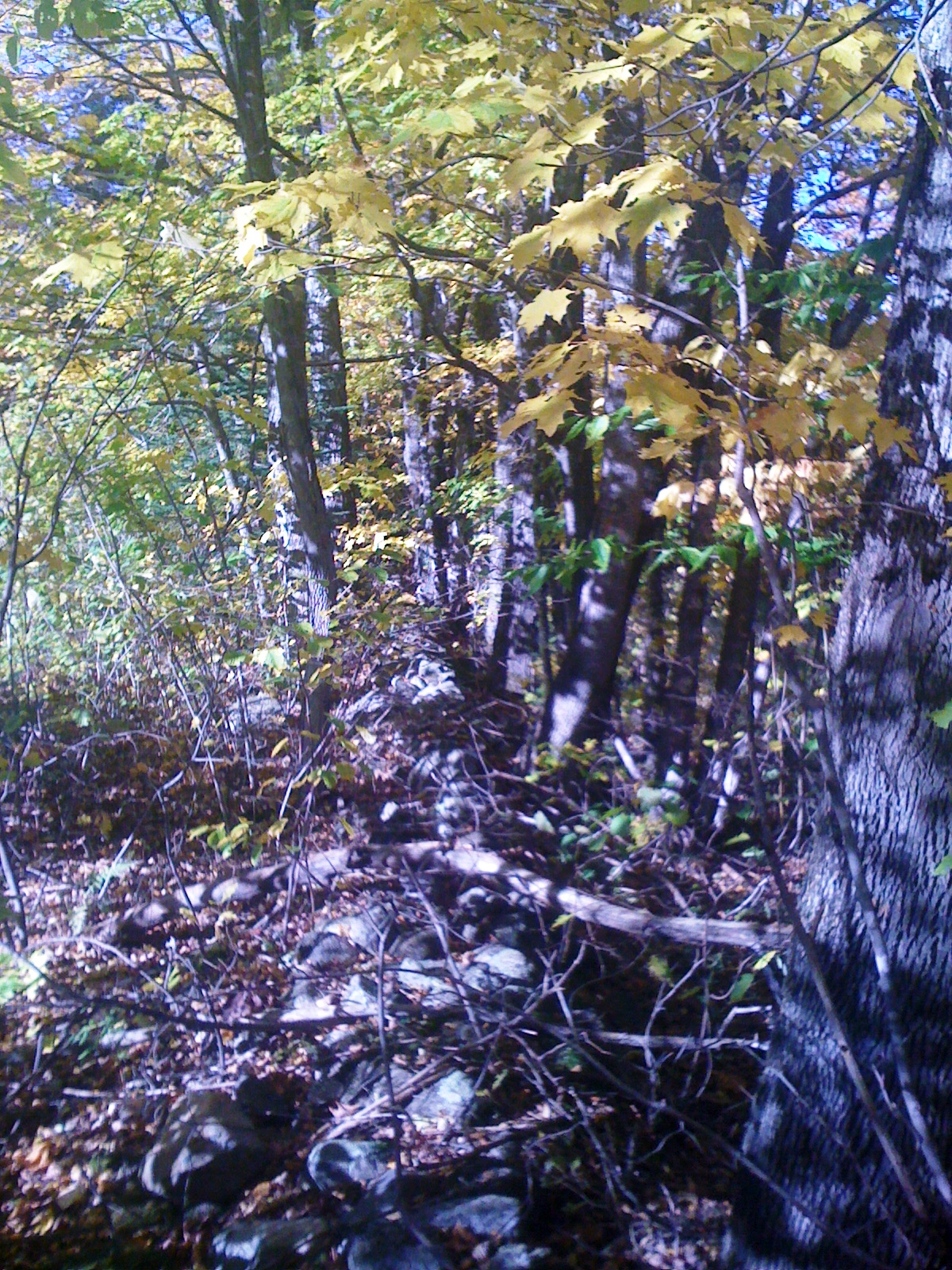
Can you find the stone wall? Photo JDickson
Walk in the woods almost anywhere in New England or drive along almost any road and you are likely to come across a stone wall. We take them for granted. We rarely pause to consider who built these walls, when were they built or even why.
Last summer, I did my own personal stone wall reenactment. I built a stone wall. Really it was just moving rocks which came out of the foundation for an addition on our house. I had the help of an excavator for three very large boulders. Other than that, it was a wheelbarrow and my own feeble arms carrying and placing these rocks. I got about to a length of about 30 feet and a height of 3 feet at most before I realized that I had bit off more than I could chew. While it looks nice, I have no illusions that it will last as long as the stone walls I saw recently walking up Mt. Greylock, or similar ones in the woods around Rangely Maine.
Several things leap to mind immediately on seeing these walls. First, they are now in the middle of woods. When they were built, they were most likely thrown together to demarcate fields and pastures. These thick woods were once pastures. How quickly have they reverted back to their natural state! These are small plots of farmland they mark off, probably accounting for why farming in this region lost out to the much larger, commercial and industrial farms of the MidWest.
Second, the walls go on and on, much longer than my miserable little 30 feet, extending along and breaking up 10 and 20 acre plots. This was a monumental exercise therefore, one which had to take place over many years. If one author estimated that it would take two men to lay 10 feet of stone wall in one day, why did it take me so long to go just 30 feet? Stone wall studies often cite an 1871 report undertaken by the Department of Agriculture, Statistics of Fences in the United States. There, it is estimated that Connecticut had 20,505 miles of walls, Massachusetts perhaps as much as 16,000 miles and New York 95,364 miles!! One author surmised that it would have taken 15,000 men 243 years to construct the stone walls in New York and New England. That may surpass the pyramids.
Next, just how many rocks could a farmer move from a field? He probably had help, in the form of oxen and wooden sliders, his sons, or tenant farmers or even slaves. The earth kept providing stones for the farmers to move, each winter would churn the earth to provide another crops of stones to be moved.
And, did he follow a technique that was widely accepted? The old adage of “one rock covering two and two rocks covering one” probably gave the wall its height, but not its broad width, without mortar? Perhaps, he just threw them in a pile.
These walls do speak. They take us back to a different life, a back-breaking life, of subsistence farming, of years of the same kind of drudgery, work with little change. And then it changed. Our human attempts to control our environment were in the end short-lived.
If These Walls Could Talk
Posted by John Dickson in Berkshires, Brown Signs, History in our surroundings on October 5, 2011
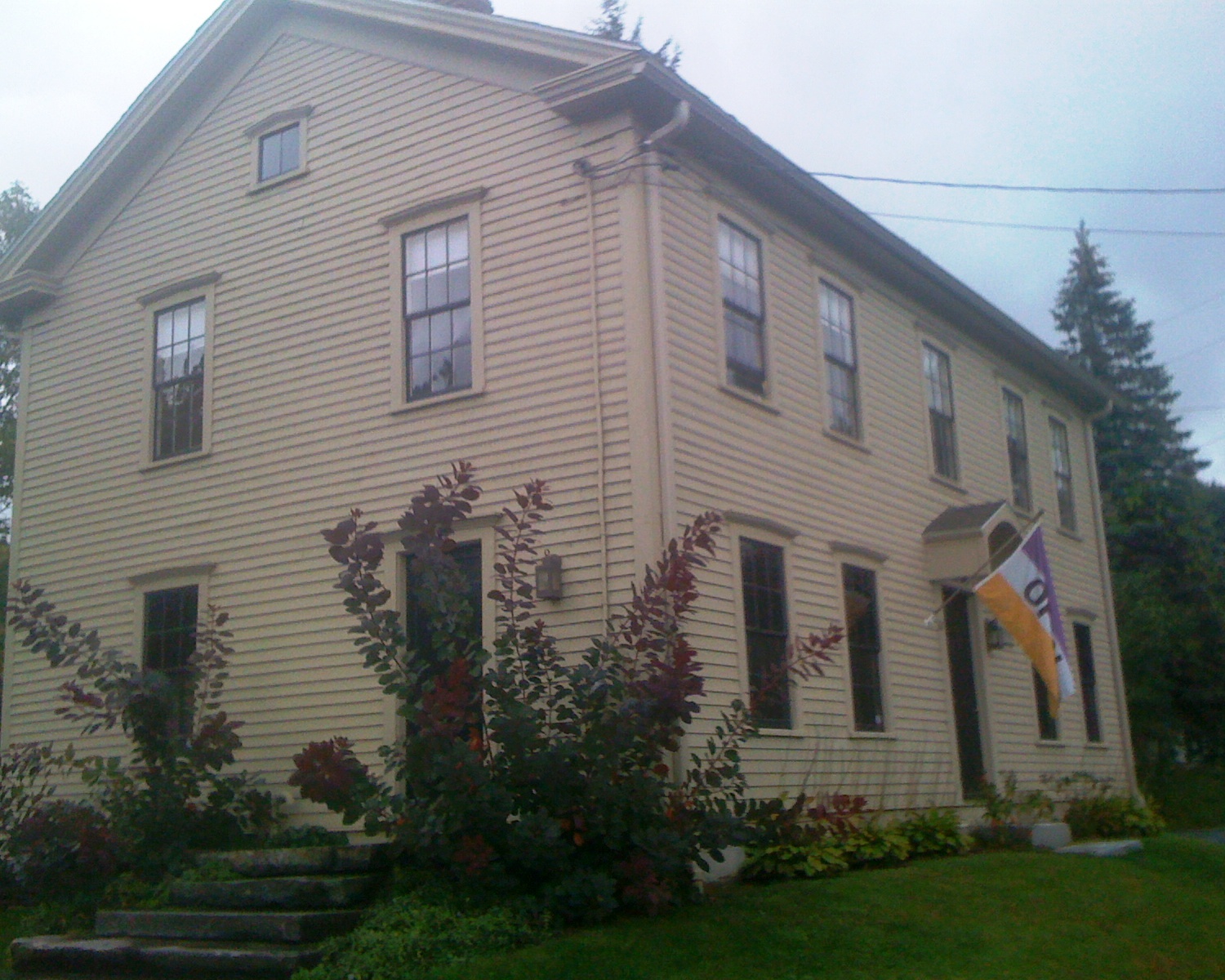
Susan B. Anthony Birthplace Museum. Photo: JDickson
Historic figures are sometimes connected with a place. Lincoln and Illinois. King and Atlanta. Jefferson and Virginia. Capone and Chicago.
Susan B. Anthony’s connection is probably upstate New York, especially as she is tied to the Seneca Falls Woman’s Rights Convention, held in 1848. It was in Adams, Massachusetts where she was born and where her birthplace home is now a small museum.
Anthony lived there until she was 6. The house, built by her father, is now a small museum and has been almost entirely restored, with attempts to make it as authentic to the 1820s period as possible. Wide floor boards; uneven lath and plaster walls. Two rectangular-shaped, small rooms lay adjacent to each side of a stairway up to a second floor with the same pattern of four rooms and a center hallway. Sounds a lot like a house my wife and I own, not 20 miles away, built a few years later.
Walking through Anthony’s birthplace home, visitors must wonder what it was inside those walls that contributed to young Susan developing into a committed, unbending woman’s rights, temperance and abolitionist reformer. Reformer may be too mild, as her newspaper was called “The Revolution.” She even had two brothers who joined anti-slavery crusades prior to the Civil War, traveling to Kansas to join John Brown in his violent activities opposing the expansion of slavery there.
Perhaps, it was her father’s Quaker pacifist, temperance beliefs. One can imagine growing up with family conversations surrounding her father’s decision to marry Lucy Read, a Baptist, and even referring to the injustice of having to apologize for marrying outside the Quaker meeting. (Betsy Ross, 50 years earlier and hundreds of miles further south, saw her sisters and experienced the shame herself as Quakers marrying outside the Meeting.)
Further, it is easy to see a possible impact coming from living with as many as a dozen young women who worked at her father’s mill, across the road. Imagine conversations the child Anthony might have had with or overheard from these young role models and mentors, focused on exhausting work, sharing their wages with families, looking ahead to lives as second-class citizens. Perhaps it was Anthony’s own experiences helping her mother cope with the feeding and care of all these boarders that contributed to her legendary organizing skills. It could have shaped her desire to get an education to avoid that kind of work, only to have a teacher deny her the opportunity to learn.
Still one more family anecdote had Anthony’s father selling liquor in the small store located in the front room of his house. Was his decision to abandon the sale of alcohol from his home at the insistence of his fellow Quakers behind Anthony’s embracing the temperance movement as one of three “causes” to which she devoted her life?
Anthony’s birthplace home is a humble house, compared to the grand-er restored mansions in Berkshire County which some of the country’s wealthiest built as summer escapes and now serve as shrines to the Gilded Age. But, her home serves another, perhaps more important, purpose besides trying to figure out her early influences. This home tells more closely the story of most residents eking out a living in the early 1800s in New England.
-
You are currently browsing the archives for the History in our surroundings category.

A memoir in letters. Excerpts from letters that a father wrote his children each week for almost 30 years, full of the mundane and poignant, the witty and wise. Stories from a different time, from a small town in Connecticut.
History Shock
 Pleased to announce the publication of my book in May 2021 by the University Press of Kansas. This collection of “stories with a history” narrates incidents over the course of my career in the Foreign Service when historical understanding – or lack of it – got in the way in the conduct of day-to-day diplomacy.
Berkshire County’s Industrial Heritage

Check out this book on the nineteenth century mills and those who owned and worked in them. Available through Arcadia Press or Amazon.
Slide Show – Getting to Yes, Woman Suffrage in the Berkshires and Beyond
-
Slide Show – Intersections, Pittsfield’s Neighborhoods
-
Slide Show – Turning Points


Slide Show – Preserving the old Berkshire Athenaeum
 Thomas Allen donated $50,000 to build the Athenaeum in 1876.
 A yong architect from New York, William Appleton Potter, had his design selected for the new Athenaeum.
 The original architectural drawing of the front elevation of the Athenaeum
 An early photo of the High Victorian Gothic building, pointed arches, twin gables, multi-color stone patterns,skylight, stained glass windows
 Majestic, quartered oak tresses in the addition built in 1896
 Proposed new library design, in 1944
 Bulging of stonework on from of building required drastic measures to shore up front, in 1979
 A restored skylight is returned to the roof in repairs undertaken in 2001
 Stained glass window on west gable, showing steel tie placed in 1979 stabilization repairs
 Masonry work begins on the Athenaeum in the deep of winter
 Removing the stained glass panels for repair
 Cracks in the masonry
 More cracks in the masonry
 Lifting the capstone off the east gable, the first stone removedd








 History All Around