Archive for category History in our surroundings
Predicting the future: Pope Francis, President Rouhani, Attorney General Holder
Posted by John Dickson in History ahead, History in our surroundings, International, Public Affairs on September 24, 2013
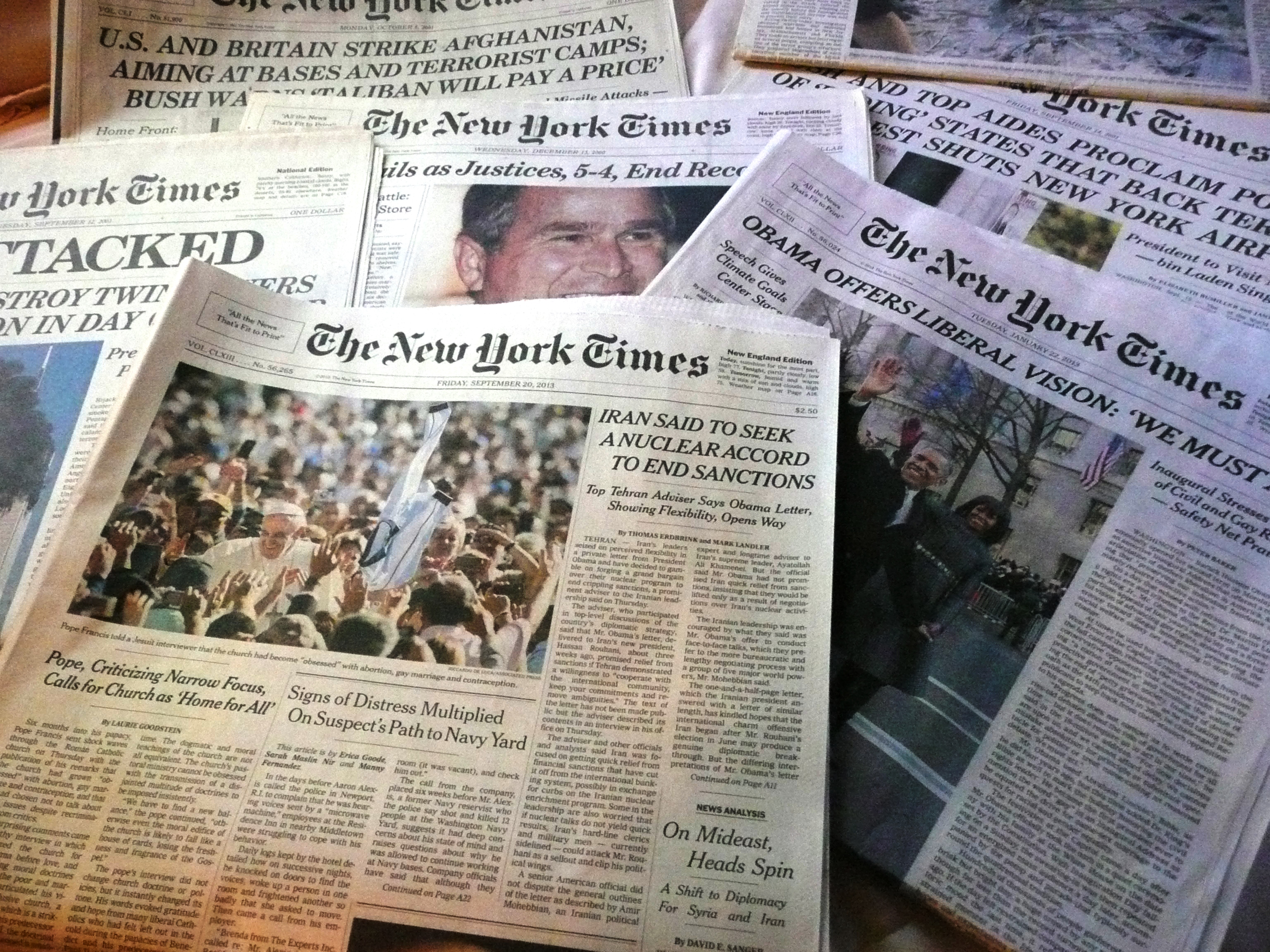 In a small trunk, here in my office are a select group of newspapers, saved because, at the time, they seemed to represent momentous events: 9/11, Bush v. Gore, death of Pope John Paul II, Watergate, impeachment of Clinton, fall of the Berlin Wall. All have across the top, large-print headlines. Today, I am adding to the collection the first which does not have the same bold typeset.
The paper on Friday, September 20, 2013 carried three separate stories, only two of them on the front page, which signaled what could be historic, transformational changes. It may be difficult to predict history, and my experiment here may ultimately fail, but these do seem like shifts which will alter the shape of slices of our history over the last 50 years.
First is what looks like may be a thaw in U.S. relations with Iran. The article, on the right hand columns of the New York Times, may only report the latest in a series of signals since the election in June of Iran’s new president, Rouhani. However, it reveals an exchange of letters between President Obama and President Rouhani exploring the possibility of direct negotiations between the two countries, who have not had diplomatic relations since the 1979 hostage crisis. The official who discussed the exchange of letters was a senior advisor to Iran’s supreme leader, Ayatollah Khamenei, seeming to indicate the latter’s acceptance with an opening.
Next is what looks like a re-direction of the Catholic Church’s social priorities. The new Pope Francis released the content of an interview he had given to a Jesuit Catholic journal in August where he pointed to a need for the church to be a “home for all.” He went on, charting a course for the Church to drop its “obsession” with abortion and contraception. On homosexuality, he asked an open-ended question wondering “when God looks at a gay person does He endorse the existence of this person with love, or reject and condemn this person?” Sounds a little like Jesus answering the efforts of the Pharisees to entrap him.
The third is the reversal of a policy of aggressive prosecution of drug crimes. The Attorney General Eric Holder gave a speech laying out the practical steps to reduce the extended sentencing of lower level drug crimes. Those harsh, often mandatory, sentencing rules have been enacted in various U.S. jurisdictions since the 1970s, the most well-known being California’s “three-strikes” provision in 1994. While changing the 1984 federal anti-drug act would require Congressional approval, Holder has instructed prosecutors to take steps in implementing the law, like not indicating the amount of drugs possessed by the accused. This would avoid triggering the automatic mandatory sentence.
Friday’s paper was not the first indication of any of these transformational shifts: the new Pope had indicated as early as his installment his concern for the poor as a fundamental focus for the church; the Iran’s President Rouhani had been sending signals of accommodation with the West since his election; and Attorney General Holder in August announced his decision to review sentencing guidelines.
Also, despite the important role played by each of the three individuals, pressure had been building for some time in each area to force the decisions each have taken. Sanctions aimed at Iran’s atomic weapons program are hurting the general population. Catholics are leaving the church, and important constituencies in the Democratic Party have latched on to overcrowding and disparate treatment between racial groups in sentencing to push for these changes.
Neither are these three pronouncements yet set on a straight, direct course towards fulfillment. In their infancy, each can be reversed, and it is more than likely that they will proceed on meandering paths in pursuit of the goals elaborated. Some accuse Iran of stalling, of engaging in a public relations campaign, to delay further international condemnation. The articles point to the Pope moving beyond the traditional power structure in the Vatican, and Congress can easily step in and halt any changes in Holder’s sentencing proposals.
Still, they each represent what could be fundamental changes. Comparisons to past historic transformational figures like Gorbachev, Sadat or Pope John Paul II are in the air. It is enough to make me add this front page to my small collection.
But before I do, my eye catches a fourth article, below the fold in Friday’s edition of the New York Times. This one reports on a resurgence of the textile industry in the U.S., one that is heavily automated, with many fewer workers, but one which would reduce the cost of transportation, as well as the potential for terrible tragedies like the collapse of a textile factory in Bangladesh. Maybe, just maybe, it is this one which foretells the most consequential shift, one that would have a greater impact in the daily lives of people around the globe.
The day the last mill closed
Posted by John Dickson in Berkshires, History in our surroundings, Personal memory on August 14, 2013
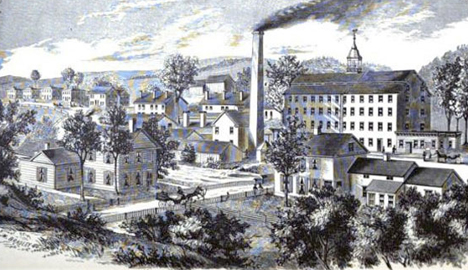
An engraving of the mill complex from an 1876 history of the city
The announcement did not make it on to the front page of the newspaper, but it should have. The final woolen mill in Pittsfield was closing. It was the longest continuous running woolen mill operation in a city which had once boasted 11 textile mills, leading a county which produced more wool than any other in the country.
It was October 26, 1963, when it was known as Wyandotte Mill. Over 100 workers walked and drove across the small bridges over the uppermost reaches of the Housatonic River that had once powered its predecessor, Pontoosuc Woolen Mill. It was not quite 140 years since that mill had been built, on the site of Keeler’s saw mill.
The story of Pontoosuc Woolen Mill tells the story of the county. It was the brainchild of Henry Shaw, the representative for the county in the U.S. Congress who hailed from Lanesborough. In politics that sounds more like our current Congress, Shaw had helped Henry Clay pass the Tariff of 1824, which placed large taxes on imported wool from England, thereby opening up a market for domestic wool. Shaw moved quickly on such an opportunity and brought together a group of investors to finance the purchase of the property and the construction of the original mill building, which is still standing today.
Pontoosuc was not the first mill in the county, but the site it was built on housed a workshop of Arthur Scholfield, a recent immigrant from England who snuck out of his home country with models of and experience in the new machinery of spinning wool. The English were desperate to prevent the loss of this know-how and hold on to their manufacturing advantage, but had already lost cotton processing technology through another emigrant, Samuel Slater, who helped build the first mills in the country in Rhode Island and Massachusetts.
Scholfield, who left England in 1793, moved north along the Housatonic, through Connecticut, and ended up in Pittsfield in 1800. Here, he built the first machine to card wool, a process of cleaning and preparing the cut wool. Since his machinery could complete the process several times faster than hand carding, he initially had a small operation to sell the cleaned wool to private individuals, spinning and weaving out of their homes. Scholfield then left woolen manufacturing and set up a small operation to build the machines to process wool, selling his equipment around the region. His special tooth-cutting machine was installed in the attic of Keeler’s saw mill at the southern tip of Pontoosuc Lake.
Scholfield’s inventions and the new protective tariff combined with the introduction of a new brand of sheep from Spain – merino – and the beginnings of an immigrant work force to bring all the variables together for the flourishing of industry which saw Pittsfield start the transition from an agricultural society to a center of manufacturing. Pontoosuc Woolen Mill initially employed 100 workers, a little less than half of whom were women and children. By mid-century, the mill had built a store, homes, townhouses and boarding houses for a growing workforce which would reach 500 employees by the 20th century.
The list of owners and managers over the course of the 19th century reads like a Who’s Who of Pittsfield. Besides Shaw, whose son took the pen name of Josh Billings and avoided the wool business for humor, names like Clapp and Kellogg, Campbell, Frances and Plunkett still grace the city’s streets, parks and schools. These individuals helped move the city forward on a path of progress which included setting up the first fire company (owing to the risk of fire in the mills,) and the first trolley (which ran from the city center to, you guessed it, Pontoosuc Lake.) Pittsfield’s first telephone call was place at Pontoosuc Woolen Mill, to a bank on North Street.
The mill filled the huge demand for kilt-like balmoral skirts and carriage blankets. When cotton became scarce during the Civil War, the demand for woolen textiles increased, creating enough demand for yet another woolen mill which opened in Pittsfield in 1863. Following the war, cotton production returned and the first mills in the city began to close. Pontoosuc Woolen Mill was able to keep open into the 20th century with lucrative government contracts, including the manufacture of military blankets during the first world war. A Maine firm bought the mill in 1928, just after its centennial, changing the name to Wyandotte Mill.
The Depression hit the wool industry hard with the closing of 4 rival mills in the 1930s. Gradually, new competition from England, caused production to start shifting south to reduce costs of labor. By the time of the second war, 100% cotton and wool textiles were replaced by synthetic fibers, further reducing demand. By the 1950s, just three mills in Pittsfield were still open. Wyandotte managed to stay afloat through production of woolen cloth which was distributed around the world as raw material for other factories to produce the finished products of clothing and blankets.
Organized labor had come to Wyandotte shortly after its purchase of the mill. By the 1930s Wyandotte Pittsfield workers joined a month-long textile strike in 1934 in 20 states. It was at the end of the Depression in 1939 that the Textile Workers Union of America organized Wyandotte. Additional labor actions took place following the Depression and the war when Wyandotte workers at all three of their mills struck in 1951 over the failure to make a pay raise retroactive. A few years later, when Wyandotte re-negotiated their contract, it included a far-reaching provision for equal pay for equal work by women. A general strike took place at Wyandotte in 1954, but the weakness of unions in mid-century America can be seen in the rehiring of only 50 of the 475 workers previously employed. In 1962, workers through the TWUA had signed a new contract with a wage increase. That same year, a new management team came to Pittsfield. Both the new contract and new leadership may have been part of a last ditch attempt to keep the mill open, but they failed; by October the mill had produced its last wool.
Today, the complex is home to a number of small businesses; neighboring buildings that once were stores, homes and boarding houses survive but are townhouses, a restaurant, single family homes and a homeless shelter. The canal through which ran a current of water strong enough to power the looms and machines has been diverted and covered over. Elevated walkways have been torn down, windows boarded to prevent vandals from breaking glass. What remains, though, is a brick monument, tall, solid and imposing and certain to outlive the prefabricated materials of modern box stores and warehouses and factories. It’s right there, hidden in plain sight and joined by 11 other mills across the city.
This Old Barn, Really Old
Posted by John Dickson in Berkshires, History in our surroundings, Preservation, Public History on May 15, 2013
I don’t know which was more impressive, the two timber-frame barns being preserved and re-assembled or the massive airplane hangar of a workshop enclosing them. Of course, the two barns take precedence, since one of them may be the nation’s oldest barn, dating as far back as the 1690s. Still, I couldn’t stop looking at the features of the workshop: the two sides of window/doors which could slide open to remove structures as big as a barn or the rack of mechanical pulleys and cranes on guides running the length of the workshop.
That structure was owned by a contractor who specializes in restoration, a middle-aged man wearing a polo shirt and khakis named David Lanoue. He recently opened up his workshop in Great Barrington Massachusetts to the public, who came to see the work in progress on the old barns and hear from those involved in the work.
At that moment, the contracting crew of 15 interspersed in the crowd, but recognizable in their matching polo shirts, had assembled the roof of the newer barn. By newer I mean late 1700s. The end side of the older barn stood next to the roof. Laid out horizontally on workhorses were other large, tapered beams belonging to the older barn, so people could see the extent of the restoration process.
An architect who specializes in timber frames spoke to the philosophy guiding the restoration. Looking like a farmer, wearing a Quaker-like hat, Jack Sobon emerged from the audience with little of the pretensions that he could claim from his having authored several books on timber frame construction and spent most of his life immersed in the subject. His manner was professorial, but he was teaching not only to the many carpenters and contractors in the workshop, but to those of us less familiar.
Sobon, a consultant to Lanoue’s project, indicated that cost and time dictate the philosophy. Pointing to the various pieces of lumber stacked in rows around the room, he indicated that, under normal circumstances, restorers would have discarded much of the old wood. Instead, since Lanoue knew he was working on what could be the oldest barn in the country, he has adopted an approach to save as much of the old wood as possible, regardless of cost. So, rotted wood has been caringly replaced with white oak pieces, carefully cut to match the sections taken from the old beams.

Can you see two barns?
Photo: JDickson
There was another philosophy that Sobon kept referring to, as he discussed the detective work undertaken on the original builders. Time and again, decisions made by New England builders in the 17th and 18th century were based on what was easy and what cost the least. Some old barns were built with no foundation, with corner beams dug right into the ground. Why? It was quicker and easier than digging and laying a stone foundation. He explained the assembling of the sides and the corner joints, creatively designed so the original measuring and laying out of the pieces could be done, lying flat on the ground.
What became clear as both Lanoue and Sobon talked was their fluency in a different language. Terms like bends, bays, sills and joists fell easily from their lips but landed hard on the novice’s ears. Not only was the vocabulary new, but so was the ability to see words in all three of their dimensions, particularly evident when Sobon was talking about the corner joints, even with the model he brought to explain it. Here I learned I had wasted my life doing history and international relations.
What will Lanoue do with these barns? He spoke of interest from private collectors, but I sure hope the Smithsonian is interested. They have the room in either the Building Museum or the American History Museum in Washington to house such a treasure. What a treat it was, in this quiet corner of western Massachusetts to see work of such importance to the whole nation.
Sim City in Reverse: The House at 276 South Street
Posted by John Dickson in Berkshires, History in our surroundings, Public History on February 15, 2013
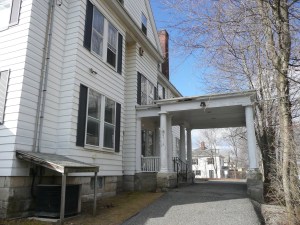
Tear down?
Photo: JDickson
The house, while not falling down, is in disrepair. The aluminum siding is bending off and has lost its luster. The chips in the concrete steps need a sweeping, and the iron pipe railing is rusting. The low roof lines on the one-story additions now look awkward, like a trailer added to the original Gilded Age-almost mansion. The renovations which were new and innovative and clean in the 1970s show their age. This house just got its demolition orders, approved by the local historical commission as not having historic significance.
They are most likely right, since no one famous lived here, or nothing transformational happened here, or it does not represent broader significant building styles. It does, though, reflect the history of the city, catching the rise, riding the good times, and then sharing the hard times. Reading the house and its inhabitants tells of industries coming and mostly going away. It tells of adapting to new circumstances, even in its demolition.
Think of it as one small graphic icon, on a SimCity computer game, a historic one, which shows how events and trends in one part of the city, or even the nation impact a single house. The game allows its players to build a city, giving them a pot of money to make adjustments and watch a city grow. Add a road, or an industry, or a new electric plant, and watch the city respond. Watch a single property respond.
Built in 1894, at the top of the plateau heading into the current historic central district, the house at 276 South Street joined a rapidly growing city. Pittsfield had just achieved municipal status three years prior, and it was about to go through a twenty-five year period as the second fastest growing municipality in Massachusetts. SimCity houses and factories popping up all over, as the city expanded in all four directions. Population grew from 17,252 to 39,607. Houses increased from 2,735 to 6,022.
SimCity would have shown by mid-century the Berkshire Medical Institute, a training facility just across South Street in operation since 1823. Surrounded by undeveloped lands, the irony of this medical anchor to the south end of town becomes evident only when 276 South Street converts to medical offices in 1956. But, we get ahead of ourselves since, the Medical Institute changed to a high school by 1876, and then, reverted to residences by the time 276 was built.
The house was built in a Gilded Age style, without the Victorian trappings which reflect other mansions of the truly wealthy as summer homes of New Yorkers and Boston Brahmins who were building elsewhere in the Berkshires in the same era. Its three stories above ground, hip roof joining gable fronts on three sides, and a pillared carriage porch at the front door smell of wealth, but not quite as grand as Edith Wharton’s Mount, just a few miles down the road.
The first owner was also an out-of-towner, a Robert G. Johnston affiliated with the Saratoga Star Spring Company in New York. The house lay on the main thoroughfare entering Pittsfield from points south, and an electric trolley rolled by the house. That may have been what drew its next owner in 1904, Samuel G. Colt, an engineer employed at various places over the ten years he owned the house, presumably jumping on the trolley to make his way as far as Cheshire where he was employed briefly. Or, since he was the grandson of one of the town’s paper mill owners, whose family owned property on the other side of South Street, he may have had the resources to purchase an automobile by then.
SimCity would show the impact of a trolley and car as houses pushed out further and further from the city center. It would also show for the first time, just before Colt moved to 276 South, the arrival of General Electric in Pittsfield, which purchased Stanley Electric, gradually becoming over the next century the preeminent industry, employer and polluter in the region.
The next owner, Cornelius Wright bought the house in 1912, and, when he died, his widow Lydia lived there until she died in 1948. By then, the trolley had disappeared, with the last rails dug up for scrap metal during World War II. For the next 7 years, the building belonged to three different owners, but was listed in city directories as a rooming house, called The Chateau. Buses had replaced the trolleys, making it convenient for boarders to get to work. Or, perhaps these boarders were in the city for too short a time, as there were no names listed in city directories. That suggests that these boarders were here on summer holidays, the first wave of automobile vacationers taking in the activities at the Colonial Theater just blocks away, or at Tanglewood, which had opened in 1940. Even winter boarders may have come for a weekend of skiing at Bosquet, which opened in 1932.
Then, on our SimCity game, we’d see the graphic house icon house change colors, converted to a medical office building, with offices for five doctors in 1956. This could have reflected the growing demand for doctors, fueled the baby boom of the 50s and 60s and the growth of industry, led by General Electric. Population had grown to over 50,000, and GE employed as many as 13,000. This growth and ethnic demographics of a city with a large Italian and Irish descendent population also led to the building of St. Theresa’s Catholic Church, next door.
By the 70s, the main house no longer sufficed. For three years after 1979, renovations were undertaken to add doctors’ offices on the inside of the main building, including changes to the spaces inside and a one-story addition built on to the side and rear of the main building to house the medical offices. Lawn was taken over as a parking lot to accommodate the patients who came to the 14 different offices housed in the facility.
One of these doctors eventually came to own the building, and he sold the property in 2011 to Berkshire Place, a retirement/nursing home in operation since 1888, just a few years before 276 was built, just a few hundred yards closer to the city center. Berkshire Place also bought St. Theresa’s next door, which had closed its doors in 2008, along with six other parishes in the county. An expanded nursing home facility brings witness to a declining church attendance nationally and an aging local population, catering as well perhaps to people who vacationed here and came back for quality-of-life retirement. That would be me.
So, does this property rise to the level of historic significance? Probably not, still. Certainly not any more so than most houses, which, like the rings of a tree, help us read broader trends and changes. Time to log off SimCity, and start a new game.
Making History
Posted by John Dickson in History in our surroundings, Public Affairs on January 24, 2013
In 2011, when referring to his approach to the uprising in Egypt, President Obama noted that “History will end up recording that….. we were on the right side of history.” He could have been anticipating his second inaugural speech this week, when he was on both sides of history, both making it and wrapping himself in several American historic traditions.
History permeated the ceremony. First of all, he adhered to his Constitutional requirements by having a private swearing-in ceremony on January 20 (as stipulated by the 20th Amendment). However, he embraced our civil rights history by shifting the public ceremony to coincide with the Martin Luther King holiday. He used two bibles in taking the oath, belonging to Dr. King and Abraham Lincoln. The two bibles evoked the history of this year, marking not only the 150th anniversary of the Emancipation Proclamation but also the 50th anniversary of Dr. King’s March on Washington, this coming August.
His speech, like many inaugural addresses, recalled the founding documents of the nation, using their language of “we the people,” “liberty” and “equality,” repeatedly. He referred to the skepticism of central government and called us to remain true to our forebears and act as “pioneers.” He mined those documents to placate his adversaries on the right, but also to call to action those who supported his re-election.
Still, more than any other modern President, Obama makes history. As the first American of African descent to hold the office and to be re-elected to the office, every day he presides over the nation he is making history, whether he is the first President to win the Nobel Peace Prize in his first year of office, the first President from Hawaii or the first to sing Al Green and play basketball in the White House.
Much has been made of his reference to Seneca Falls, Selma and Stonewall, three places which carry deep symbolism for women, African-Americans and gays in their struggle for inclusion in the promise of liberty and equality in America. He made history by being the first President not only to use the word “gay” in an inaugural, but also to echo the appeal for equality in marriage.
These references, coupled with his remarks related to immigrants, underscored a more important historic transformation in the political composition which carried Obama to victory. While not the first to see the coalition taking shape, he is the first to ride the new Democratic coalition of minorities, women, gays and their progressive supporters of all shades and persuasions to two Presidential victories. It is a new Democratic coalition, emerging from the remnants of FDR’s coalition of labor lower and middle classes which had shifted on the issue of race towards the Republicans beginning in the 1960s and solidly in the 1980s era of Ronald Reagan.
It is a new coalition, principally because of the change in the way Americans view gay rights. As recently as 2004, reluctance to accept equal rights for gays could have been enough to tip the balance against the Democratic Senator from Massachusetts which had the only gay marriage law in the country at the time.
That this coalition is new as well as enduring is underscored by the dramatic change in attitude by Republicans who sensed hours after the November election results were in that they needed to reappraise their approach towards immigration.
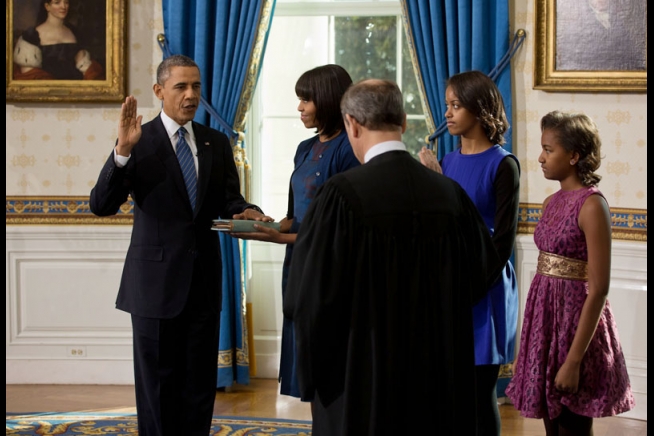
Photo: L. Jackson, White House
President Obama is aware of his role in making history, each time he refers to being on its “right side.” His reference in his inaugural speech to acting for “posterity” means that he will continue make history in this second term. The White House web page right now has a pop-up, extolling his coalition to “Help ake history.”
He can’t help it. He makes history every day, just by getting up and going to work.
-
You are currently browsing the archives for the History in our surroundings category.

A memoir in letters. Excerpts from letters that a father wrote his children each week for almost 30 years, full of the mundane and poignant, the witty and wise. Stories from a different time, from a small town in Connecticut.
History Shock
 Pleased to announce the publication of my book in May 2021 by the University Press of Kansas. This collection of “stories with a history” narrates incidents over the course of my career in the Foreign Service when historical understanding – or lack of it – got in the way in the conduct of day-to-day diplomacy.
Berkshire County’s Industrial Heritage

Check out this book on the nineteenth century mills and those who owned and worked in them. Available through Arcadia Press or Amazon.
Slide Show – Getting to Yes, Woman Suffrage in the Berkshires and Beyond
-
Slide Show – Intersections, Pittsfield’s Neighborhoods
-
Slide Show – Turning Points


Slide Show – Preserving the old Berkshire Athenaeum
 Thomas Allen donated $50,000 to build the Athenaeum in 1876.
 A yong architect from New York, William Appleton Potter, had his design selected for the new Athenaeum.
 The original architectural drawing of the front elevation of the Athenaeum
 An early photo of the High Victorian Gothic building, pointed arches, twin gables, multi-color stone patterns,skylight, stained glass windows
 Majestic, quartered oak tresses in the addition built in 1896
 Proposed new library design, in 1944
 Bulging of stonework on from of building required drastic measures to shore up front, in 1979
 A restored skylight is returned to the roof in repairs undertaken in 2001
 Stained glass window on west gable, showing steel tie placed in 1979 stabilization repairs
 Masonry work begins on the Athenaeum in the deep of winter
 Removing the stained glass panels for repair
 Cracks in the masonry
 More cracks in the masonry
 Lifting the capstone off the east gable, the first stone removedd








 History All Around