This Old Barn, Really Old
Posted by John Dickson in Berkshires, History in our surroundings, Preservation, Public History on May 15, 2013
I don’t know which was more impressive, the two timber-frame barns being preserved and re-assembled or the massive airplane hangar of a workshop enclosing them. Of course, the two barns take precedence, since one of them may be the nation’s oldest barn, dating as far back as the 1690s. Still, I couldn’t stop looking at the features of the workshop: the two sides of window/doors which could slide open to remove structures as big as a barn or the rack of mechanical pulleys and cranes on guides running the length of the workshop.
That structure was owned by a contractor who specializes in restoration, a middle-aged man wearing a polo shirt and khakis named David Lanoue. He recently opened up his workshop in Great Barrington Massachusetts to the public, who came to see the work in progress on the old barns and hear from those involved in the work.
At that moment, the contracting crew of 15 interspersed in the crowd, but recognizable in their matching polo shirts, had assembled the roof of the newer barn. By newer I mean late 1700s. The end side of the older barn stood next to the roof. Laid out horizontally on workhorses were other large, tapered beams belonging to the older barn, so people could see the extent of the restoration process.
An architect who specializes in timber frames spoke to the philosophy guiding the restoration. Looking like a farmer, wearing a Quaker-like hat, Jack Sobon emerged from the audience with little of the pretensions that he could claim from his having authored several books on timber frame construction and spent most of his life immersed in the subject. His manner was professorial, but he was teaching not only to the many carpenters and contractors in the workshop, but to those of us less familiar.
Sobon, a consultant to Lanoue’s project, indicated that cost and time dictate the philosophy. Pointing to the various pieces of lumber stacked in rows around the room, he indicated that, under normal circumstances, restorers would have discarded much of the old wood. Instead, since Lanoue knew he was working on what could be the oldest barn in the country, he has adopted an approach to save as much of the old wood as possible, regardless of cost. So, rotted wood has been caringly replaced with white oak pieces, carefully cut to match the sections taken from the old beams.

Can you see two barns?
Photo: JDickson
There was another philosophy that Sobon kept referring to, as he discussed the detective work undertaken on the original builders. Time and again, decisions made by New England builders in the 17th and 18th century were based on what was easy and what cost the least. Some old barns were built with no foundation, with corner beams dug right into the ground. Why? It was quicker and easier than digging and laying a stone foundation. He explained the assembling of the sides and the corner joints, creatively designed so the original measuring and laying out of the pieces could be done, lying flat on the ground.
What became clear as both Lanoue and Sobon talked was their fluency in a different language. Terms like bends, bays, sills and joists fell easily from their lips but landed hard on the novice’s ears. Not only was the vocabulary new, but so was the ability to see words in all three of their dimensions, particularly evident when Sobon was talking about the corner joints, even with the model he brought to explain it. Here I learned I had wasted my life doing history and international relations.
What will Lanoue do with these barns? He spoke of interest from private collectors, but I sure hope the Smithsonian is interested. They have the room in either the Building Museum or the American History Museum in Washington to house such a treasure. What a treat it was, in this quiet corner of western Massachusetts to see work of such importance to the whole nation.
When did we burn Toronto?
Posted by John Dickson in International, Public History on April 27, 2013
Here’s a history quiz: When did U.S. soldiers raze the city of Toronto?
a) Never
b) I don’t know, or I don’t care
c) April 27, 1813
If you chose the first, you would be right, since without even pointing out that it wasn’t really a city, U.S. soldiers burned a settlement, then known as York. But we did burn it to the ground, nonetheless, and it was re-built and then renamed Toronto 20 years later.
If you chose the second, you might be right as well, possibly shrugging your shoulders out of indifference, but more likely in disbelief that the United States ever burned the capital of what was then Upper Canada (as distinct from, you guessed it, Lower Canada, both named for the geographic location on the St. Lawrence.)
The last answer, though, is the correct one: 200 years ago, on April 27, 1813. I probably would have given either of the first two answers, and I used to teach U.S. history, and specifically the War of 1812, during which this attack occurred.
Sure, I taught the fact that the British burned down the White House and other parts of Washington DC, in 1814. Many remember enough history to know of Dolly Madison saving the portrait of George Washington with the White House in flames. More well-known is the attack weeks later on Ft. McHenry in Baltimore when a young Frances Scott Key saw the flag following a night of bombardment, so moved that he penned what would become our national anthem. Part of the lore from that war was Andrew Jackson’s victory over the British at the Battle of New Orleans, weeks after a peace treaty had been signed in Paris.
But, the fact that the U.S. burned and looted York never came up. It didn’t come up even in the context that the British attack on Washington came a year later was in retaliation for York. We don’t remember, but you know who does.
Canada. In fact, Canada is remembering that war in a national way, with a fair amount of controversy (with the accent over the second syllable up north: con-TRA-ve-see.) Canada wasn’t even a country then, but still part of British Colonial America. It wouldn’t become independent until 1867, and even then it maintained its ties to the British Monarchy, to this day still the head of government in Canada.
The conscious choice to commemorate that war stems not from the fact that it repelled U.S. war aims of extending the northern border (OK maybe a little.) Rather, Canadians see this war more as a critical step in the establishment of their nation. Since there was no rebellion against the British, no Declaration of Independence, Canadians have little in the founding of their nation in 1867 to unify them. So, they have decided that their country might see the bicentennial of this war, as a commemoration to instill national pride, rather than their language, or their province and region, or even their affiliation with the part of the “states” which lay across the border. If you think that doesn’t exist, did you know that the Premier of Nova Scotia had, within hours of the attack on the Boston Marathon, pledged $50,000 to Boston Children’s Hospital?
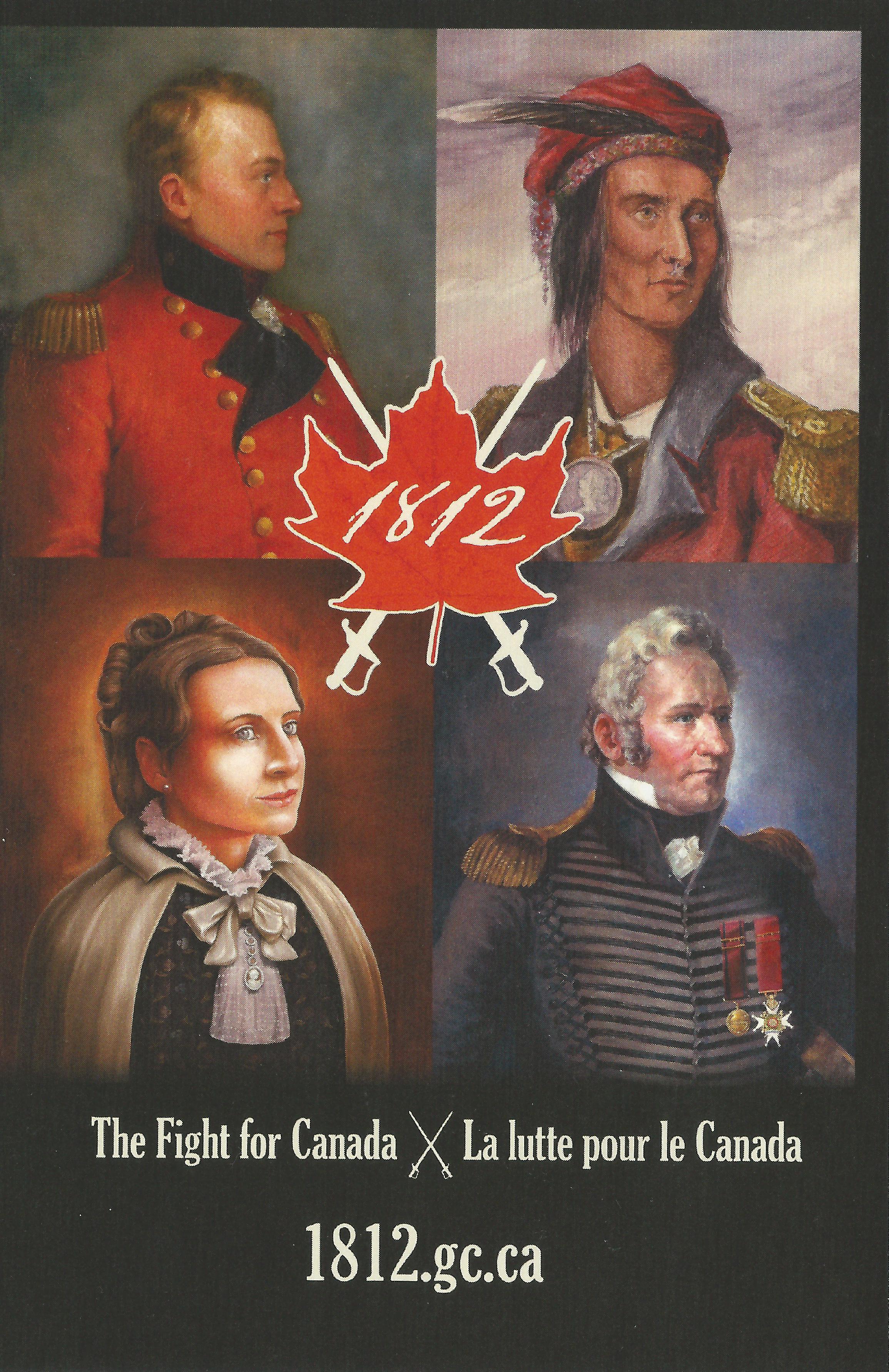
Four Canadian Heroes of War of 1812. Photo: Government of Canada
The controversy with the commemoration lies in the Federal Government setting aside $28 million for public commemorations, a sum deemed too large and even frivolous in a recession. The money has been set aside for commemorative events, for museum exhibitions, for media publicity. The official emblem of the bicentennial speaks to the desire to unify the country. It is a seal with four heroes from the war: a British General, a French-Canadian officer, a woman who warned the British troops of an attack, and a Shawnee chief. (Guess the names; they are listed below.)
What’s striking is the contrast with the commemoration in the U.S. of the War of 1812. What commemoration? New York Governor Andrew Cuomo vetoed any appropriation for marking the bicentennial, but a few states did approve spending, and as is normally done on this side of the border, there is more private than public funding. Still, it would not be surprising if most have seen nothing related the War of 1812 these past two years.
The Canadians are choosing to remember, and we have chosen to forget. The U.S. Consul General in Toronto can’t forget. He will attend the official ceremony marking the bicentennial of the attack on York. Care to join him, facing the Canadians who remember that attack?
(From upper right corner, clockwise: Major General Sir Isaac Brock, French officer Charles de Salaberry, Laura Secord, and Tecumseh)
Sequester them
Posted by John Dickson in Public Affairs, Public History on March 3, 2013
When Congressional Republicans shut down the government in 1995, it was the closing of the national parks which seemed to draw public attention to the impact of the budget impasse. In fact, the outcome did result in the temporary closing of 368 park sites and a loss of an estimated 7 million visitors, with local communities bearing the loss of tourism dollars, according to a Congressional Research Service report.
The recurring budget crises in Washington this year also raise the specter of potential impact on the parks. Why pick on the parks? Sure, they are symbolic, and easy for the general public to understand. Certainly easier to understand than some indecipherable federal program, buried in any one of dozens of federal agencies. Further, as a symbol, they project our common heritage, the best of our history of our land, of what holds us together as a nation. The argument is that these impacts affect what we hold dearest.
Or do we? For those serious about the size of government, the dire consequence of closing the parks may not seem so dire after all. It’s not hard to imagine a Tea Partier reacting with a big shrug to the fact that some retirees may have to change vacation plans because of the shutdown. Or, one of those big political funders in the 1% is probably yawning, preferring to preserve their special tax loopholes, when they could probably buy out any number of the parks they threaten to shut down.
Why not pick on something that would that would really hurt those bringing about this impasse? Here’s a suggestion: identify all those earmarked special interest programs and cut those first.
Or, furlough first Members of Congress and their staffs, since their impasse shows they’re not doing anything anyway.
For more read: http://www.nytimes.com/2013/03/02/us/politics/a-monument-to-a-long-tradition-of-budget-brinkmanship.html
Sim City in Reverse: The House at 276 South Street
Posted by John Dickson in Berkshires, History in our surroundings, Public History on February 15, 2013
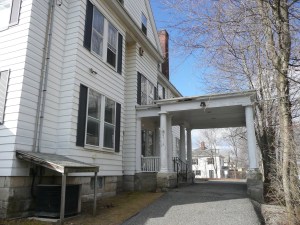
Tear down?
Photo: JDickson
The house, while not falling down, is in disrepair. The aluminum siding is bending off and has lost its luster. The chips in the concrete steps need a sweeping, and the iron pipe railing is rusting. The low roof lines on the one-story additions now look awkward, like a trailer added to the original Gilded Age-almost mansion. The renovations which were new and innovative and clean in the 1970s show their age. This house just got its demolition orders, approved by the local historical commission as not having historic significance.
They are most likely right, since no one famous lived here, or nothing transformational happened here, or it does not represent broader significant building styles. It does, though, reflect the history of the city, catching the rise, riding the good times, and then sharing the hard times. Reading the house and its inhabitants tells of industries coming and mostly going away. It tells of adapting to new circumstances, even in its demolition.
Think of it as one small graphic icon, on a SimCity computer game, a historic one, which shows how events and trends in one part of the city, or even the nation impact a single house. The game allows its players to build a city, giving them a pot of money to make adjustments and watch a city grow. Add a road, or an industry, or a new electric plant, and watch the city respond. Watch a single property respond.
Built in 1894, at the top of the plateau heading into the current historic central district, the house at 276 South Street joined a rapidly growing city. Pittsfield had just achieved municipal status three years prior, and it was about to go through a twenty-five year period as the second fastest growing municipality in Massachusetts. SimCity houses and factories popping up all over, as the city expanded in all four directions. Population grew from 17,252 to 39,607. Houses increased from 2,735 to 6,022.
SimCity would have shown by mid-century the Berkshire Medical Institute, a training facility just across South Street in operation since 1823. Surrounded by undeveloped lands, the irony of this medical anchor to the south end of town becomes evident only when 276 South Street converts to medical offices in 1956. But, we get ahead of ourselves since, the Medical Institute changed to a high school by 1876, and then, reverted to residences by the time 276 was built.
The house was built in a Gilded Age style, without the Victorian trappings which reflect other mansions of the truly wealthy as summer homes of New Yorkers and Boston Brahmins who were building elsewhere in the Berkshires in the same era. Its three stories above ground, hip roof joining gable fronts on three sides, and a pillared carriage porch at the front door smell of wealth, but not quite as grand as Edith Wharton’s Mount, just a few miles down the road.
The first owner was also an out-of-towner, a Robert G. Johnston affiliated with the Saratoga Star Spring Company in New York. The house lay on the main thoroughfare entering Pittsfield from points south, and an electric trolley rolled by the house. That may have been what drew its next owner in 1904, Samuel G. Colt, an engineer employed at various places over the ten years he owned the house, presumably jumping on the trolley to make his way as far as Cheshire where he was employed briefly. Or, since he was the grandson of one of the town’s paper mill owners, whose family owned property on the other side of South Street, he may have had the resources to purchase an automobile by then.
SimCity would show the impact of a trolley and car as houses pushed out further and further from the city center. It would also show for the first time, just before Colt moved to 276 South, the arrival of General Electric in Pittsfield, which purchased Stanley Electric, gradually becoming over the next century the preeminent industry, employer and polluter in the region.
The next owner, Cornelius Wright bought the house in 1912, and, when he died, his widow Lydia lived there until she died in 1948. By then, the trolley had disappeared, with the last rails dug up for scrap metal during World War II. For the next 7 years, the building belonged to three different owners, but was listed in city directories as a rooming house, called The Chateau. Buses had replaced the trolleys, making it convenient for boarders to get to work. Or, perhaps these boarders were in the city for too short a time, as there were no names listed in city directories. That suggests that these boarders were here on summer holidays, the first wave of automobile vacationers taking in the activities at the Colonial Theater just blocks away, or at Tanglewood, which had opened in 1940. Even winter boarders may have come for a weekend of skiing at Bosquet, which opened in 1932.
Then, on our SimCity game, we’d see the graphic house icon house change colors, converted to a medical office building, with offices for five doctors in 1956. This could have reflected the growing demand for doctors, fueled the baby boom of the 50s and 60s and the growth of industry, led by General Electric. Population had grown to over 50,000, and GE employed as many as 13,000. This growth and ethnic demographics of a city with a large Italian and Irish descendent population also led to the building of St. Theresa’s Catholic Church, next door.
By the 70s, the main house no longer sufficed. For three years after 1979, renovations were undertaken to add doctors’ offices on the inside of the main building, including changes to the spaces inside and a one-story addition built on to the side and rear of the main building to house the medical offices. Lawn was taken over as a parking lot to accommodate the patients who came to the 14 different offices housed in the facility.
One of these doctors eventually came to own the building, and he sold the property in 2011 to Berkshire Place, a retirement/nursing home in operation since 1888, just a few years before 276 was built, just a few hundred yards closer to the city center. Berkshire Place also bought St. Theresa’s next door, which had closed its doors in 2008, along with six other parishes in the county. An expanded nursing home facility brings witness to a declining church attendance nationally and an aging local population, catering as well perhaps to people who vacationed here and came back for quality-of-life retirement. That would be me.
So, does this property rise to the level of historic significance? Probably not, still. Certainly not any more so than most houses, which, like the rings of a tree, help us read broader trends and changes. Time to log off SimCity, and start a new game.
Making History
Posted by John Dickson in History in our surroundings, Public Affairs on January 24, 2013
In 2011, when referring to his approach to the uprising in Egypt, President Obama noted that “History will end up recording that….. we were on the right side of history.” He could have been anticipating his second inaugural speech this week, when he was on both sides of history, both making it and wrapping himself in several American historic traditions.
History permeated the ceremony. First of all, he adhered to his Constitutional requirements by having a private swearing-in ceremony on January 20 (as stipulated by the 20th Amendment). However, he embraced our civil rights history by shifting the public ceremony to coincide with the Martin Luther King holiday. He used two bibles in taking the oath, belonging to Dr. King and Abraham Lincoln. The two bibles evoked the history of this year, marking not only the 150th anniversary of the Emancipation Proclamation but also the 50th anniversary of Dr. King’s March on Washington, this coming August.
His speech, like many inaugural addresses, recalled the founding documents of the nation, using their language of “we the people,” “liberty” and “equality,” repeatedly. He referred to the skepticism of central government and called us to remain true to our forebears and act as “pioneers.” He mined those documents to placate his adversaries on the right, but also to call to action those who supported his re-election.
Still, more than any other modern President, Obama makes history. As the first American of African descent to hold the office and to be re-elected to the office, every day he presides over the nation he is making history, whether he is the first President to win the Nobel Peace Prize in his first year of office, the first President from Hawaii or the first to sing Al Green and play basketball in the White House.
Much has been made of his reference to Seneca Falls, Selma and Stonewall, three places which carry deep symbolism for women, African-Americans and gays in their struggle for inclusion in the promise of liberty and equality in America. He made history by being the first President not only to use the word “gay” in an inaugural, but also to echo the appeal for equality in marriage.
These references, coupled with his remarks related to immigrants, underscored a more important historic transformation in the political composition which carried Obama to victory. While not the first to see the coalition taking shape, he is the first to ride the new Democratic coalition of minorities, women, gays and their progressive supporters of all shades and persuasions to two Presidential victories. It is a new Democratic coalition, emerging from the remnants of FDR’s coalition of labor lower and middle classes which had shifted on the issue of race towards the Republicans beginning in the 1960s and solidly in the 1980s era of Ronald Reagan.
It is a new coalition, principally because of the change in the way Americans view gay rights. As recently as 2004, reluctance to accept equal rights for gays could have been enough to tip the balance against the Democratic Senator from Massachusetts which had the only gay marriage law in the country at the time.
That this coalition is new as well as enduring is underscored by the dramatic change in attitude by Republicans who sensed hours after the November election results were in that they needed to reappraise their approach towards immigration.
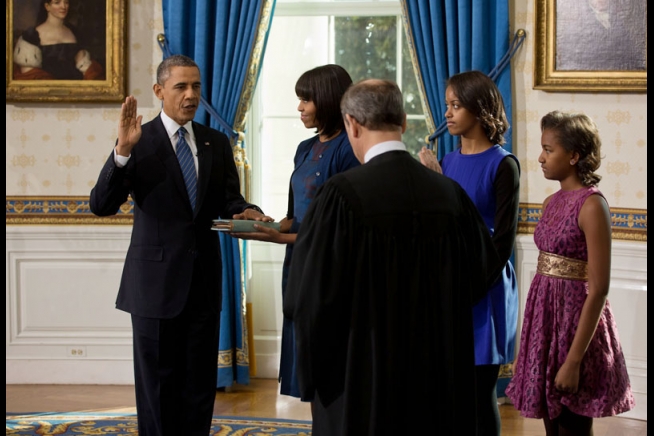
Photo: L. Jackson, White House
President Obama is aware of his role in making history, each time he refers to being on its “right side.” His reference in his inaugural speech to acting for “posterity” means that he will continue make history in this second term. The White House web page right now has a pop-up, extolling his coalition to “Help ake history.”
He can’t help it. He makes history every day, just by getting up and going to work.

A memoir in letters. Excerpts from letters that a father wrote his children each week for almost 30 years, full of the mundane and poignant, the witty and wise. Stories from a different time, from a small town in Connecticut.
History Shock
 Pleased to announce the publication of my book in May 2021 by the University Press of Kansas. This collection of “stories with a history” narrates incidents over the course of my career in the Foreign Service when historical understanding – or lack of it – got in the way in the conduct of day-to-day diplomacy.
Berkshire County’s Industrial Heritage

Check out this book on the nineteenth century mills and those who owned and worked in them. Available through Arcadia Press or Amazon.
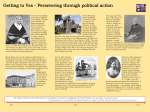
Slide Show – Getting to Yes, Woman Suffrage in the Berkshires and Beyond
-
Slide Show – Intersections, Pittsfield’s Neighborhoods
-
Slide Show – Turning Points


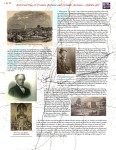
Slide Show – Preserving the old Berkshire Athenaeum
 Thomas Allen donated $50,000 to build the Athenaeum in 1876.
 A yong architect from New York, William Appleton Potter, had his design selected for the new Athenaeum.
 The original architectural drawing of the front elevation of the Athenaeum
 An early photo of the High Victorian Gothic building, pointed arches, twin gables, multi-color stone patterns,skylight, stained glass windows
 Majestic, quartered oak tresses in the addition built in 1896
 Proposed new library design, in 1944
 Bulging of stonework on from of building required drastic measures to shore up front, in 1979
 A restored skylight is returned to the roof in repairs undertaken in 2001
 Stained glass window on west gable, showing steel tie placed in 1979 stabilization repairs
 Masonry work begins on the Athenaeum in the deep of winter
 Removing the stained glass panels for repair
 Cracks in the masonry
 More cracks in the masonry
 Lifting the capstone off the east gable, the first stone removedd








 History All Around