The Poetry in Emily’s and Austin’s Homes
Posted by John Dickson in Brown Signs, History in our surroundings, Preservation, Public History on October 17, 2013
Time for another field trip. This time to the Emily Dickinson Museum in Amherst Massachusetts. It turns out the Herman Melville is not the only American author who achieved public and literary acclaim only long after his death. So did Emily Dickinson with her poetry, but with a twist: she never sought that acclaim in her lifetime.

The only known photo of Emily Dickinson, the original owned now by Amherst College
Emily’s house, now a museum, is actually two houses. One, next door, belonged to her brother Austin; both help to tell the story of her writing. What draws people to the home is this story of a private woman, creating, in bursts of prolific energy, a poetry ahead of its time and for the ages, but not publishing any of it. It is through Austin that the world eventually gets to see and appreciate the poetry. It is hard to know if mid-18th century American readers were ready for her poetry, which expanded the boundaries of the form.
Still, the renovations and additions, the wallpaper and paintings, the path and hedge of both houses are historic traces, primary sources themselves, revealing the complicated relationships between Austin, his wife, his daughter, his paramour and his sister. Through the objects, the museum guide is able to craft the story of how Emily’s writing became known to the outside world. It is a story which speaks to us today, of women’s roles in society, of the unknown loss of similar treasure due to an inability to contribute fully. There is a strong possibility that her poetry may never have emerged.
The two side-by-side historic houses tell a different story as well, a story of authenticity in their contrasting models of preservation. They tell a story of authenticity, juxtaposing ways to create an honest portrayal of how we now can appreciate the lives of the siblings, how we now understand the story of her writing. Emily’s house, The Homestead, is restored, with fresh, clean paint and new wallpaper, sanded floors, with new work underway to “take away the 20th century in Emily’s bedroom,” as Jane Wald, the director of the museum, characterized the project. Austin’s house, The Evergreens, on the other hand, stands as it was found and transferred to the museum, with nothing changed or restored. The walls are moldy and crumbling, the wallpaper is peeling, the rugs threadbare and the furniture unfinished. Dark and smelly. It is a ruin, akin to one of those old stone walls scattered in the New England woods.
The contrast has much to do with what transpired between the Dickinson occupation/ownership of the houses and their acquisition by Amherst College, and then the museum. Simply, Austin’s home was kept intact, first by his by his daughter Martha and then by her heir, the young man who helped Martha edit Emily’s poetry for publication. Next door, no Dickinson lived in Emily’s home after her unmarried sister Lavinia’s death in 1899, 14 years after Emily died. First tenants, then new owners moved in to The Homestead, and they renovated and changed features of the structure. Once the house was bought by Amherst College, then work began to restore to as faithful a version as possible the house Emily lived in.
Which is authentic? Both, but it depends. It depends on how we approach them. Authenticity implies honesty. Austin’s home in its ruinous state, does not honestly reflect how he and his family lived. The threadbare carpets gave it away; they alone do not allow anyone to say “this is how the house looked when Austin lived here.” It may have been Austin’s carpet, but it is not how it looked in his tenure. Emily’s home, preserved, does try to reflect the “present-ness” of how Emily lived. But, it is only a reflection, and as a re-creation, is a present version, unable to say without caveats, “this is precisely how the house looked when Emily lived here.” Her plush carpet may look like the one she had, but it is not the same carpet.
From a preservation perspective, it is useful to have the two different approaches side-by-side. From the insights which the two houses tell us about gender and art, the juxtaposition also offers meaning, by showing both the actual, deteriorating objects in Austin’s home, but re-imagining them to a prior era in Emily’s home. Side-by-side, these traces complement each other, the real and the imagined, to tell the story of women’s lives and routines and the central role of their homes.
Predicting the future: Pope Francis, President Rouhani, Attorney General Holder
Posted by John Dickson in History ahead, History in our surroundings, International, Public Affairs on September 24, 2013
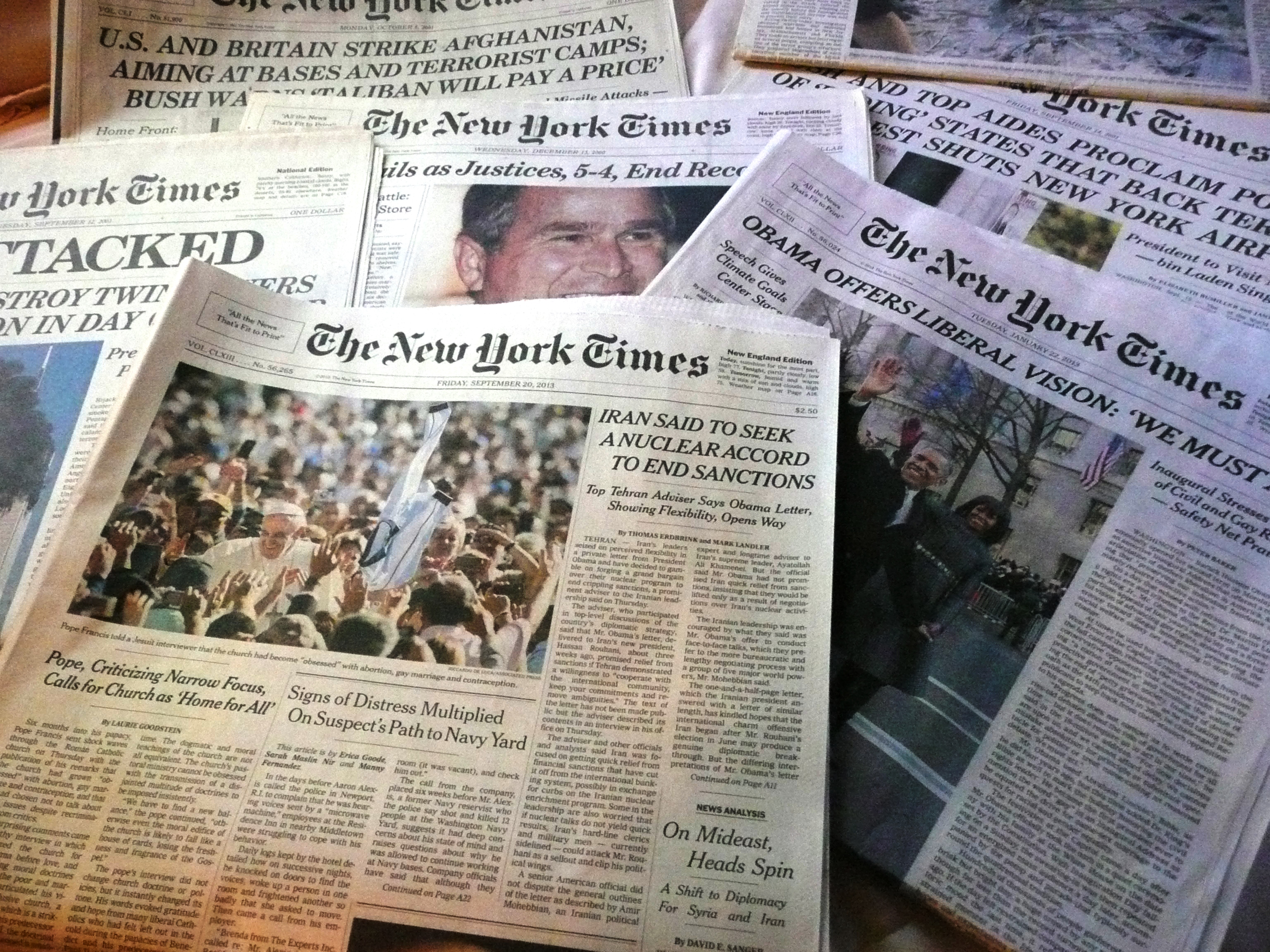 In a small trunk, here in my office are a select group of newspapers, saved because, at the time, they seemed to represent momentous events: 9/11, Bush v. Gore, death of Pope John Paul II, Watergate, impeachment of Clinton, fall of the Berlin Wall. All have across the top, large-print headlines. Today, I am adding to the collection the first which does not have the same bold typeset.
The paper on Friday, September 20, 2013 carried three separate stories, only two of them on the front page, which signaled what could be historic, transformational changes. It may be difficult to predict history, and my experiment here may ultimately fail, but these do seem like shifts which will alter the shape of slices of our history over the last 50 years.
First is what looks like may be a thaw in U.S. relations with Iran. The article, on the right hand columns of the New York Times, may only report the latest in a series of signals since the election in June of Iran’s new president, Rouhani. However, it reveals an exchange of letters between President Obama and President Rouhani exploring the possibility of direct negotiations between the two countries, who have not had diplomatic relations since the 1979 hostage crisis. The official who discussed the exchange of letters was a senior advisor to Iran’s supreme leader, Ayatollah Khamenei, seeming to indicate the latter’s acceptance with an opening.
Next is what looks like a re-direction of the Catholic Church’s social priorities. The new Pope Francis released the content of an interview he had given to a Jesuit Catholic journal in August where he pointed to a need for the church to be a “home for all.” He went on, charting a course for the Church to drop its “obsession” with abortion and contraception. On homosexuality, he asked an open-ended question wondering “when God looks at a gay person does He endorse the existence of this person with love, or reject and condemn this person?” Sounds a little like Jesus answering the efforts of the Pharisees to entrap him.
The third is the reversal of a policy of aggressive prosecution of drug crimes. The Attorney General Eric Holder gave a speech laying out the practical steps to reduce the extended sentencing of lower level drug crimes. Those harsh, often mandatory, sentencing rules have been enacted in various U.S. jurisdictions since the 1970s, the most well-known being California’s “three-strikes” provision in 1994. While changing the 1984 federal anti-drug act would require Congressional approval, Holder has instructed prosecutors to take steps in implementing the law, like not indicating the amount of drugs possessed by the accused. This would avoid triggering the automatic mandatory sentence.
Friday’s paper was not the first indication of any of these transformational shifts: the new Pope had indicated as early as his installment his concern for the poor as a fundamental focus for the church; the Iran’s President Rouhani had been sending signals of accommodation with the West since his election; and Attorney General Holder in August announced his decision to review sentencing guidelines.
Also, despite the important role played by each of the three individuals, pressure had been building for some time in each area to force the decisions each have taken. Sanctions aimed at Iran’s atomic weapons program are hurting the general population. Catholics are leaving the church, and important constituencies in the Democratic Party have latched on to overcrowding and disparate treatment between racial groups in sentencing to push for these changes.
Neither are these three pronouncements yet set on a straight, direct course towards fulfillment. In their infancy, each can be reversed, and it is more than likely that they will proceed on meandering paths in pursuit of the goals elaborated. Some accuse Iran of stalling, of engaging in a public relations campaign, to delay further international condemnation. The articles point to the Pope moving beyond the traditional power structure in the Vatican, and Congress can easily step in and halt any changes in Holder’s sentencing proposals.
Still, they each represent what could be fundamental changes. Comparisons to past historic transformational figures like Gorbachev, Sadat or Pope John Paul II are in the air. It is enough to make me add this front page to my small collection.
But before I do, my eye catches a fourth article, below the fold in Friday’s edition of the New York Times. This one reports on a resurgence of the textile industry in the U.S., one that is heavily automated, with many fewer workers, but one which would reduce the cost of transportation, as well as the potential for terrible tragedies like the collapse of a textile factory in Bangladesh. Maybe, just maybe, it is this one which foretells the most consequential shift, one that would have a greater impact in the daily lives of people around the globe.
Is it August 1914 or March 1999?
Posted by John Dickson in International, Public Affairs, Public History on September 5, 2013
Where are we now? Europe, August 1914? Iraq, March 2003? Afghanistan, August 1998? Rwanda, April 1994 or Yugoslavia, March 1999?

Syrian refugee camp in Jordan. Photo: Department of State
As we lurch hesitatingly towards some form of military action in Syria, pundits and politicians search for the right historic precedent, trying to bolster their political case for a response to the accusations that Syria used saran gas against its own citizens.
Let’s leave aside from the start the political maneuvering by certain politicians who all of a sudden are concerned about the unknown and unpredictable consequences of military action, whenever it happens. These same individuals who so blindly supported the Iraq invasion just ten years ago without credible evidence (despite the volume and confidence of the assertions) are preaching caution now that they have fairly firm evidence of poison gas use by Syria’s President Assad. They might use Iraq in 2003 as their precedent, but then that might also expose their previous support for invasion.
Others preaching caution point to Europe on the verge of the Great War, when a political assassination of a member of the Austrian royal family in Serbia triggered a chain of events that saw nations line up in treaty-bound coalitions to protect and defend each other. They rushed with folly into a war they would surely have sought to avoid had they known the death toll, devastation and brutal violence which ensued. Would such a strike unleash a larger war, in a region so fraught with its own complex web of rivalries and abundance of arms?
You would think in a scenario like either Iraq 2003 or Europe 1914, there would be support for the kind of limited action President Obama is gambling on. Yet, by showing his hand holding only a limited air strike (not only to domestic political opponents, but also to the Syrians who can now prepare,) Obama opens himself up to the comparison with the Clinton airstrikes following the African Embassy bombings in 1998. They were loud and may have felt good in seeking a dose of punishment, but they ended up having not just no practical effect, but may have further aggravated the anger directed at the U.S.
So, we hear those whose guiding principal for use of the largest military force in the history of the world is conditioned on the direct attack on U.S. interests. We don’t want to become the “world’s policeman,” a phrase stemming from Vietnam or Somalia, when in both large and small scale-scale military interventions, questions about our own national interests led to weak withdrawals short of our stated goals.
With unclear U.S. interests, then we may end up watching from the sidelines, as the world allowed an unspeakable genocide to take place in Rwanda. In such a case, should the discussion of U.S. interests extend beyond U.S. physical or economic security to include a moral responsibility? Do our long-term interests include demonstrating to peoples, who in this particular region are still struggling to define the outcome of their Arab Spring, that the U.S. will stand on the side of ordinary citizens? And, if that connection is too fuzzy or moral, can we define our long-term interests in something more practical like long-term security in a region which has held a great share of the global economic and political well-being in its grasp for decades?
The global crises immediately following the world’s paralysis in Rwanda were situated in Bosnia and Kosovo. Determined not to watch from the sidelines another humanitarian disaster brought on by an earlier incarnation of Assad attacking his own citizens, the U.S. and Europe took months to act, but eventually they did. Unable to secure UN Security Council approvals because of the same vetoes by Russia and China who refuse to vote now, NATO forces were brought to bear in a punishing air assault to force the soon-to-be convicted war criminal Slobodan Milosevic to stop the assault on his own non-Serb citizens.
Direct U.S. interests were hard to define in that action. What makes this precedent the most compelling may be the almost exclusive use of air power to bring about the intended result. Fighting from the air meant limited casualties on the NATO side, but tragic unintended civilian loss of life.
Precedents, we know, are never exact. Yugoslavia was not the Middle East; Libya stood farther away from the Lebanon-Israel-Palestine than Syria. Unlike 1914, the world has institutions of varying effectiveness to prevent a global escalation of conflict. And, unlike Iraq, we have greater trust that we are not being lied to.
The day the last mill closed
Posted by John Dickson in Berkshires, History in our surroundings, Personal memory on August 14, 2013
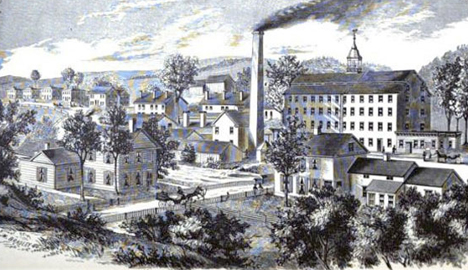
An engraving of the mill complex from an 1876 history of the city
The announcement did not make it on to the front page of the newspaper, but it should have. The final woolen mill in Pittsfield was closing. It was the longest continuous running woolen mill operation in a city which had once boasted 11 textile mills, leading a county which produced more wool than any other in the country.
It was October 26, 1963, when it was known as Wyandotte Mill. Over 100 workers walked and drove across the small bridges over the uppermost reaches of the Housatonic River that had once powered its predecessor, Pontoosuc Woolen Mill. It was not quite 140 years since that mill had been built, on the site of Keeler’s saw mill.
The story of Pontoosuc Woolen Mill tells the story of the county. It was the brainchild of Henry Shaw, the representative for the county in the U.S. Congress who hailed from Lanesborough. In politics that sounds more like our current Congress, Shaw had helped Henry Clay pass the Tariff of 1824, which placed large taxes on imported wool from England, thereby opening up a market for domestic wool. Shaw moved quickly on such an opportunity and brought together a group of investors to finance the purchase of the property and the construction of the original mill building, which is still standing today.
Pontoosuc was not the first mill in the county, but the site it was built on housed a workshop of Arthur Scholfield, a recent immigrant from England who snuck out of his home country with models of and experience in the new machinery of spinning wool. The English were desperate to prevent the loss of this know-how and hold on to their manufacturing advantage, but had already lost cotton processing technology through another emigrant, Samuel Slater, who helped build the first mills in the country in Rhode Island and Massachusetts.
Scholfield, who left England in 1793, moved north along the Housatonic, through Connecticut, and ended up in Pittsfield in 1800. Here, he built the first machine to card wool, a process of cleaning and preparing the cut wool. Since his machinery could complete the process several times faster than hand carding, he initially had a small operation to sell the cleaned wool to private individuals, spinning and weaving out of their homes. Scholfield then left woolen manufacturing and set up a small operation to build the machines to process wool, selling his equipment around the region. His special tooth-cutting machine was installed in the attic of Keeler’s saw mill at the southern tip of Pontoosuc Lake.
Scholfield’s inventions and the new protective tariff combined with the introduction of a new brand of sheep from Spain – merino – and the beginnings of an immigrant work force to bring all the variables together for the flourishing of industry which saw Pittsfield start the transition from an agricultural society to a center of manufacturing. Pontoosuc Woolen Mill initially employed 100 workers, a little less than half of whom were women and children. By mid-century, the mill had built a store, homes, townhouses and boarding houses for a growing workforce which would reach 500 employees by the 20th century.
The list of owners and managers over the course of the 19th century reads like a Who’s Who of Pittsfield. Besides Shaw, whose son took the pen name of Josh Billings and avoided the wool business for humor, names like Clapp and Kellogg, Campbell, Frances and Plunkett still grace the city’s streets, parks and schools. These individuals helped move the city forward on a path of progress which included setting up the first fire company (owing to the risk of fire in the mills,) and the first trolley (which ran from the city center to, you guessed it, Pontoosuc Lake.) Pittsfield’s first telephone call was place at Pontoosuc Woolen Mill, to a bank on North Street.
The mill filled the huge demand for kilt-like balmoral skirts and carriage blankets. When cotton became scarce during the Civil War, the demand for woolen textiles increased, creating enough demand for yet another woolen mill which opened in Pittsfield in 1863. Following the war, cotton production returned and the first mills in the city began to close. Pontoosuc Woolen Mill was able to keep open into the 20th century with lucrative government contracts, including the manufacture of military blankets during the first world war. A Maine firm bought the mill in 1928, just after its centennial, changing the name to Wyandotte Mill.
The Depression hit the wool industry hard with the closing of 4 rival mills in the 1930s. Gradually, new competition from England, caused production to start shifting south to reduce costs of labor. By the time of the second war, 100% cotton and wool textiles were replaced by synthetic fibers, further reducing demand. By the 1950s, just three mills in Pittsfield were still open. Wyandotte managed to stay afloat through production of woolen cloth which was distributed around the world as raw material for other factories to produce the finished products of clothing and blankets.
Organized labor had come to Wyandotte shortly after its purchase of the mill. By the 1930s Wyandotte Pittsfield workers joined a month-long textile strike in 1934 in 20 states. It was at the end of the Depression in 1939 that the Textile Workers Union of America organized Wyandotte. Additional labor actions took place following the Depression and the war when Wyandotte workers at all three of their mills struck in 1951 over the failure to make a pay raise retroactive. A few years later, when Wyandotte re-negotiated their contract, it included a far-reaching provision for equal pay for equal work by women. A general strike took place at Wyandotte in 1954, but the weakness of unions in mid-century America can be seen in the rehiring of only 50 of the 475 workers previously employed. In 1962, workers through the TWUA had signed a new contract with a wage increase. That same year, a new management team came to Pittsfield. Both the new contract and new leadership may have been part of a last ditch attempt to keep the mill open, but they failed; by October the mill had produced its last wool.
Today, the complex is home to a number of small businesses; neighboring buildings that once were stores, homes and boarding houses survive but are townhouses, a restaurant, single family homes and a homeless shelter. The canal through which ran a current of water strong enough to power the looms and machines has been diverted and covered over. Elevated walkways have been torn down, windows boarded to prevent vandals from breaking glass. What remains, though, is a brick monument, tall, solid and imposing and certain to outlive the prefabricated materials of modern box stores and warehouses and factories. It’s right there, hidden in plain sight and joined by 11 other mills across the city.
I and My Lawnmower
Posted by John Dickson in Berkshires, Personal memory, Public History on June 10, 2013

Reliable friend.
Photo: JDickson
One of the highlights of walking through Herman Melville’s home at Arrowhead in Pittsfield, Massachusetts is the central fireplace in the dining area. Its grand size and fine stone work dominate the room and evoke a time when all the heating and cooking came from that one source. What is most unusual here though is the writing above and across the fireplace. It quotes from Melville’s whimsical story “I and My Chimney” which first appeared in Putnam’s Monthly in 1856, six years after Melville moved to Arrowhead from New York City.
The story is of a husband’s determination to save the destruction of the chimney in his home from his equally determined wife to have a central hallway, instead of a space-wasting chimney. Melville speaks of this chimney as a person, even a friend, and a close one at that: “I and my chimney, two grey-headed old smokers reside in the country.” The two of them are “old settlers,” putting the chimney on the same human level as the narrator. Melville explains the unusual construction placing the “I” before “my chimney” in the title as the only time that he actually takes precedence over the chimney.
In grand humor and 19th century majestic style, Melville describes the female head of household’s attempts to rid herself of the chimney, hiring architects and enlisting her daughters to convince her male counterpart of the multiple reasons to rid herself of this domineering structure. “I will never surrender,” says the protagonist, reassuring his pipe and his chimney that he will prevail.
I have my own chimney problem, and it is my 22-year old push lawnmower. Purchased for barely more than $100, my walking companion has served me well in three different residences, suffering through ten years of neglect while in storage. Upon his release, though, he started right up and, as long as he can avoid rain in the fuel tank, he has never let me down.
This faded red gas push mower has outlasted a brief flirtation with an electric/battery model with its commitment to a green environment as an enticement. Barely five years into this newer arrangement, the battery model could not keep up with either high grass or more lawn. With barely an apology, the old push mower took me back and has remained faithful since.
We are alone in our weekly endeavors. My wife and pretty much any outside observer think me mad, for walking around these almost 2 acres with such an outdated, hard to operate companion. The hot sun, the uneven terrain, the long grass, the obstacles of rocks and roots and trees conspire to leave me exhausted each time. My wife claims it will be the end of me. I call it exercise which will make me stronger and live longer.
Melville was on to something, that genius of human nature and descriptive detail. From even before his time, he knew that every marriage needs a chimney or a lawnmower, to test its foundation and durability.
I only wonder what his quill pen would do to my lawnmower.

A memoir in letters. Excerpts from letters that a father wrote his children each week for almost 30 years, full of the mundane and poignant, the witty and wise. Stories from a different time, from a small town in Connecticut.
History Shock
 Pleased to announce the publication of my book in May 2021 by the University Press of Kansas. This collection of “stories with a history” narrates incidents over the course of my career in the Foreign Service when historical understanding – or lack of it – got in the way in the conduct of day-to-day diplomacy.
Berkshire County’s Industrial Heritage

Check out this book on the nineteenth century mills and those who owned and worked in them. Available through Arcadia Press or Amazon.
Slide Show – Getting to Yes, Woman Suffrage in the Berkshires and Beyond
-
Slide Show – Intersections, Pittsfield’s Neighborhoods
-
Slide Show – Turning Points


Slide Show – Preserving the old Berkshire Athenaeum
 Thomas Allen donated $50,000 to build the Athenaeum in 1876.
 A yong architect from New York, William Appleton Potter, had his design selected for the new Athenaeum.
 The original architectural drawing of the front elevation of the Athenaeum
 An early photo of the High Victorian Gothic building, pointed arches, twin gables, multi-color stone patterns,skylight, stained glass windows
 Majestic, quartered oak tresses in the addition built in 1896
 Proposed new library design, in 1944
 Bulging of stonework on from of building required drastic measures to shore up front, in 1979
 A restored skylight is returned to the roof in repairs undertaken in 2001
 Stained glass window on west gable, showing steel tie placed in 1979 stabilization repairs
 Masonry work begins on the Athenaeum in the deep of winter
 Removing the stained glass panels for repair
 Cracks in the masonry
 More cracks in the masonry
 Lifting the capstone off the east gable, the first stone removedd








 History All Around