In my mind I’ve gone to Ft. Ticonderoga
Posted by John Dickson in Brown Signs, Colonial, Personal memory, Public History on November 16, 2012
If people experience history best through personalizing it, then it is likely what we get out of a museum is something that connects directly to our personal experience.
That was the case during a visit this fall to Fort Ticonderoga on the New York side of Lake Champlain. The fort which occupies a strategic position on the southern tip of the lake played a role in both the French and Indian War and the Revolutionary War in the 1700s. The strategic part was made clear in a map at one of the displays showing the water route taken down the lake from Canada, and then across a brief stretch of land over to the Hudson River, which leads all the way to New York City.
So, how did my wife and I experience this personally?
For one, we skipped the musket demonstration which drew off the small crowd early on Sunday morning, leaving the rebuilt fort and room displays to ourselves (we hate crowds and are not too keen on guns either.)
Second, we lucked into the only tour available during our time frame, of the King’s Gardens on the property. The fort has succeeded in planning gardens and pasture which period soldiers may have used (albeit surrounded by electric fence at night.) The gardens we focused on, though, pertained to the private property owned by the Pell family, ancestors of Senator Claiborne Pell from Rhode Island. At the time, we had been busy re-landscaping our newly renovated house (on a much smaller scale, admittedly), so these beautifully cared for gardens and trees captured our attention.
Third, we were instinctively drawn to any connection to our home town of Pittsfield in the display. We skipped right past the names of Ethan Allen and Benedict Arnold and focused on a name neither of us had heard previously, a Pittsfield native, Colonel John Brown. We saw a plaque honoring him as we entered, and we spent more time in front of the displays explaining his leadership of a three-day assault on the fort in September 1777, which helped lead to the abandonment and subsequent destruction by British forces of the fort two months later. We learned John Brown was killed later in the war at the age of 36.
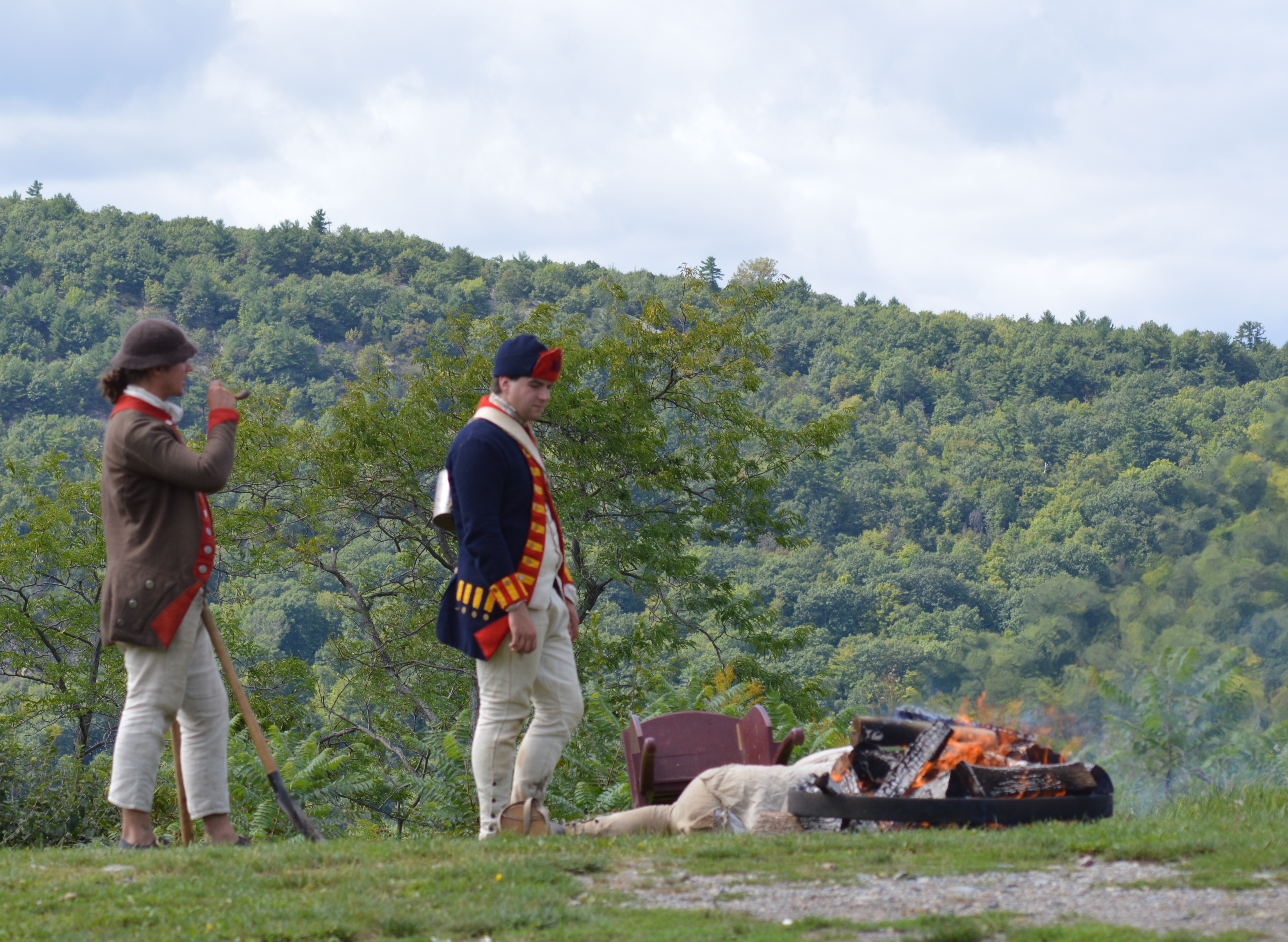
Soldiers at Ft. Ticonderoga. Credit: M. Dickson
Finally, we zoomed in on the motivations behind the tour guide/reenactors who, both paid and volunteer, filled the environs, even with their children. We assumed they probably had spent the night there, at least some of them. Our tour guide, in period uniform, explained he bought his uniform from a store in the U.K., with special wool and buttons and sewing techniques, all at a fairly expensive cost. We later overheard several of the uniformed guides discussing amongst themselves where they had procured various pieces of their outfit. Here again, we personalized, admitting this was not anything we would ever find ourselves doing, but frankly pleased the fort was able to attract people who put such time, energy and expense into this hobby.
As we were heading out, we noticed that others were studying in detail the musket displays, which we had zoomed right by, but stopped for an equally intent examination of the maps which showed prominently western Massachusetts, Pittsfield and even our neighboring lake.
What’s that?
Posted by John Dickson in Personal memory, Public History on September 4, 2012
In several days, I go to the first of my classes in the Public History program at the University of Massachusetts. It has taken me almost two years to get to this point, browsing through course opportunities, studying for the GRE, compiling an application, waiting to hear of acceptance, and then, once accepting opting to defer for a year.
Throughout this journey, the most frequent and, ultimately, the hardest question I had to answer about my choice of returning to the classroom to study Public History has been, “What is that?” Or, “Isn’t all history public?”
After a career in public diplomacy, I am used to people not understanding what it is that I do. I found it easiest to translate with a code of lay vocabulary, like “press and culture exchanges,” or refer to an activity we managed, such as “we ran the Fulbright exchanges.” That begged the question of why we didn’t just call the function “press and cultural affairs.”
So, I did develop a bit of shorthand for the “What is Public History?” question. “It’s history for museums.” Or, if I had 20 more seconds, “It’s making history accessible to a broader public, beyond academia, like in museums, or commemorative events and sites.” Even though it is more than that, that seemed to satisfy my family and friends who would then move on to talking about the hot weather this summer.
If it is more than that, then what is it? I suppose it may take two years of a Masters degree program to be able to answer this, but here are a few things which some of the practitioners say about it:
— making history relevant to social concern (Charles Beard)
— helping members of the public do their own history (Carl Becker)
— bringing state and local history into the academy, or co-opting state and local history (Grele)
— history beyond teaching and research, entrepreneurial, collaborative, engaging business, government and other entities (Bookspan)
— a people’s history, which fills in the gaps of what we have chosen to ignore (Frisch)
— uncovering the history of the “ordinary,” or history for the people, with the people; people seeking knowledge of the world they have made or that was made for them, shaping the way the present is viewed (Grele)
They all make sense to me, and are in many ways inspiring, but also lacking in answering the question, how? In museums, in preserving, in archiving, in writing, in interviewing, and yes, in teaching and even researching.
I’d still like to boil that all down to 20 words or less, that make sense to the ordinary person, with whom we are supposed to be collaborating.
After the Greatest Generation Came Us
Posted by John Dickson in History in our surroundings, Personal memory, Public Affairs on August 26, 2012
My reaction to Tom Brokaw’s “Greatest Generation” documentary and book was typical of my approach whenever I read biographies. I stand in awe of these individuals, even when they are young, at their accomplishments, their energy, commitment, drive and talents.
It is not too hard to contemplate the next step, leaping from admiration to introspective evaluation on my own life, or in Tom Brokaw’s case, our own generation. What after all have we in the Baby Boom generation accomplished? What kind of world are we turning over to our children? Quickly, I reach the conclusion that we pale by comparison, that the Greatest Generation handed us on a silver platter a society that we have messed up. A collective selfishness gave way to self-indulgence, not hardship and effort, and leaves our children with challenges we did not endure, like monumental national and personal debt and the prospect of insoluble entitlement programs for the ill and elderly which they may not be able to benefit from. We’ll make sure we get ours, thanks to their contributions and those of our parents. We are handing over the dominant nation we inherited to the next generation as a nation in decline, unable to compete against rising powers in Asia or Latin America. We lost our wars, in Vietnam, and the ones on poverty and in drugs.
Depressing? That is, until I saw the “Madmen” episode of Don and Betty Draper littering on their family picnic. It is a scene which everyone who watches the show remembers, cringed from. Advertising executive Don stands up at the end of the picnic, crunches his beer can and tosses it into the woods. His wife Betty hustles the children into the car and then shakes the picnic blanket full of dirty napkins and empty potato chip bags on to the lawn and leaves. Viewers cringed, repulsed, disbelieving that people actually could commit such an unspeakable act.
Then again, much of “Madmen” is, while hopefully exaggerated for dramatic effect, reenacting a bygone time, when people smoked in public places, men ran the office, took liberties with the secretarial pool, stayed hidden in the closet, kept liquor bottles in their offices and drank heavily throughout the work day, among other things.
“Madmen” has triggered a re-evaluation of contributions of the Baby Boomers. It’s not just litter along the highways and in our parks, which still exists, but not to the same extent, thanks to Keep America Beautiful, the EPA, Lady Byrd Johnson, Earth Days, recycling and much more. It’s expanding fuller participation in broad aspects of society (work, study, voting, athletics) on the basis of gender, race, ethnicity, sexual preference, ability, age and so on. It’s seat belts and car seats for children; it’s awareness of the costs of war; it’s foreign policy based on human rights and development, not just security; it’s decreasing the threat of atomic war.
What’s striking about some of these is that the accomplishments were grass-roots movements or campaigns. Our most significant achievements were not government-run, but government played catch-up to campaigns already underway, such as adversion to tobacco or seat belts. As a result, these changes are deeply ingrained, ensured to elicit the kind of reaction viewers had to Donald Draper throwing a beer can into the woods.
So, maybe we’re not as great as the Greatest, but we didn’t entirely waste our time on this planet either. Give yourselves a break, boomers.
Did Anyone Die in the War of 1812?
Posted by John Dickson in Brown Signs, History in our surroundings, International on June 24, 2012
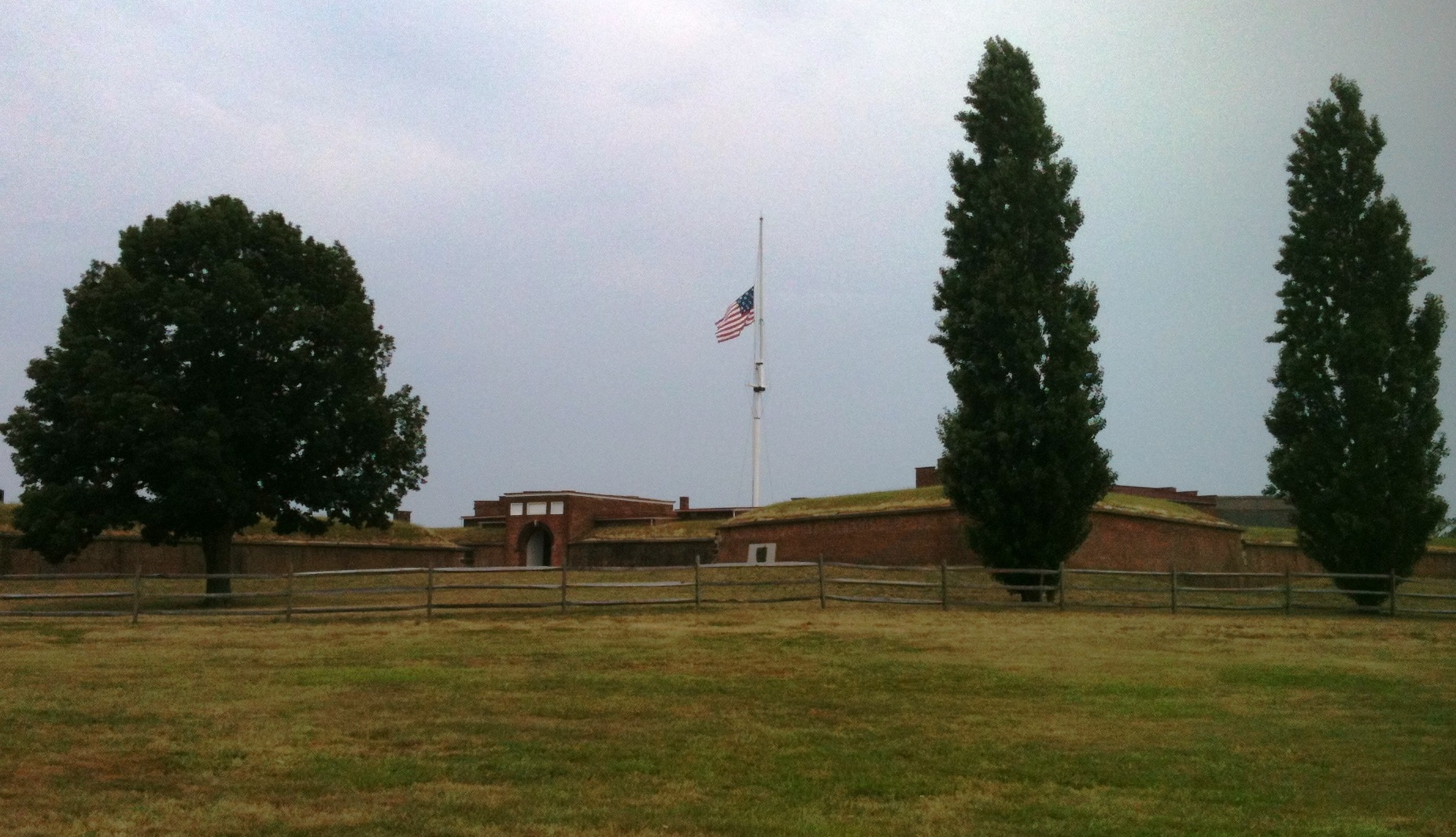
Proof through the night
A week after the tall ships descended on Baltimore for the bicentennial of the beginning of the War of 1812, and the city’s historic landmarks related to that event had returned perhaps to our national forgetfulness of that war. A few visitors to Fort McHenry made our tour relaxed and free of mobs. The Inner Harbor was back to paddle-boat dragons, summer-time outdoor live music and smoothies.
Two things struck me about the exhibits at Fort McHenry, where Francis Scott Key’s view of the flag still waving after a night of British bombardment is memorialized, quite informatively and attractively. 1500 shells. Four people died. In fact, little mention was made of any casualties in the entire war.
It is hard to go to a battlefield or memorial of the Civil War, or any American military engagement since, and not be confronted with a narrative of death and casualty. But in the War of 1812, and to a lesser extent, our Revolutionary War, the notion of soldiers dying in action is not central to the historic narrative. Certainly, today, following the mass casualties in the Vietnam War, news coverage from both Iraq and Afghanistan has been dominated by our losses. Did these soldiers die in vain without their remembrance?
The second missing item was the burning of York (present-day Toronto) by Americans. Much emphasis was placed on the burning of the White House and the Capitol, but with no mention of the previous sacking of Toronto. In Canada, the battle in Toronto and subsequent defense of territory captures the story line and aligns with their national identity as non-Americans.
The question we have to ask, with our emphasis on our loss in Washington, and Canadian’s emphasis on their loss in York, do we choose to hold to the painful remembrance of loss inflicted on us, on our tragedies, rather than on the tragedies we inflict on others?
Walking around Ft. McHenry, I imagined 5th graders on class trips running around the premises, looking in on rooms where soldiers slept four to a bed, or climbing on the huge cannons, or trying to imagine a harbor full of tall warships firing relentlessly at the fort. Would they make the connection between the smoothies in the Inner Harbor and the sacrifices 200 years earlier at that fort?
In fact, many died in this war. An estimated 15,000 U.S. soldiers.
When Video Takes Over History
Posted by John Dickson in History in our surroundings, Personal memory, Public Affairs on March 10, 2012

NYFD Door Panel from 9/11. Photo: Smithsonian Museum
In connection with the tenth anniversary of the attacks on New York City and Washington DC, the Smithsonian Museum of American History put together an exhibit commemorating that history-changing day. My wife and I stood in line for 90 minutes to enter the small room, which contained four tables of artifacts, one each for New York, Washington, Pennsylvania and the Transportation Security Administration. Yes, the last one seemed oddly lacking the parallelism of the first three.
Firefighters’ equipment, a beeper, survivors’ photograph from the stairwell, an ID tag, a firetruck door twisted by heat and , a uniform were among the items I vaguely remember displayed. More clear was the reverent, bordering-on-sacred hushed tones from the long line of people slowly winding their way around the room. We were told of the uniqueness of these displays, on tables with no glass between the viewer and the artifact.
Yet, the most memorable display was a television set, re-running the morning’s news clips, starting with the pointless chatter of Michael Jordan’s comeback to the NBA and winding through to the almost off-handed announcement of a plane crashing into the World Trade Center all the way through the lead anchors getting to the station and taking over the non-stop news through the rest of the day.
This television reel portrayed better than any artifact on the tables our journey that day, passing from our innocence to the emergence of a changed world. It was certainly more emotional, more riveting. We wanted to hit the pause button and reclaim that lost epoch; we wanted the rest of Good Morning America to continue as planned, with stories about new diets or small-town oddities.
What brought this to mind now, six months later, was a recent re-playing on National Geographic of “The Lost JFK Tapes.” Re-watching the motorcade winding its way through Dallas, with Jackie and JFK transported me back to the nine year-old riveted to the television that fall weekend, wishing that the motorcade would make its way to the luncheon where he was to speak before the assembled business elite of Dallas.
It reminded me of my visit last month to Atlanta and the Martin Luther King National Historic Site. The humble wagon which carried King’s casket through Atlanta, the pictures of his childhood, the civil rights walk of fame, the Ebenezer Baptist Church all paled in contrast to two videos – his Dream speech in Washington DC and, especially, his Promised Land speech the night before he died, where he predicted his end.
Do other film moments evoke such instant, emotive history? Perhaps the Challenger liftoff or the first moon landing. Certainly the tsunami disasters are best portrayed by video. And, what does this mean for museums, seeking to tell a story, if visitors could just as easily have stayed at home and watched the moment from their living room flat screen or laptop or mobile phone? Or for historians trying to write the story when the video allows the viewer to see for themselves, not through the words of an interpreter?

A memoir in letters. Excerpts from letters that a father wrote his children each week for almost 30 years, full of the mundane and poignant, the witty and wise. Stories from a different time, from a small town in Connecticut.
History Shock
 Pleased to announce the publication of my book in May 2021 by the University Press of Kansas. This collection of “stories with a history” narrates incidents over the course of my career in the Foreign Service when historical understanding – or lack of it – got in the way in the conduct of day-to-day diplomacy.
Berkshire County’s Industrial Heritage

Check out this book on the nineteenth century mills and those who owned and worked in them. Available through Arcadia Press or Amazon.
Slide Show – Getting to Yes, Woman Suffrage in the Berkshires and Beyond
-
Slide Show – Intersections, Pittsfield’s Neighborhoods
-
Slide Show – Turning Points


Slide Show – Preserving the old Berkshire Athenaeum
 Thomas Allen donated $50,000 to build the Athenaeum in 1876.
 A yong architect from New York, William Appleton Potter, had his design selected for the new Athenaeum.
 The original architectural drawing of the front elevation of the Athenaeum
 An early photo of the High Victorian Gothic building, pointed arches, twin gables, multi-color stone patterns,skylight, stained glass windows
 Majestic, quartered oak tresses in the addition built in 1896
 Proposed new library design, in 1944
 Bulging of stonework on from of building required drastic measures to shore up front, in 1979
 A restored skylight is returned to the roof in repairs undertaken in 2001
 Stained glass window on west gable, showing steel tie placed in 1979 stabilization repairs
 Masonry work begins on the Athenaeum in the deep of winter
 Removing the stained glass panels for repair
 Cracks in the masonry
 More cracks in the masonry
 Lifting the capstone off the east gable, the first stone removedd








 History All Around