Archive for category Public Affairs
Turn, Turn Turn
Posted by John Dickson in Personal memory, Public Affairs, Public History on January 30, 2014
I feel like I’ve known Pete Seeger since I was 18, even though I never met him. So, when the news came that he passed away this week, memories of his music and social causes that inspired many returned easily.
A little about my connection with someone who was my idol. It was his integrity that drew so many to him, even though it’s the same integrity that would likely make him wince at the word “idol”
When I graduated from high school, I received a guitar as a graduation present from my parents. Odd, since I had shown no interest in playing the instrument. A few months later at Christmas, my brother gave me “The Incompleat Folksinger,” a book doubling as a songbook and autobiography. In it, Pete laid out his views on social and economic justice, his flirtation with popular music as a member of the Weavers in the early 1950s, and then his targeting as a Communist in the 1950s. All that, he interspersed with lyrics and tablature of many songs. His story, from his work with labor unions during the Depression through the McCarthy era and into the anti-war and civil rights movements of the 1960s, became the subject of a history thesis my senior year of college.
My thesis argued that the political left showed continuity, from its heyday of support for the working class in the 1920s and 30s, moving through the anti-Nazi era, then weathering the lean, red-baiting 1950s, only to emerge in the 1960s with new issues of peace abroad and racial justice at home. Through it all was music, the folk music of Pete Seeger and others that helped frame the issues, spread the word and unite the activists and supporters. Pete played with Woody Guthrie whose ballads touched a nerve for the mass of unemployed during the Depression; he played with Bob Dylan and Joan Baez, whose folk music in the 1960s addressed the Vietnam War and the Civil Rights movement.
Moving into the 1970s and 1980s (and beyond my graduation and focus of thesis,) the fervor of those movements was passing, even though goals connected to those movements had not been attained. Pete Seeger remained, while many in my generation moved on, to work and family, leaving behind those ideals for which we had once so passionately believed in. Pete (as if he were my best friend) stayed true, true to his music and to his ideals, finding the right balance to match his humble lifestyle. He was the thread to the next progressive movement, using his name and his music to advance environmental issues, specifically the cleaning up of the Hudson River.
I was not surprised to see Pete Seeger performing at President Obama’s inaugural in 2009. He was on the stage set up in front of the Lincoln Memorial, along with Bruce Springsteen. Springsteen had put out an album a few years earlier entitled The Seeger Sessions, where he adapted Seeger’s Americana songbook to his own band and style. Seeger again became the continuity, for the music and the politics, sharing his concern for the common man and woman, the working class squeezed out by an economy that catered to the wealthy few. Thus, it was not surprising to see Pete join the Occupy Movement. He was 90 then.
Much has been written of Pete Seeger’s affiliation with the Communist Party and with the resulting blacklist for ten years which kept him off the airwaves for ten years. Not his music, though, with its clear lyrics advancing causes which now seem mainstream. The blacklist became his badge of honor, one he didn’t thrust forward as a victim but one that kept him steadfast in his own view of the world. His life made it on to the front page of the New York Times, while those who tried to silence him have long been forgotten. His season had come, again and again.
The first and only time I saw Pete Seeger in concert was in 1975 when he performed with Brownie McGhee and Sonny Terry at Carnegie Hall. What was most memorable was Pete brought out a log and an axe for one song, and sang by himself, keeping beat with the swings of his axe hitting the wood. We will likely never see that again.
My last post was another obituary of sorts. Mandela and Seeger were the same age. And exhibited the same persevering commitment and passion for social justice.
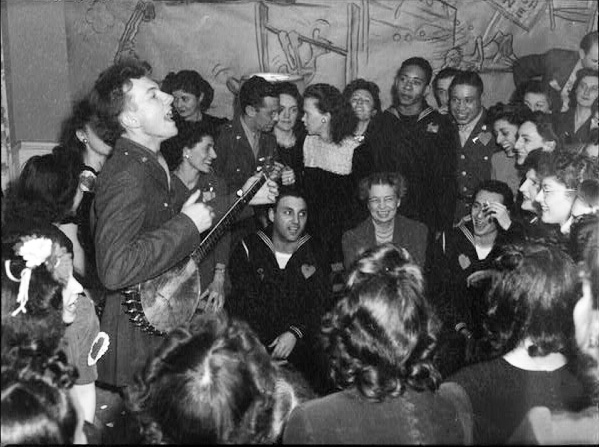
Pete singing with Eleanor Roosevelt listening (and singing along?) Photo: Photograph by Joseph A. Horne. Via Library of Congress site
Predicting the future: Pope Francis, President Rouhani, Attorney General Holder
Posted by John Dickson in History ahead, History in our surroundings, International, Public Affairs on September 24, 2013
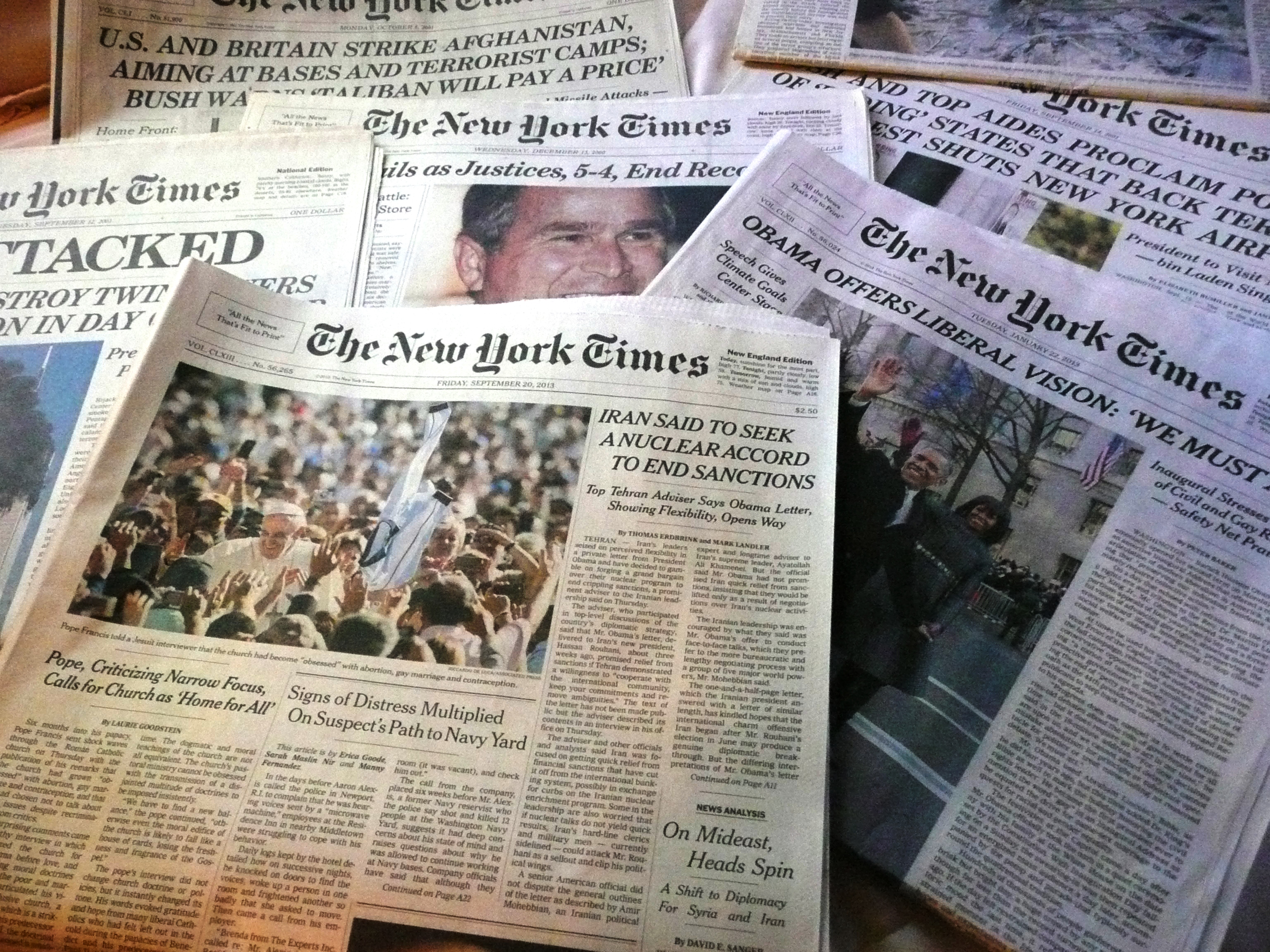 In a small trunk, here in my office are a select group of newspapers, saved because, at the time, they seemed to represent momentous events: 9/11, Bush v. Gore, death of Pope John Paul II, Watergate, impeachment of Clinton, fall of the Berlin Wall. All have across the top, large-print headlines. Today, I am adding to the collection the first which does not have the same bold typeset.
The paper on Friday, September 20, 2013 carried three separate stories, only two of them on the front page, which signaled what could be historic, transformational changes. It may be difficult to predict history, and my experiment here may ultimately fail, but these do seem like shifts which will alter the shape of slices of our history over the last 50 years.
First is what looks like may be a thaw in U.S. relations with Iran. The article, on the right hand columns of the New York Times, may only report the latest in a series of signals since the election in June of Iran’s new president, Rouhani. However, it reveals an exchange of letters between President Obama and President Rouhani exploring the possibility of direct negotiations between the two countries, who have not had diplomatic relations since the 1979 hostage crisis. The official who discussed the exchange of letters was a senior advisor to Iran’s supreme leader, Ayatollah Khamenei, seeming to indicate the latter’s acceptance with an opening.
Next is what looks like a re-direction of the Catholic Church’s social priorities. The new Pope Francis released the content of an interview he had given to a Jesuit Catholic journal in August where he pointed to a need for the church to be a “home for all.” He went on, charting a course for the Church to drop its “obsession” with abortion and contraception. On homosexuality, he asked an open-ended question wondering “when God looks at a gay person does He endorse the existence of this person with love, or reject and condemn this person?” Sounds a little like Jesus answering the efforts of the Pharisees to entrap him.
The third is the reversal of a policy of aggressive prosecution of drug crimes. The Attorney General Eric Holder gave a speech laying out the practical steps to reduce the extended sentencing of lower level drug crimes. Those harsh, often mandatory, sentencing rules have been enacted in various U.S. jurisdictions since the 1970s, the most well-known being California’s “three-strikes” provision in 1994. While changing the 1984 federal anti-drug act would require Congressional approval, Holder has instructed prosecutors to take steps in implementing the law, like not indicating the amount of drugs possessed by the accused. This would avoid triggering the automatic mandatory sentence.
Friday’s paper was not the first indication of any of these transformational shifts: the new Pope had indicated as early as his installment his concern for the poor as a fundamental focus for the church; the Iran’s President Rouhani had been sending signals of accommodation with the West since his election; and Attorney General Holder in August announced his decision to review sentencing guidelines.
Also, despite the important role played by each of the three individuals, pressure had been building for some time in each area to force the decisions each have taken. Sanctions aimed at Iran’s atomic weapons program are hurting the general population. Catholics are leaving the church, and important constituencies in the Democratic Party have latched on to overcrowding and disparate treatment between racial groups in sentencing to push for these changes.
Neither are these three pronouncements yet set on a straight, direct course towards fulfillment. In their infancy, each can be reversed, and it is more than likely that they will proceed on meandering paths in pursuit of the goals elaborated. Some accuse Iran of stalling, of engaging in a public relations campaign, to delay further international condemnation. The articles point to the Pope moving beyond the traditional power structure in the Vatican, and Congress can easily step in and halt any changes in Holder’s sentencing proposals.
Still, they each represent what could be fundamental changes. Comparisons to past historic transformational figures like Gorbachev, Sadat or Pope John Paul II are in the air. It is enough to make me add this front page to my small collection.
But before I do, my eye catches a fourth article, below the fold in Friday’s edition of the New York Times. This one reports on a resurgence of the textile industry in the U.S., one that is heavily automated, with many fewer workers, but one which would reduce the cost of transportation, as well as the potential for terrible tragedies like the collapse of a textile factory in Bangladesh. Maybe, just maybe, it is this one which foretells the most consequential shift, one that would have a greater impact in the daily lives of people around the globe.
Is it August 1914 or March 1999?
Posted by John Dickson in International, Public Affairs, Public History on September 5, 2013
Where are we now? Europe, August 1914? Iraq, March 2003? Afghanistan, August 1998? Rwanda, April 1994 or Yugoslavia, March 1999?

Syrian refugee camp in Jordan. Photo: Department of State
As we lurch hesitatingly towards some form of military action in Syria, pundits and politicians search for the right historic precedent, trying to bolster their political case for a response to the accusations that Syria used saran gas against its own citizens.
Let’s leave aside from the start the political maneuvering by certain politicians who all of a sudden are concerned about the unknown and unpredictable consequences of military action, whenever it happens. These same individuals who so blindly supported the Iraq invasion just ten years ago without credible evidence (despite the volume and confidence of the assertions) are preaching caution now that they have fairly firm evidence of poison gas use by Syria’s President Assad. They might use Iraq in 2003 as their precedent, but then that might also expose their previous support for invasion.
Others preaching caution point to Europe on the verge of the Great War, when a political assassination of a member of the Austrian royal family in Serbia triggered a chain of events that saw nations line up in treaty-bound coalitions to protect and defend each other. They rushed with folly into a war they would surely have sought to avoid had they known the death toll, devastation and brutal violence which ensued. Would such a strike unleash a larger war, in a region so fraught with its own complex web of rivalries and abundance of arms?
You would think in a scenario like either Iraq 2003 or Europe 1914, there would be support for the kind of limited action President Obama is gambling on. Yet, by showing his hand holding only a limited air strike (not only to domestic political opponents, but also to the Syrians who can now prepare,) Obama opens himself up to the comparison with the Clinton airstrikes following the African Embassy bombings in 1998. They were loud and may have felt good in seeking a dose of punishment, but they ended up having not just no practical effect, but may have further aggravated the anger directed at the U.S.
So, we hear those whose guiding principal for use of the largest military force in the history of the world is conditioned on the direct attack on U.S. interests. We don’t want to become the “world’s policeman,” a phrase stemming from Vietnam or Somalia, when in both large and small scale-scale military interventions, questions about our own national interests led to weak withdrawals short of our stated goals.
With unclear U.S. interests, then we may end up watching from the sidelines, as the world allowed an unspeakable genocide to take place in Rwanda. In such a case, should the discussion of U.S. interests extend beyond U.S. physical or economic security to include a moral responsibility? Do our long-term interests include demonstrating to peoples, who in this particular region are still struggling to define the outcome of their Arab Spring, that the U.S. will stand on the side of ordinary citizens? And, if that connection is too fuzzy or moral, can we define our long-term interests in something more practical like long-term security in a region which has held a great share of the global economic and political well-being in its grasp for decades?
The global crises immediately following the world’s paralysis in Rwanda were situated in Bosnia and Kosovo. Determined not to watch from the sidelines another humanitarian disaster brought on by an earlier incarnation of Assad attacking his own citizens, the U.S. and Europe took months to act, but eventually they did. Unable to secure UN Security Council approvals because of the same vetoes by Russia and China who refuse to vote now, NATO forces were brought to bear in a punishing air assault to force the soon-to-be convicted war criminal Slobodan Milosevic to stop the assault on his own non-Serb citizens.
Direct U.S. interests were hard to define in that action. What makes this precedent the most compelling may be the almost exclusive use of air power to bring about the intended result. Fighting from the air meant limited casualties on the NATO side, but tragic unintended civilian loss of life.
Precedents, we know, are never exact. Yugoslavia was not the Middle East; Libya stood farther away from the Lebanon-Israel-Palestine than Syria. Unlike 1914, the world has institutions of varying effectiveness to prevent a global escalation of conflict. And, unlike Iraq, we have greater trust that we are not being lied to.
Sequester them
Posted by John Dickson in Public Affairs, Public History on March 3, 2013
When Congressional Republicans shut down the government in 1995, it was the closing of the national parks which seemed to draw public attention to the impact of the budget impasse. In fact, the outcome did result in the temporary closing of 368 park sites and a loss of an estimated 7 million visitors, with local communities bearing the loss of tourism dollars, according to a Congressional Research Service report.
The recurring budget crises in Washington this year also raise the specter of potential impact on the parks. Why pick on the parks? Sure, they are symbolic, and easy for the general public to understand. Certainly easier to understand than some indecipherable federal program, buried in any one of dozens of federal agencies. Further, as a symbol, they project our common heritage, the best of our history of our land, of what holds us together as a nation. The argument is that these impacts affect what we hold dearest.
Or do we? For those serious about the size of government, the dire consequence of closing the parks may not seem so dire after all. It’s not hard to imagine a Tea Partier reacting with a big shrug to the fact that some retirees may have to change vacation plans because of the shutdown. Or, one of those big political funders in the 1% is probably yawning, preferring to preserve their special tax loopholes, when they could probably buy out any number of the parks they threaten to shut down.
Why not pick on something that would that would really hurt those bringing about this impasse? Here’s a suggestion: identify all those earmarked special interest programs and cut those first.
Or, furlough first Members of Congress and their staffs, since their impasse shows they’re not doing anything anyway.
For more read: http://www.nytimes.com/2013/03/02/us/politics/a-monument-to-a-long-tradition-of-budget-brinkmanship.html
Making History
Posted by John Dickson in History in our surroundings, Public Affairs on January 24, 2013
In 2011, when referring to his approach to the uprising in Egypt, President Obama noted that “History will end up recording that….. we were on the right side of history.” He could have been anticipating his second inaugural speech this week, when he was on both sides of history, both making it and wrapping himself in several American historic traditions.
History permeated the ceremony. First of all, he adhered to his Constitutional requirements by having a private swearing-in ceremony on January 20 (as stipulated by the 20th Amendment). However, he embraced our civil rights history by shifting the public ceremony to coincide with the Martin Luther King holiday. He used two bibles in taking the oath, belonging to Dr. King and Abraham Lincoln. The two bibles evoked the history of this year, marking not only the 150th anniversary of the Emancipation Proclamation but also the 50th anniversary of Dr. King’s March on Washington, this coming August.
His speech, like many inaugural addresses, recalled the founding documents of the nation, using their language of “we the people,” “liberty” and “equality,” repeatedly. He referred to the skepticism of central government and called us to remain true to our forebears and act as “pioneers.” He mined those documents to placate his adversaries on the right, but also to call to action those who supported his re-election.
Still, more than any other modern President, Obama makes history. As the first American of African descent to hold the office and to be re-elected to the office, every day he presides over the nation he is making history, whether he is the first President to win the Nobel Peace Prize in his first year of office, the first President from Hawaii or the first to sing Al Green and play basketball in the White House.
Much has been made of his reference to Seneca Falls, Selma and Stonewall, three places which carry deep symbolism for women, African-Americans and gays in their struggle for inclusion in the promise of liberty and equality in America. He made history by being the first President not only to use the word “gay” in an inaugural, but also to echo the appeal for equality in marriage.
These references, coupled with his remarks related to immigrants, underscored a more important historic transformation in the political composition which carried Obama to victory. While not the first to see the coalition taking shape, he is the first to ride the new Democratic coalition of minorities, women, gays and their progressive supporters of all shades and persuasions to two Presidential victories. It is a new Democratic coalition, emerging from the remnants of FDR’s coalition of labor lower and middle classes which had shifted on the issue of race towards the Republicans beginning in the 1960s and solidly in the 1980s era of Ronald Reagan.
It is a new coalition, principally because of the change in the way Americans view gay rights. As recently as 2004, reluctance to accept equal rights for gays could have been enough to tip the balance against the Democratic Senator from Massachusetts which had the only gay marriage law in the country at the time.
That this coalition is new as well as enduring is underscored by the dramatic change in attitude by Republicans who sensed hours after the November election results were in that they needed to reappraise their approach towards immigration.
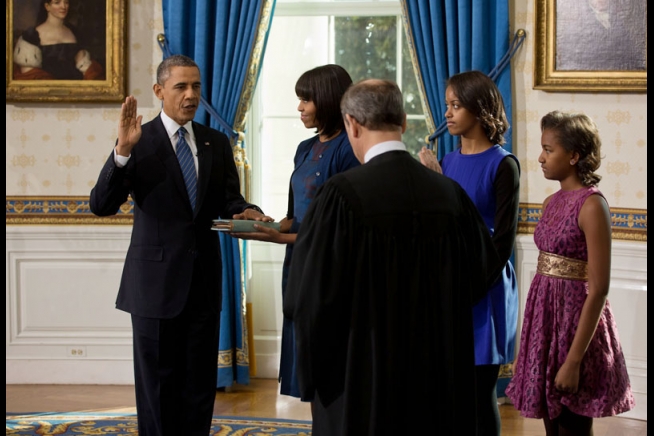
Photo: L. Jackson, White House
President Obama is aware of his role in making history, each time he refers to being on its “right side.” His reference in his inaugural speech to acting for “posterity” means that he will continue make history in this second term. The White House web page right now has a pop-up, extolling his coalition to “Help ake history.”
He can’t help it. He makes history every day, just by getting up and going to work.
-
You are currently browsing the archives for the Public Affairs category.

A memoir in letters. Excerpts from letters that a father wrote his children each week for almost 30 years, full of the mundane and poignant, the witty and wise. Stories from a different time, from a small town in Connecticut.
History Shock
 Pleased to announce the publication of my book in May 2021 by the University Press of Kansas. This collection of “stories with a history” narrates incidents over the course of my career in the Foreign Service when historical understanding – or lack of it – got in the way in the conduct of day-to-day diplomacy.
Berkshire County’s Industrial Heritage

Check out this book on the nineteenth century mills and those who owned and worked in them. Available through Arcadia Press or Amazon.
Slide Show – Getting to Yes, Woman Suffrage in the Berkshires and Beyond
-
Slide Show – Intersections, Pittsfield’s Neighborhoods
-
Slide Show – Turning Points


Slide Show – Preserving the old Berkshire Athenaeum
 Thomas Allen donated $50,000 to build the Athenaeum in 1876.
 A yong architect from New York, William Appleton Potter, had his design selected for the new Athenaeum.
 The original architectural drawing of the front elevation of the Athenaeum
 An early photo of the High Victorian Gothic building, pointed arches, twin gables, multi-color stone patterns,skylight, stained glass windows
 Majestic, quartered oak tresses in the addition built in 1896
 Proposed new library design, in 1944
 Bulging of stonework on from of building required drastic measures to shore up front, in 1979
 A restored skylight is returned to the roof in repairs undertaken in 2001
 Stained glass window on west gable, showing steel tie placed in 1979 stabilization repairs
 Masonry work begins on the Athenaeum in the deep of winter
 Removing the stained glass panels for repair
 Cracks in the masonry
 More cracks in the masonry
 Lifting the capstone off the east gable, the first stone removedd








 History All Around