Archive for category International
Did Anyone Die in the War of 1812?
Posted by John Dickson in Brown Signs, History in our surroundings, International on June 24, 2012
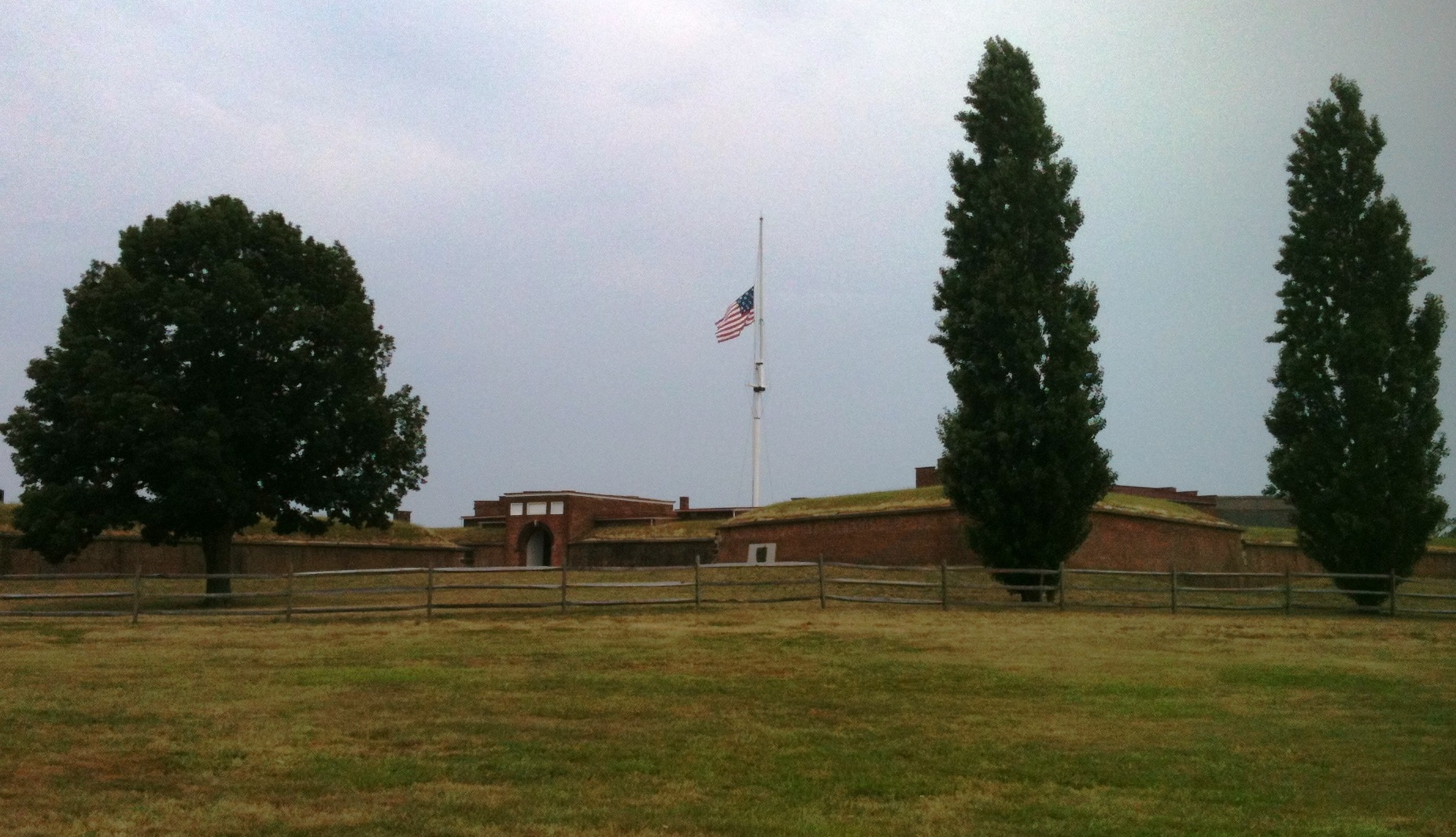
Proof through the night
A week after the tall ships descended on Baltimore for the bicentennial of the beginning of the War of 1812, and the city’s historic landmarks related to that event had returned perhaps to our national forgetfulness of that war. A few visitors to Fort McHenry made our tour relaxed and free of mobs. The Inner Harbor was back to paddle-boat dragons, summer-time outdoor live music and smoothies.
Two things struck me about the exhibits at Fort McHenry, where Francis Scott Key’s view of the flag still waving after a night of British bombardment is memorialized, quite informatively and attractively. 1500 shells. Four people died. In fact, little mention was made of any casualties in the entire war.
It is hard to go to a battlefield or memorial of the Civil War, or any American military engagement since, and not be confronted with a narrative of death and casualty. But in the War of 1812, and to a lesser extent, our Revolutionary War, the notion of soldiers dying in action is not central to the historic narrative. Certainly, today, following the mass casualties in the Vietnam War, news coverage from both Iraq and Afghanistan has been dominated by our losses. Did these soldiers die in vain without their remembrance?
The second missing item was the burning of York (present-day Toronto) by Americans. Much emphasis was placed on the burning of the White House and the Capitol, but with no mention of the previous sacking of Toronto. In Canada, the battle in Toronto and subsequent defense of territory captures the story line and aligns with their national identity as non-Americans.
The question we have to ask, with our emphasis on our loss in Washington, and Canadian’s emphasis on their loss in York, do we choose to hold to the painful remembrance of loss inflicted on us, on our tragedies, rather than on the tragedies we inflict on others?
Walking around Ft. McHenry, I imagined 5th graders on class trips running around the premises, looking in on rooms where soldiers slept four to a bed, or climbing on the huge cannons, or trying to imagine a harbor full of tall warships firing relentlessly at the fort. Would they make the connection between the smoothies in the Inner Harbor and the sacrifices 200 years earlier at that fort?
In fact, many died in this war. An estimated 15,000 U.S. soldiers.
Saving Haiti’s Heritage
Posted by John Dickson in History in our surroundings, International, Personal memory on January 21, 2012
Last week, Haiti marked the second anniversary of the earthquake which devastated an already impoverished nation, resulting in an estimated 300,000 lives lost.
The rebuilding effort has put enormous strains on a government, itself devastated both in terms of physical buildings and human talent in the disaster. It has struggled to lead and coordinate a global army of government and non-government aid organizations.
At the same time, the character of the Haitian people known for their resilience, patience under suffering and independence has largely carried the country through this period.
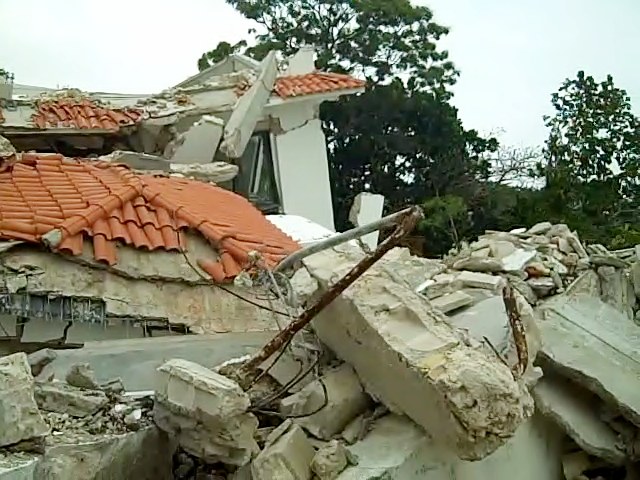
Quisqueya University after the quake. Photo: JDickson
This strength of character is rooted deep in Haiti’s heritage, based on a prolonged, violent struggle against slavery, then for independence and, in this century, against brutal regimes. African religious traditions combine with Christian missionary vestiges to forge a deeply spiritual people. These elements of a unique heritage are depicted in a vast, rich and diverse body of visual and performing arts, of libraries and archives. This art is a significant way of passing along to each generation their story as a nation and hence their identity.
The earthquake also struck these manifestations of Haitian identity. Cathedrals collapsed along with their murals. The national library, archives buildings and universities were destroyed. Art in private collections was lost.
Shortly after the earthquake struck, the image of postwar Iraq with looting and devastation of cultural and historic treasures mobilized an army of cultural experts around the globe. Smithsonian museum officials took the lead in this country to raise awareness. They were greeted with skepticism internationally as the heavy-handed Americans, but amidst the studies, conferences and promises, not much tangible was being done. Someone had to take the lead, and fortunately the Smithsonian, with its international reputation for excellence, persevered.
Not only did officials have to persevere internationally, but also against our own government. Recovery and restoration of cultural buildings and artifacts was not a priority, U.S. leadership in diplomatic, military and aid offices indicated. The Smithsonian led a coalition of concerned organizations to advance a relief and recovery effort for Haiti’s heritage. They put together a smart plan which not only restored and saved murals, paintings and artifacts, but also trained Haitians to do this very work, giving them employment in a wrecked economy.
How do you put a price or a priority on one’s identity? On one’s history? It is easier to attach such concepts to people’s emergency needs of health, food and shelter. Yet, what has really been important in seeing the nation through this crisis, is its heritage, its character of resilience and neighbor helping neighbor, in the absence of government or relief organization.
An interesting footnote to the Haitian anniversary came this week here in Washington following a much milder tremor last summer along the east coast. The only real damage to have taken place was sustained in the National Cathedral and the Washington Monument.
We as a country could not see our way to using public resources to restore our most recognizable feature on our capital landscape. This week, a billionaire equity magnate and lobbyist announced he was putting up the funding to fix the Washington Monument. The new Episcopal Bishop is seeking to raise private funding to restore the cathedral.
The U.S. earthquake proved, perhaps even more starkly, the Haitian and Iraqi experiences that the manifestations of a people’s heritage suffer in such natural and man-made disasters, and yet efforts to protect, preserve and restore evidence of a people’s contributions to human history are held in such low esteem.
Peace Corps is 50
Posted by John Dickson in International, Personal memory on September 22, 2011
This week, Foreign Policy magazine started a feature on its web site called Decline Watch where it asks readers to give examples of American decline. This coming week, the Peace Corps is commemorating its 50th anniversary. Heading back to the heady times at the beginning of the Peace Corps, it’s apparent that we would be unable to pull off that kind of inspiring government initiative today.
A brief review. President Kennedy actually floated the idea of a Peace Corps type organization during the Presidential campaign. He officially started it by Executive Order on March 1, 1961, ordering the State Department to use existing funds to set up a pilot program. Within three months, the Peace Corps had 11,000 applications. By June, training had begun for programs in two countries: Colombia and Tanganyika (Tanzania, now.) By August, the first volunteers had arrived overseas, in Ghana. It wasn’t until September 22 that Congress actually approved legislation to establish and fund the Peace Corps. By December, there were 500 volunteers in nine countries.
It’s not hard to imagine what would happen in 2011 were such a program conceived. What would a timeline look like for such an idea today, with the built-in delays in Congressional obstruction, in interagency bureaucratic wrangling, in media criticism. Imagine a President trying to set up anything under Executive Order, or a government bureaucracy finding funds in its own budget to launch a new program. Or a Congress acting in 6 months to establish a program that quickly. Granted that JFK enjoyed greater majorities in both houses of Congress than President Obama has had. Still, it’s hard to imagine that we could put the same kind of “boots on the ground” within six months for any government initiative now.
The Peace Corps has always been bigger than its actual statistics. It’s been an idea that captivated many, early on and enduring. It’s left an imprint on the 139 countries which had seen Westerners as colonizers only, as militarists or as imperialists making a profit off of their resources. Further, it’s left an imprint on the 200,000 volunteers who have offered two years of service, making them, their families and neighbors more worldly aware. A recent survey said over 90% of former volunteers rated their experience as excellent or very good.
I am one of them. So is my wife!
Golden Eras
Posted by John Dickson in History in our surroundings, International on July 20, 2011
A funny thing happened on the way back to the Golden Era. In fact many funny things, since one way back became the story line in Midnight in Paris, a Woody Allen movie. The main character in this story, a Hollywood screen writer who travels to Paris with his fiancé in 2010, is able to transport himself back to his vision of the Golden Era – Paris in the 1920s with its cultural, expatriate scene.
The movie certain portrayed an exceptional Golden Era. Hemingway and the Fitzgeralds, partying with Cole Porter, Picasso and Gertrude Stein and Salvador Dali. Exciting, young, energetic, late nights, cafes, dancing and drinking and discussing writing and painting abstract expressionism.
The funny thing was that the young screen writer met and fell in love with a woman muse from that era, but she had a her own concept of the Golden Era – Paris at the turn of the century with Toulouse Lautrec and Degas and Gaugin. They, too, whom the couple met, had their idea of the Golden Era and then the young screen writer moved to the logical conclusion that every era will think back to an earlier one and romanticize it as a Golden Era.
My own Golden Era? Several. Pre-Kennedy assassination 1960s. Or, revolutionary Boston. Westward expansion into Ohio and Kentucky. Times filled with hope and confidence, new ideas that mattered and hard work with a purpose.
What are yours?
These remain, though, nothing but romance, glossing over other uncomfortable realities about those eras. The movie’s protagonist admits to having a nightmare of living in a time without anti-depressants and antibiotics.
Still, one has to wonder. Will these years be viewed as anyone’s Golden Era? It’s hard to imagine. Where’s the romance in 140 characters of Twitter, self-absorbed blogs (like this one!) or deleted e-mails? Where are the new ideas and ambitious undertakings when our government is hopelessly in debt and incapable of addressing our inability to fund projects that will carry the next generation.
You want bold ideas and projects? Go to China. We just came back from our first trip to China, and would have never gone were our daughter not living there. It is hard to miss the double BOOM going on there. One the day we left, they were inaugurating the longest bridge over salt water in the world and a high speed train between Beijing and Shanghai.
Of course, the trade-off is that they can ignore delaying criticism of the projects, such as environmental or structural safety issues. No need to consult with all the stakeholders, residents, or taxpayers.
Still, one does get the strong sense that our moment has passed. We have passed the torch to a new generation, and we have built a bridge to the 21st century. It’s just that they both are in China. The Golden Era, but they would probably give it another term, like the Era of Heavenly Rejuvenation.
Tear Down That Wall
Posted by John Dickson in International, Public Affairs on May 7, 2011
Is there information overload on Bin Laden’s death? Well, here’s another thought, looking at the last ten years with an eye to future history.
First, let’s not forget the last ten years. Let’s not forget what it has been to live with a Bin Laden at large, with a huge impact on our lives, from direct trauma to major inconvenience. One of the most frequent questions heard in interviews this past week on the talk shows was “Did you ever think we would see this day (when Bin Laden was eliminated?)” I bet a poll would show that most people thought that we would never find him. And still, most people think his demise will have little influence and that we are going to live with terror and our heightened state of alerts from now on.
Yet, years from now, it may look like it was foreordained that we would capture Bin Laden and that his reign of terror would naturally come to an end, but when we are living in the middle of it, it is hard to imagine such an outcome.
Second, let’s hope that his demise has the same impact that capturing Abimael Guzman, the leader of Shining Path in Peru, had on that country emerging from decades of terrorist attacks and a resulting “under siege” mentality. I moved to Peru just several years after his capture and over the following couple of years saw the country transform itself, and gradually return to normal living. Yet, the mark remains, as Peruvians lived through the worst and fear developments which could constitute a return.
A similar transition occurred in South Africa, where I also witnessed first-hand the demise of apartheid and the violent resistance to it. Almost overnight, following the release of Mandela and the unbanning of the African National Congress, the security at airports, movie theaters and shopping malls came down, curfews were lifted and troops left the townships.
The fall of the Berlin Wall also ushered in a more relaxed atmosphere, an unthinkable event just a few years earlier. Prior to 1989, many of us thought we were living in a permanent state of tension, between East and West.
Is it too much to think that one day the security at our airports will also be removed? Relaxed? That our troops will come home from Iraq and Afghanistan and that we could enjoy the same kind of peace dividend we earned during the 1990s?
Tear down those walls, those jersey barriers, those screens, those magnatometers!

Photo taken from christyclark.ca, via debateitout.com
-
You are currently browsing the archives for the International category.

A memoir in letters. Excerpts from letters that a father wrote his children each week for almost 30 years, full of the mundane and poignant, the witty and wise. Stories from a different time, from a small town in Connecticut.
History Shock
 Pleased to announce the publication of my book in May 2021 by the University Press of Kansas. This collection of “stories with a history” narrates incidents over the course of my career in the Foreign Service when historical understanding – or lack of it – got in the way in the conduct of day-to-day diplomacy.
Berkshire County’s Industrial Heritage

Check out this book on the nineteenth century mills and those who owned and worked in them. Available through Arcadia Press or Amazon.
Slide Show – Getting to Yes, Woman Suffrage in the Berkshires and Beyond
-
Slide Show – Intersections, Pittsfield’s Neighborhoods
-
Slide Show – Turning Points


Slide Show – Preserving the old Berkshire Athenaeum
 Thomas Allen donated $50,000 to build the Athenaeum in 1876.
 A yong architect from New York, William Appleton Potter, had his design selected for the new Athenaeum.
 The original architectural drawing of the front elevation of the Athenaeum
 An early photo of the High Victorian Gothic building, pointed arches, twin gables, multi-color stone patterns,skylight, stained glass windows
 Majestic, quartered oak tresses in the addition built in 1896
 Proposed new library design, in 1944
 Bulging of stonework on from of building required drastic measures to shore up front, in 1979
 A restored skylight is returned to the roof in repairs undertaken in 2001
 Stained glass window on west gable, showing steel tie placed in 1979 stabilization repairs
 Masonry work begins on the Athenaeum in the deep of winter
 Removing the stained glass panels for repair
 Cracks in the masonry
 More cracks in the masonry
 Lifting the capstone off the east gable, the first stone removedd








 History All Around