Archive for category History in our surroundings
Is 9/11 History?
Posted by John Dickson in History in our surroundings, Personal memory, Public Affairs on September 6, 2011
As we approach the tenth anniversary of the attacks of September 11, 2001, we find ourselves consumed with remembrances and interpretations of that day, and its impact on our lives since.

Smithsonian 9/11 Exhibit. Photo credit: J Dickson
We are as consumed with these as we were riveted to television that day, watching over and over again the unimaginable images of planes flying into the buildings and of buildings collapsing. So many of us have our own story to tell of that day, where we were, how we found out, and, incredibly, how we knew someone in the buildings, on their way to the buildings, or caught up in the rescue efforts.
My own story is set in an airplane, flying across the Atlantic with my son, landing in London to learn that something terrible had just happened by the mere question of the rental car agent who asked “Are you American?”
I have a family member who was an EMT who was in the area when the towers fell (and survived.) I have a colleague whose son was late to work that morning and never entered the building before it was hit.
We all have our own stories as well of our response to that day, of friends and family in combat missions in Afghanistan and Iraq, of being lied to, and in my case, trying to defend to foreign partners our government’s actions based on this misinformation.
We have lived with and adapted to the heightened security, most evident in our travel but also in and around our monuments and workplaces.
This is still not history, though, as we are still living it. We are still fighting wars as a consequence, we are still in a state of heightened security, and we are still living with the debt run up to fight those wars.
History will come when our soldiers have returned home, when our economy is responding to other challenges, when we are no longer x-rayed and photographed while trying to board planes. Historic understanding tells us that these realities will not endure. Just as the fall of the Berlin Wall signaled the end of the Cold War, this 9/11 chapter will also end, replaced by the next development, hopefully without the horrific or far-reaching consequences that those 20 hijackers unleashed ten years ago.
The Smithsonian Museum of American History has now an exhibit of 9/11. As the repository for all artifacts collected from New York, Washington and Pennsylvania, the museum has put a small sampling on display, on tables out from behind glass cases for people to see and read and experience the short stories of each item. We stood in line for over an hour to enter the small room, with four tables on which lay these artifacts – the cell phone used by New York Mayor Rudy Guiliani, a doll collected from the scene of the two towers, badges of office workers and rescue workers from all three sites or a door from a crushed fire engine.
The most powerful, though, remains the video of the television news, unfolding that morning, with Good Morning America starting off with the breaking news that Michael Jordan was considering a comeback to the NBA that season, followed by the initial reports of an explosion at the World Trade Center, and then the live coverage of the second plane flying into the second tower, the fire at the Pentagon, the crash in the Pentagon and the collapse of the two towers.
The anniversary will focus on the heroes, of the day and since. And there are many, and they deserve our gratitude and admiration. History will also record their actions that day, that year and the decade since. But what history will also have to try to capture was the sheer sense of disbelief, of paralysis as we sat and watched over and over again these images. That was our collective reality.
Why Didn’t I Think of That?
Posted by John Dickson in History in our surroundings on August 26, 2011
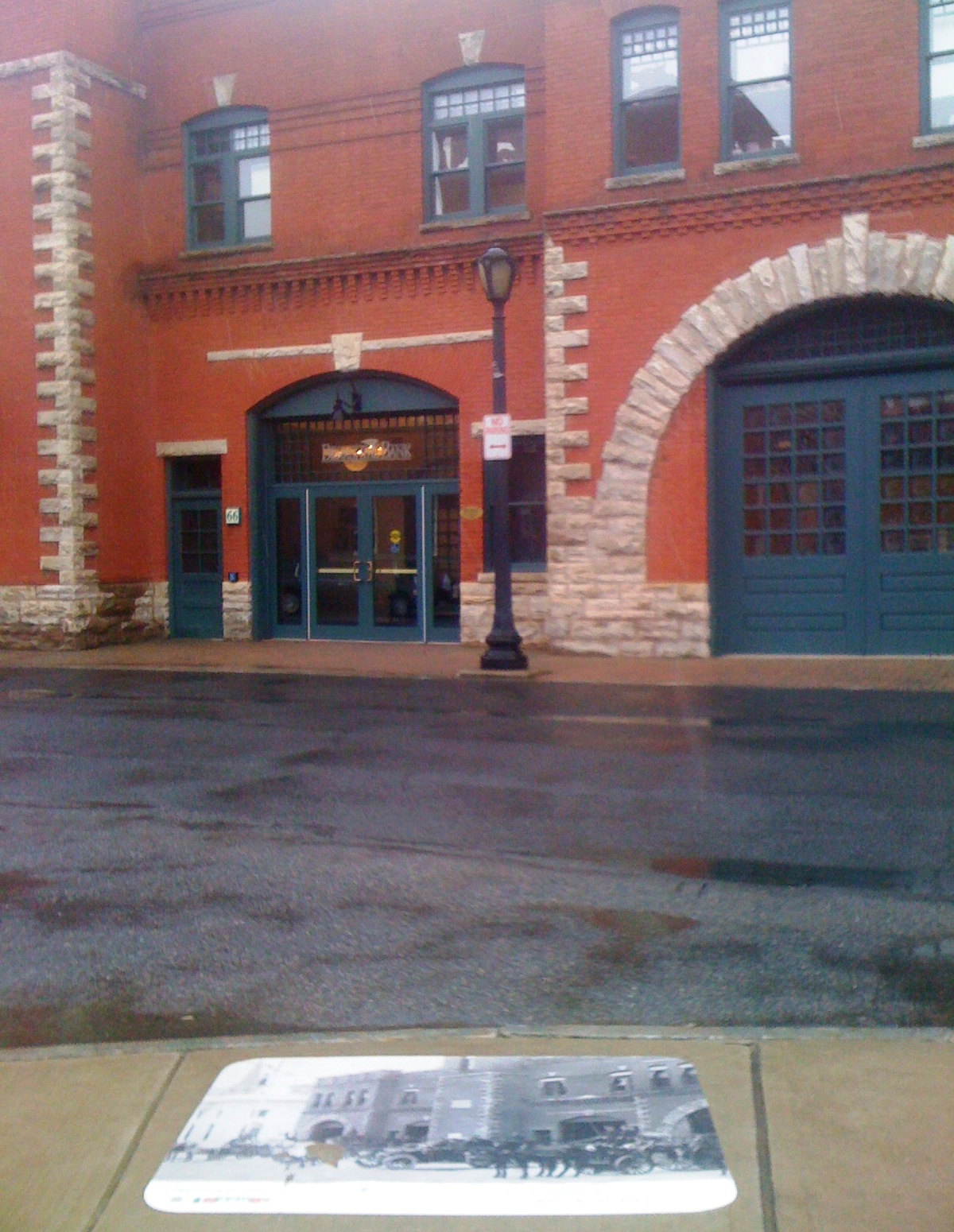
Walk On, Pittsfield 250. Credit J Dickson
Put this in the better idea category. At least in the idea on how to use photos to travel back in time.
I was wandering in downtown Pittsfield, Massachusetts when I came upon a photo pasted on the sidewalk. It turned out to be a historic photo of a building across the street, taken from the same vantage point over a century earlier. The current building is a bank, but the photo shows it used to be a fire department.
The poster is a “walk-on” and is but one of multiple posters in a public art project set up to commemorate the city’s 250th anniversary. Only a handful of the posters are historic, but they do represent one way to transport oneself back in time to see, for example, shoppers coming out of a downtown department store (now another bank building) or an aerial view of the GE facilities (now largely deserted) or of Park Square in the 1860s (now, more open). Placed correctly, you can let your imagination run!
One other way to use historic photos is through mobile technology. There’s a mobile app called “What was There” which pinpoints (through Google Maps) photos which users have uploaded of sites around the country. With an address, you can go to the site, find the photo and position yourself to see what it looked like 50 or 150 years earlier. Right now, it just needs a lot more users to upload photos.
For more info:
On “Walk On”: http://pittsfield250.com/2011/02/walk-on-%E2%80%A2-public-art-installation/
On “What was There”: http://whatwasthere.com/
Why are battlefield sites so peaceful
Posted by John Dickson in Brown Signs, Colonial, History in our surroundings on August 12, 2011
Ever heard of the Battle of Hubbardton? Neither had I, until this past weekend when driving south in Vermont we came upon the “brown sign.” Turns out, it is the only battle fought “entirely in Vermont” during the Revolutionary War. The “entirely” is important since within a month there was a second battle in Bennington, Vermont in the southwestern corner of the state, bordering Massachusetts and New York. Turns out, as well, that it was a pivotal battle on July 7, 1777 to forestall the British in their march from Ticonderoga, in their belief that they could contain the revolution to the rebellious New England colonies by controlling the Hudson and cutting them off from New York and all points south. Or, at least that’s what we read in the clean and informative visitor center.
I have found over many years of reading history the difficulty of conveying the unrolling of a battle through the printed word. Too many groupings, elements and terrain leave me confused. Hubbardton was no different, but they did have a relief map with lights which lit up as the taped narrator walked the observers through the chronology of the colonists holding the ridge, then giving way, but seeing a vulnerable opening in the British flank which did allow them to achieve one objective of delaying the British advance south.
Moving from that well-designed explanation to the actual site proved a setback, as we tried to imagine troop movements coming from which valley? Proceeding to which points on the ridge and down which hill and where was the log/brush fence?
It didn’t matter to us, since we were more interested in the beautiful scenery on a summer Sunday looking out over the forests and the hills. The only sounds were the wind through the trees, an occasional bird, and our voices.
It was so serene it was hard to imagine the fog of war where we standing no matter how long ago, and how quickly the battle transpired on just one morning. The fact that over 100 soldiers died where we were walking added an eerie presence to the serenity. The field becomes less a battlefield than a cemetery.
This calm proved no different from other battlefields I have visited, like Gettysburg or Little Bighorn or Isandlwana in South Africa.
We learned there is a large reenactment at Hubbardton every year, and since next year is the 240th anniversary, the congregating reenactors will reach the hundreds.
Given the deaths on the battlefield, shouldn’t there be a memorial service instead?
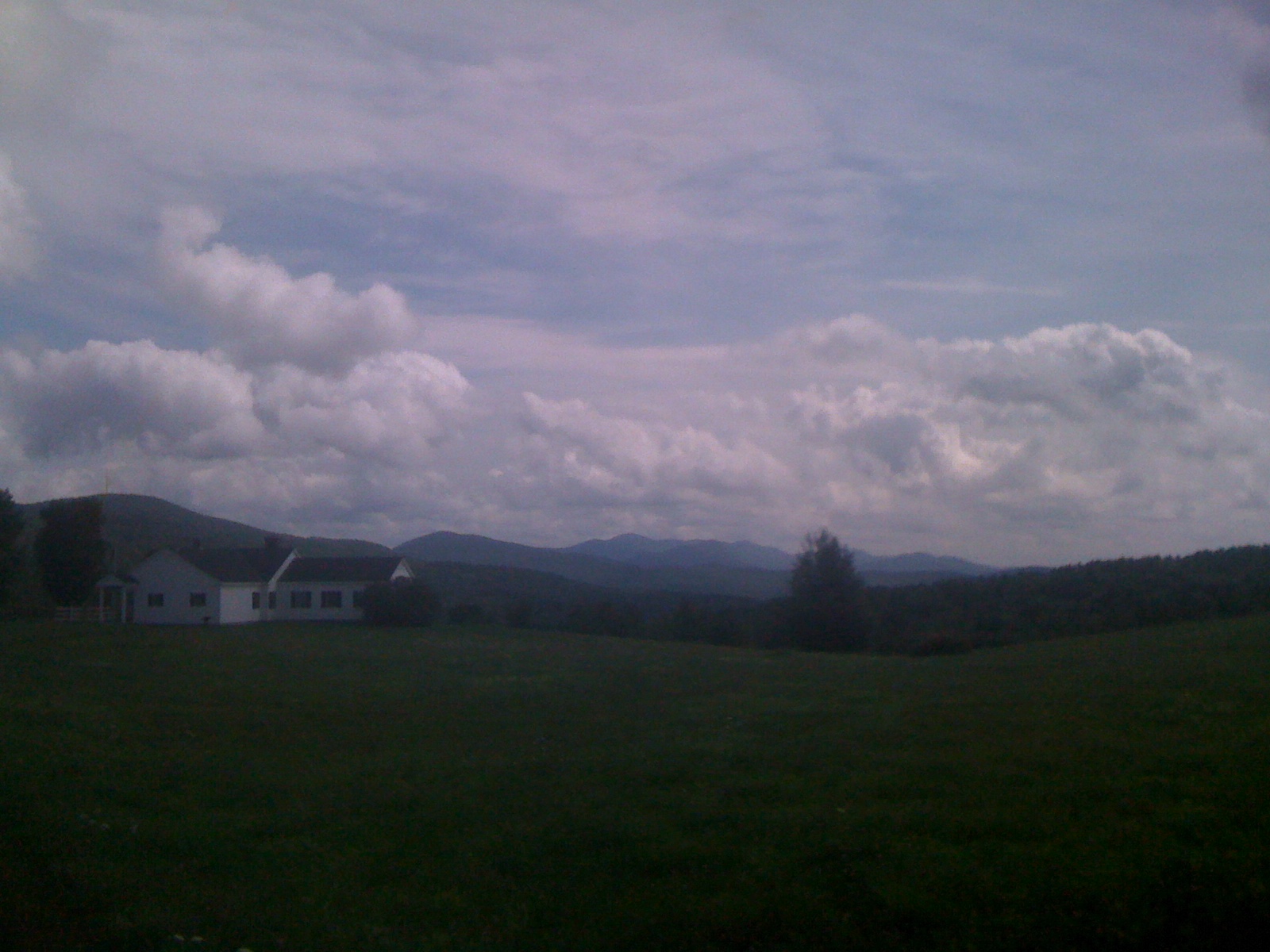
The view from Monument Hill, with battlefield visitor center. Hubbardton, Vermont
Golden Eras
Posted by John Dickson in History in our surroundings, International on July 20, 2011
A funny thing happened on the way back to the Golden Era. In fact many funny things, since one way back became the story line in Midnight in Paris, a Woody Allen movie. The main character in this story, a Hollywood screen writer who travels to Paris with his fiancé in 2010, is able to transport himself back to his vision of the Golden Era – Paris in the 1920s with its cultural, expatriate scene.
The movie certain portrayed an exceptional Golden Era. Hemingway and the Fitzgeralds, partying with Cole Porter, Picasso and Gertrude Stein and Salvador Dali. Exciting, young, energetic, late nights, cafes, dancing and drinking and discussing writing and painting abstract expressionism.
The funny thing was that the young screen writer met and fell in love with a woman muse from that era, but she had a her own concept of the Golden Era – Paris at the turn of the century with Toulouse Lautrec and Degas and Gaugin. They, too, whom the couple met, had their idea of the Golden Era and then the young screen writer moved to the logical conclusion that every era will think back to an earlier one and romanticize it as a Golden Era.
My own Golden Era? Several. Pre-Kennedy assassination 1960s. Or, revolutionary Boston. Westward expansion into Ohio and Kentucky. Times filled with hope and confidence, new ideas that mattered and hard work with a purpose.
What are yours?
These remain, though, nothing but romance, glossing over other uncomfortable realities about those eras. The movie’s protagonist admits to having a nightmare of living in a time without anti-depressants and antibiotics.
Still, one has to wonder. Will these years be viewed as anyone’s Golden Era? It’s hard to imagine. Where’s the romance in 140 characters of Twitter, self-absorbed blogs (like this one!) or deleted e-mails? Where are the new ideas and ambitious undertakings when our government is hopelessly in debt and incapable of addressing our inability to fund projects that will carry the next generation.
You want bold ideas and projects? Go to China. We just came back from our first trip to China, and would have never gone were our daughter not living there. It is hard to miss the double BOOM going on there. One the day we left, they were inaugurating the longest bridge over salt water in the world and a high speed train between Beijing and Shanghai.
Of course, the trade-off is that they can ignore delaying criticism of the projects, such as environmental or structural safety issues. No need to consult with all the stakeholders, residents, or taxpayers.
Still, one does get the strong sense that our moment has passed. We have passed the torch to a new generation, and we have built a bridge to the 21st century. It’s just that they both are in China. The Golden Era, but they would probably give it another term, like the Era of Heavenly Rejuvenation.
What’s Your Linden Oak?
Posted by John Dickson in History in our surroundings on June 14, 2011
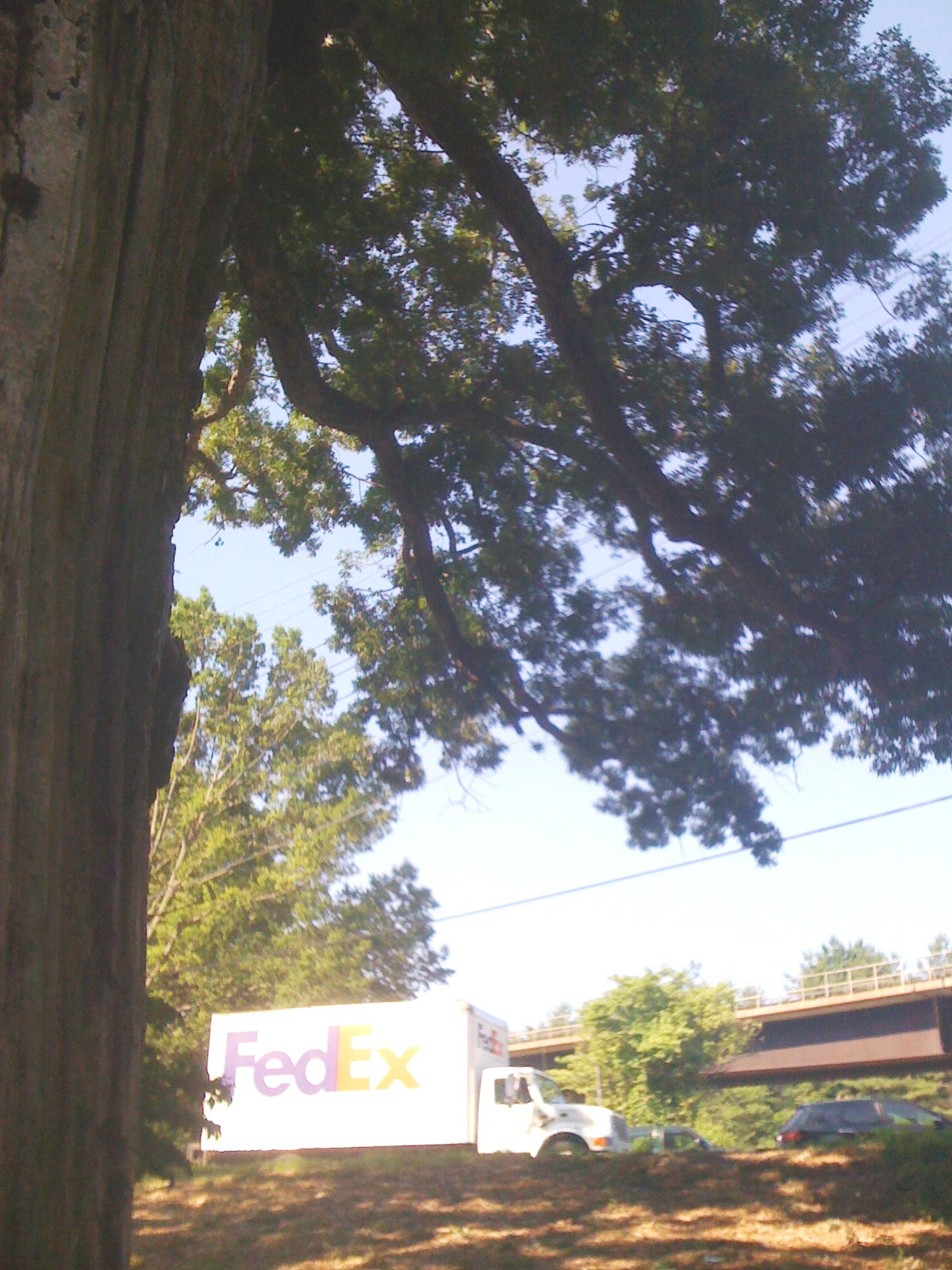
photo credit: JDickson
I rode the Washington Metro to work for several years, slogging it from the Maryland suburbs to downtown DC. My stop was Grosvenor, just past the Medical Center (NIH) station. Between those two stations, the track comes out from the underground, and then it makes an odd curve. When I did think of it (which was hardly ever,) I assumed the curve followed the road, Rockville Pike, an extension of Wisconsin Avenue. Until last weekend.
On a jog around the neighborhood, a friend pointed out a historic marker on the side of the road and told the brief story of Linden Oak. The original plans for the Metro had the Red Line going right through this old white oak tree, which was older than the country. A local politician and activist led a fight to preserve the tree, and you guessed it, the Metro designers changed the course of the Red Line to include an odd curve going around the tree.
The white oak is the official state tree for Maryland, so designated because of the Wye Oak which had reached an age of over 450 years. Still, it was the Linden Oak which earned the honors of the Bicentennial Tree in 1976, perhaps because of its association as a protest tree. More recently, it has surpassed the Wye Oak which was toppled by a storm in 2002. So the Linden Oak, a babe not quite 300 eyars old, is now the largest and oldest white oak tree in the state.
Of equal interest may be the career of Idamae Garrott, the politician instrumental for saving the tree. She won terms as a County Council member and state legislator in both the House and the Senate. Her obit in the local paper gives a flavor of her energy, her political style (“paralysis by analysis”) and her tenacity serving the county for over 40 years. Yet, her obit makes no mention of the “Linden Oak.” It had to have been just one small paragraph in a long book of legislative struggles at the local level.
What’s striking is history finding its way into the most random of places, unobserved and unknown by the thousands of passers-by, every single day. A history of a tree, of a civic activist, of a major urban transportation system.
It gives us pause. How many of these stories surround us? How many times during the course of the day do we pass by a spot which may or may not have a marker, but certainly has a compelling story? What’s your Linden Oak?
-
You are currently browsing the archives for the History in our surroundings category.

A memoir in letters. Excerpts from letters that a father wrote his children each week for almost 30 years, full of the mundane and poignant, the witty and wise. Stories from a different time, from a small town in Connecticut.
History Shock
 Pleased to announce the publication of my book in May 2021 by the University Press of Kansas. This collection of “stories with a history” narrates incidents over the course of my career in the Foreign Service when historical understanding – or lack of it – got in the way in the conduct of day-to-day diplomacy.
Berkshire County’s Industrial Heritage

Check out this book on the nineteenth century mills and those who owned and worked in them. Available through Arcadia Press or Amazon.
Slide Show – Getting to Yes, Woman Suffrage in the Berkshires and Beyond
-
Slide Show – Intersections, Pittsfield’s Neighborhoods
-
Slide Show – Turning Points


Slide Show – Preserving the old Berkshire Athenaeum
 Thomas Allen donated $50,000 to build the Athenaeum in 1876.
 A yong architect from New York, William Appleton Potter, had his design selected for the new Athenaeum.
 The original architectural drawing of the front elevation of the Athenaeum
 An early photo of the High Victorian Gothic building, pointed arches, twin gables, multi-color stone patterns,skylight, stained glass windows
 Majestic, quartered oak tresses in the addition built in 1896
 Proposed new library design, in 1944
 Bulging of stonework on from of building required drastic measures to shore up front, in 1979
 A restored skylight is returned to the roof in repairs undertaken in 2001
 Stained glass window on west gable, showing steel tie placed in 1979 stabilization repairs
 Masonry work begins on the Athenaeum in the deep of winter
 Removing the stained glass panels for repair
 Cracks in the masonry
 More cracks in the masonry
 Lifting the capstone off the east gable, the first stone removedd








 History All Around