John Dickson

This user hasn't shared any biographical information
Homepage: https://timecapsulepilot.wordpress.com
If These Walls Could Talk
Posted in Berkshires, Brown Signs, History in our surroundings on October 5, 2011
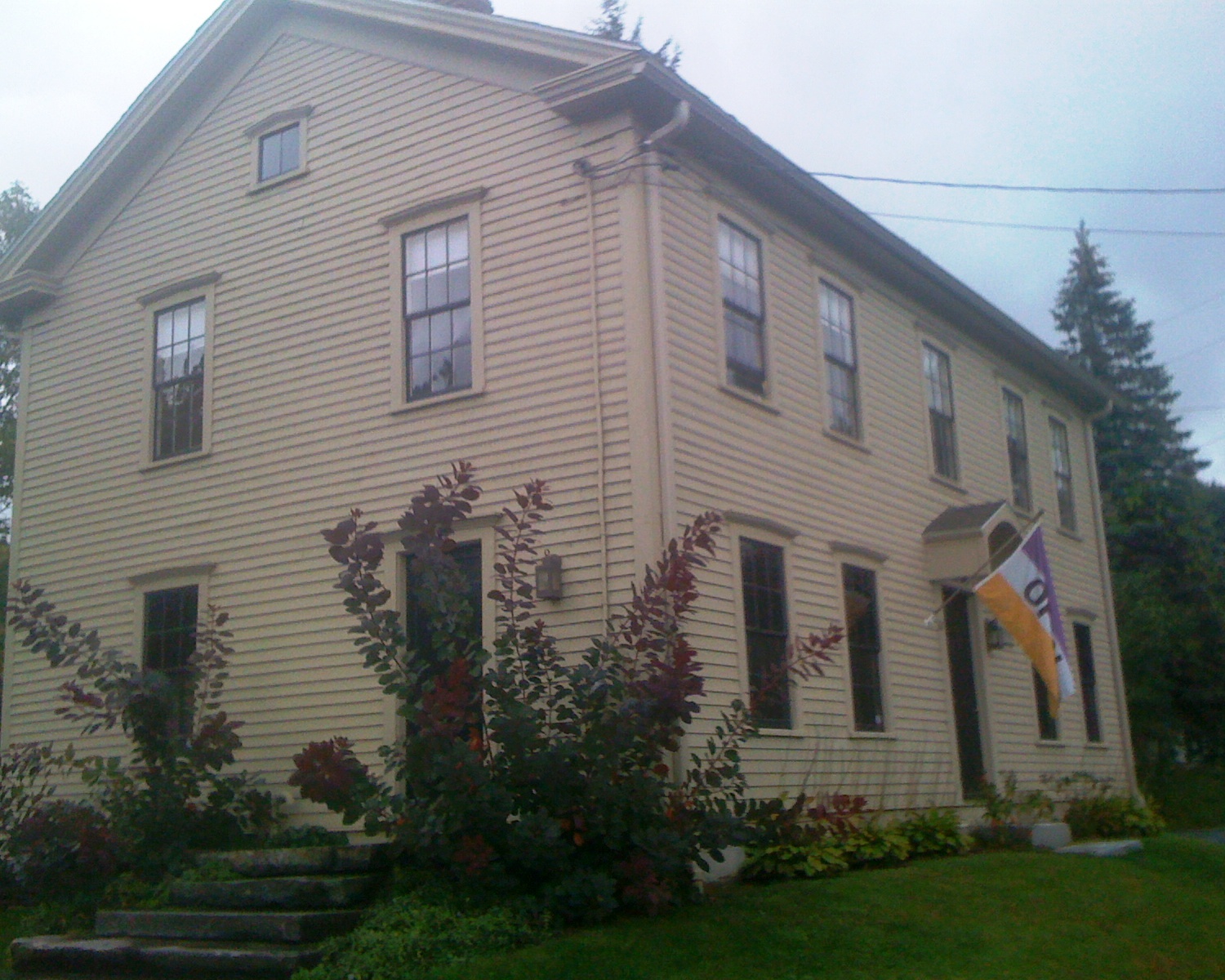
Susan B. Anthony Birthplace Museum. Photo: JDickson
Historic figures are sometimes connected with a place. Lincoln and Illinois. King and Atlanta. Jefferson and Virginia. Capone and Chicago.
Susan B. Anthony’s connection is probably upstate New York, especially as she is tied to the Seneca Falls Woman’s Rights Convention, held in 1848. It was in Adams, Massachusetts where she was born and where her birthplace home is now a small museum.
Anthony lived there until she was 6. The house, built by her father, is now a small museum and has been almost entirely restored, with attempts to make it as authentic to the 1820s period as possible. Wide floor boards; uneven lath and plaster walls. Two rectangular-shaped, small rooms lay adjacent to each side of a stairway up to a second floor with the same pattern of four rooms and a center hallway. Sounds a lot like a house my wife and I own, not 20 miles away, built a few years later.
Walking through Anthony’s birthplace home, visitors must wonder what it was inside those walls that contributed to young Susan developing into a committed, unbending woman’s rights, temperance and abolitionist reformer. Reformer may be too mild, as her newspaper was called “The Revolution.” She even had two brothers who joined anti-slavery crusades prior to the Civil War, traveling to Kansas to join John Brown in his violent activities opposing the expansion of slavery there.
Perhaps, it was her father’s Quaker pacifist, temperance beliefs. One can imagine growing up with family conversations surrounding her father’s decision to marry Lucy Read, a Baptist, and even referring to the injustice of having to apologize for marrying outside the Quaker meeting. (Betsy Ross, 50 years earlier and hundreds of miles further south, saw her sisters and experienced the shame herself as Quakers marrying outside the Meeting.)
Further, it is easy to see a possible impact coming from living with as many as a dozen young women who worked at her father’s mill, across the road. Imagine conversations the child Anthony might have had with or overheard from these young role models and mentors, focused on exhausting work, sharing their wages with families, looking ahead to lives as second-class citizens. Perhaps it was Anthony’s own experiences helping her mother cope with the feeding and care of all these boarders that contributed to her legendary organizing skills. It could have shaped her desire to get an education to avoid that kind of work, only to have a teacher deny her the opportunity to learn.
Still one more family anecdote had Anthony’s father selling liquor in the small store located in the front room of his house. Was his decision to abandon the sale of alcohol from his home at the insistence of his fellow Quakers behind Anthony’s embracing the temperance movement as one of three “causes” to which she devoted her life?
Anthony’s birthplace home is a humble house, compared to the grand-er restored mansions in Berkshire County which some of the country’s wealthiest built as summer escapes and now serve as shrines to the Gilded Age. But, her home serves another, perhaps more important, purpose besides trying to figure out her early influences. This home tells more closely the story of most residents eking out a living in the early 1800s in New England.
Peace Corps is 50
Posted in International, Personal memory on September 22, 2011
This week, Foreign Policy magazine started a feature on its web site called Decline Watch where it asks readers to give examples of American decline. This coming week, the Peace Corps is commemorating its 50th anniversary. Heading back to the heady times at the beginning of the Peace Corps, it’s apparent that we would be unable to pull off that kind of inspiring government initiative today.
A brief review. President Kennedy actually floated the idea of a Peace Corps type organization during the Presidential campaign. He officially started it by Executive Order on March 1, 1961, ordering the State Department to use existing funds to set up a pilot program. Within three months, the Peace Corps had 11,000 applications. By June, training had begun for programs in two countries: Colombia and Tanganyika (Tanzania, now.) By August, the first volunteers had arrived overseas, in Ghana. It wasn’t until September 22 that Congress actually approved legislation to establish and fund the Peace Corps. By December, there were 500 volunteers in nine countries.
It’s not hard to imagine what would happen in 2011 were such a program conceived. What would a timeline look like for such an idea today, with the built-in delays in Congressional obstruction, in interagency bureaucratic wrangling, in media criticism. Imagine a President trying to set up anything under Executive Order, or a government bureaucracy finding funds in its own budget to launch a new program. Or a Congress acting in 6 months to establish a program that quickly. Granted that JFK enjoyed greater majorities in both houses of Congress than President Obama has had. Still, it’s hard to imagine that we could put the same kind of “boots on the ground” within six months for any government initiative now.
The Peace Corps has always been bigger than its actual statistics. It’s been an idea that captivated many, early on and enduring. It’s left an imprint on the 139 countries which had seen Westerners as colonizers only, as militarists or as imperialists making a profit off of their resources. Further, it’s left an imprint on the 200,000 volunteers who have offered two years of service, making them, their families and neighbors more worldly aware. A recent survey said over 90% of former volunteers rated their experience as excellent or very good.
I am one of them. So is my wife!
The King Memorial
Posted in History ahead on September 19, 2011
News flash. There’s nothing wrong with the Martin Luther King Jr monument on the mall in Washington DC. In fact, there’s a lot that’s right to it.
King emerges in a slice of granite, out of a mountain, looking across the Tidal Basin to the Jefferson Memorial. He stands erect, arms crossed with a look of righteous anger. He’s staring out across the water to Jefferson, with a vigilance on our own progress towards living up to the ideals proposed in the Declaration of Independence. King’s body is only partly sculpted, just like the work of extending civil rights and equal opportunities for all remains unfinished. The plaza is replete with quotes from his speeches and letters, reminders to Americans of his life, and the courageous activism throughout his brief 39 years.
The view across the water gives the site a serenity and a sacredness broken only by the children enjoying the space to run and to line up for pictures at the base of the monument and next to quotes.
The plaza was full of people on the mid-week morning I visited. People of all races and all ages. It’s a short walk from the WWII Memorial and the Lincoln Memorial, a walk also full of people, on their pilgrimage to this site. It’s around the corner from FDR’s memorial, which is more like an outdoor museum, informative, but tucked away, and empty of people.
I’m pretty sure that most visitors were not thinking of the controversies surrounding the monument, issues which have been given too much attention. Yes, King looked a little stern and imposing, a little too much like other statues which the Chinese sculptor may have designed for Mao. Yes, there is an edited quote on the statue base, which could have been cited in its fullness on the wall surrounding the statue.
It’s not as if King avoided controversy in his lifetime. We caught a glimpse of that with the release of Jackie Kennedy’s tapes with her 1964 comments calling him a “phony” and “terrible.” I doubt too that visitors had those comments on their mind.
The monument will endure beyond these little issues, which will undoubtedly fade into obscurity. One hundred years from now, people will continue to pay tribute to King and his ideals. Moreover, his challenge to the nation will, unfortunately, probably also outlast the petty issues that help fill up our instant news cycle.
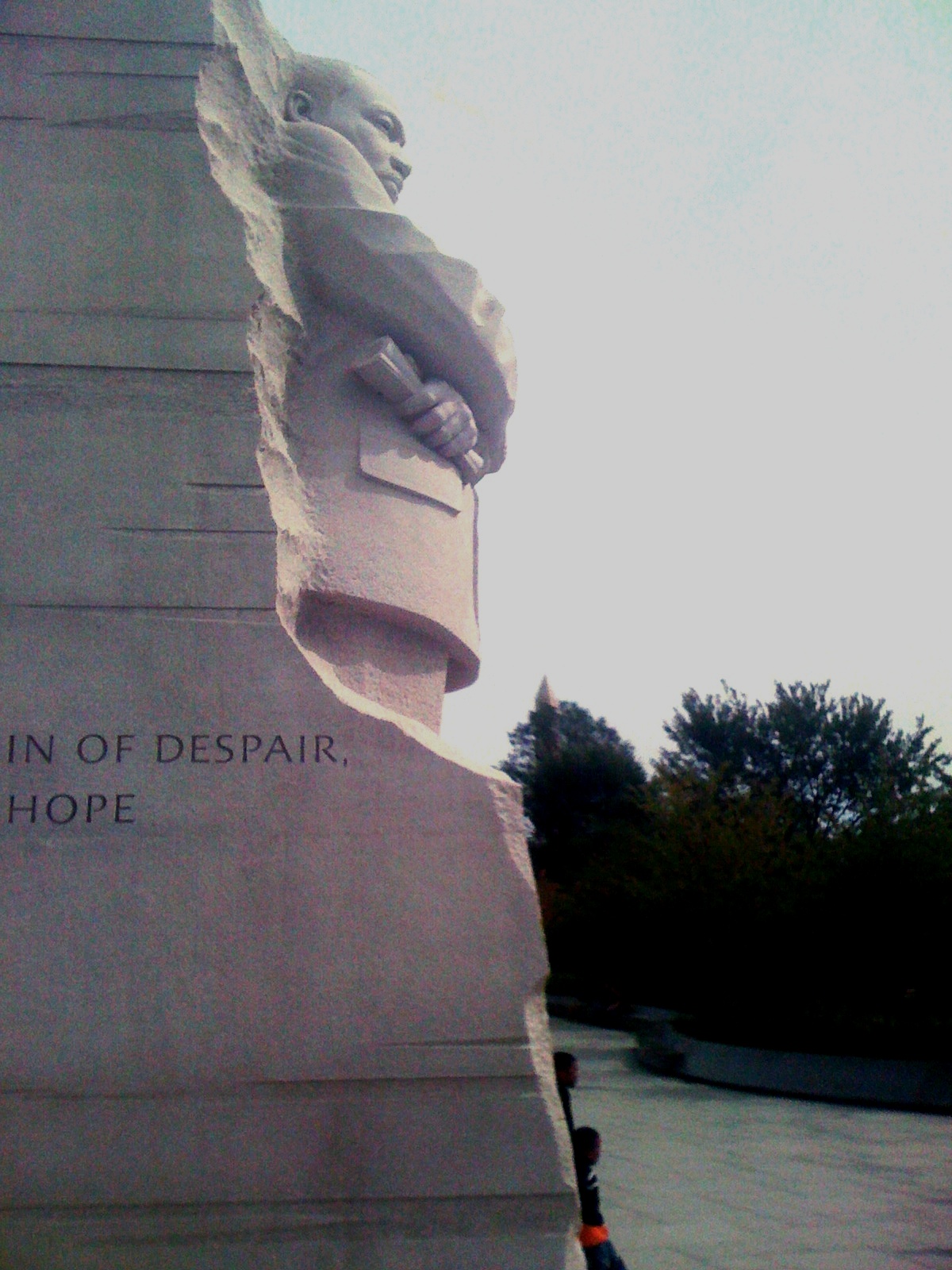
King on the Mall. Photo: JDickson
Is 9/11 History?
Posted in History in our surroundings, Personal memory, Public Affairs on September 6, 2011
As we approach the tenth anniversary of the attacks of September 11, 2001, we find ourselves consumed with remembrances and interpretations of that day, and its impact on our lives since.

Smithsonian 9/11 Exhibit. Photo credit: J Dickson
We are as consumed with these as we were riveted to television that day, watching over and over again the unimaginable images of planes flying into the buildings and of buildings collapsing. So many of us have our own story to tell of that day, where we were, how we found out, and, incredibly, how we knew someone in the buildings, on their way to the buildings, or caught up in the rescue efforts.
My own story is set in an airplane, flying across the Atlantic with my son, landing in London to learn that something terrible had just happened by the mere question of the rental car agent who asked “Are you American?”
I have a family member who was an EMT who was in the area when the towers fell (and survived.) I have a colleague whose son was late to work that morning and never entered the building before it was hit.
We all have our own stories as well of our response to that day, of friends and family in combat missions in Afghanistan and Iraq, of being lied to, and in my case, trying to defend to foreign partners our government’s actions based on this misinformation.
We have lived with and adapted to the heightened security, most evident in our travel but also in and around our monuments and workplaces.
This is still not history, though, as we are still living it. We are still fighting wars as a consequence, we are still in a state of heightened security, and we are still living with the debt run up to fight those wars.
History will come when our soldiers have returned home, when our economy is responding to other challenges, when we are no longer x-rayed and photographed while trying to board planes. Historic understanding tells us that these realities will not endure. Just as the fall of the Berlin Wall signaled the end of the Cold War, this 9/11 chapter will also end, replaced by the next development, hopefully without the horrific or far-reaching consequences that those 20 hijackers unleashed ten years ago.
The Smithsonian Museum of American History has now an exhibit of 9/11. As the repository for all artifacts collected from New York, Washington and Pennsylvania, the museum has put a small sampling on display, on tables out from behind glass cases for people to see and read and experience the short stories of each item. We stood in line for over an hour to enter the small room, with four tables on which lay these artifacts – the cell phone used by New York Mayor Rudy Guiliani, a doll collected from the scene of the two towers, badges of office workers and rescue workers from all three sites or a door from a crushed fire engine.
The most powerful, though, remains the video of the television news, unfolding that morning, with Good Morning America starting off with the breaking news that Michael Jordan was considering a comeback to the NBA that season, followed by the initial reports of an explosion at the World Trade Center, and then the live coverage of the second plane flying into the second tower, the fire at the Pentagon, the crash in the Pentagon and the collapse of the two towers.
The anniversary will focus on the heroes, of the day and since. And there are many, and they deserve our gratitude and admiration. History will also record their actions that day, that year and the decade since. But what history will also have to try to capture was the sheer sense of disbelief, of paralysis as we sat and watched over and over again these images. That was our collective reality.
Why Didn’t I Think of That?
Posted in History in our surroundings on August 26, 2011
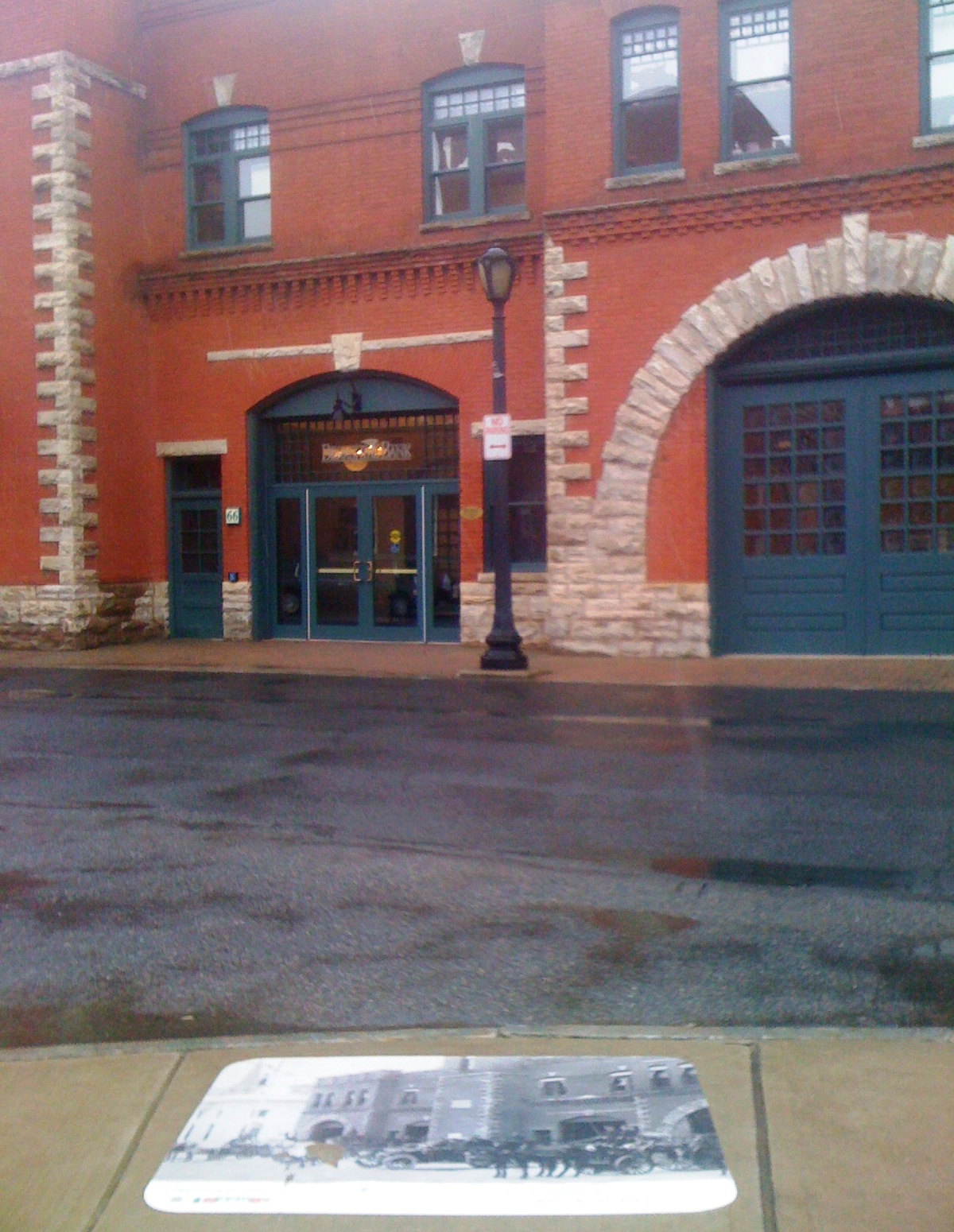
Walk On, Pittsfield 250. Credit J Dickson
Put this in the better idea category. At least in the idea on how to use photos to travel back in time.
I was wandering in downtown Pittsfield, Massachusetts when I came upon a photo pasted on the sidewalk. It turned out to be a historic photo of a building across the street, taken from the same vantage point over a century earlier. The current building is a bank, but the photo shows it used to be a fire department.
The poster is a “walk-on” and is but one of multiple posters in a public art project set up to commemorate the city’s 250th anniversary. Only a handful of the posters are historic, but they do represent one way to transport oneself back in time to see, for example, shoppers coming out of a downtown department store (now another bank building) or an aerial view of the GE facilities (now largely deserted) or of Park Square in the 1860s (now, more open). Placed correctly, you can let your imagination run!
One other way to use historic photos is through mobile technology. There’s a mobile app called “What was There” which pinpoints (through Google Maps) photos which users have uploaded of sites around the country. With an address, you can go to the site, find the photo and position yourself to see what it looked like 50 or 150 years earlier. Right now, it just needs a lot more users to upload photos.
For more info:
On “Walk On”: http://pittsfield250.com/2011/02/walk-on-%E2%80%A2-public-art-installation/
On “What was There”: http://whatwasthere.com/

A memoir in letters. Excerpts from letters that a father wrote his children each week for almost 30 years, full of the mundane and poignant, the witty and wise. Stories from a different time, from a small town in Connecticut.
History Shock
 Pleased to announce the publication of my book in May 2021 by the University Press of Kansas. This collection of “stories with a history” narrates incidents over the course of my career in the Foreign Service when historical understanding – or lack of it – got in the way in the conduct of day-to-day diplomacy.
Berkshire County’s Industrial Heritage

Check out this book on the nineteenth century mills and those who owned and worked in them. Available through Arcadia Press or Amazon.
Slide Show – Getting to Yes, Woman Suffrage in the Berkshires and Beyond
-
Slide Show – Intersections, Pittsfield’s Neighborhoods
-
Slide Show – Turning Points


Slide Show – Preserving the old Berkshire Athenaeum
 Thomas Allen donated $50,000 to build the Athenaeum in 1876.
 A yong architect from New York, William Appleton Potter, had his design selected for the new Athenaeum.
 The original architectural drawing of the front elevation of the Athenaeum
 An early photo of the High Victorian Gothic building, pointed arches, twin gables, multi-color stone patterns,skylight, stained glass windows
 Majestic, quartered oak tresses in the addition built in 1896
 Proposed new library design, in 1944
 Bulging of stonework on from of building required drastic measures to shore up front, in 1979
 A restored skylight is returned to the roof in repairs undertaken in 2001
 Stained glass window on west gable, showing steel tie placed in 1979 stabilization repairs
 Masonry work begins on the Athenaeum in the deep of winter
 Removing the stained glass panels for repair
 Cracks in the masonry
 More cracks in the masonry
 Lifting the capstone off the east gable, the first stone removedd








 History All Around