Archive for category Public Affairs
The Guantánamo Beacon
Posted by John Dickson in International, Personal memory, Public Affairs, Public History on January 11, 2013
This month marks the second inaugural for President Obama. It’s also the fourth anniversary of his executive order requiring the closing of the detention center at Guantánamo within one year. That decision prompted a group of museum professionals and activists to launch a month later the Guantánamo Public Memory Project (GPMP), aimed at preserving the site for historical purposes, and thereby preventing it from being used again as a detention center.
In December, the GPMP hosted a conference in New York City in connection with the opening of an exhibit to explore the issues that the naval base and the prison hold for the U.S., and its place in the world. The exhibit consists of a series of panels in the windows of the Kimmel Center at NYU and an online collection of materials and interviews, collected by the project and its many partner institutions. Much transpired at the conference, including testimonials by Cuban and Haitian refugees from the 1990s, from military officers and lawyers, from historians and students. Most striking, and telling, were two questions posed by students.
The first student, let’s call Jose, stood up in front of the room of 100 people attending the conference to ask his question, stating that he was from the Dominican Republic, and while not enrolled in university, he was studying on his own. He said that where he was from and throughout all of Latin America, the United States stood like “a beacon” on issues of democracy and human rights. “What,” he asked, “happens now after Guantánamo? What can you say to us anymore?” His tone was clearly one of wanting to continue to see the U.S. as that beacon, in a region still struggling with consolidating its own democracies.
Several minutes later, another student called Katie asked what was happening to the lighthouse at Guantánamo Naval Base. “Were there any restoration plans?”
The former naval commander in charge of facilities on the base indicated that the lighthouse was in disrepair, that pieces were falling off it, and that there was no funding to restore or maintain it. In fact, it was closed off, surrounded by chain link fence.
The two questions were asked separately, but became connected metaphorically, since the second student had contributed to the GPMP on-line exhibit a page on the lighthouse, in which she referred to it as “a beacon.”
The physical disrepair of that lighthouse on Guantánamo takes on greater meaning in light of Jose’s question. The symbol of the U.S. as a beacon takes the form of the lighthouse on the naval base, damaged and surrounded by a fence.
The only answer to Jose and people around the region should be, watch our democratic practices take place to find the self-correcting mechanisms. It will take time, and there will be advances and setbacks. The conference and the Guantánamo Public Memory Project are part of that process by seeking
a) to raise awareness about the base and the detention center,
b) to use public history through exhibits, digital spaces and oral history to initiate a dialogue about the trade-offs between national security and human rights and
c) to re-think the use of Guantánamo as a detention center in the future.
For more information on the project, go to: http://hrcolumbia.org/Guantánamo/ . To see the final product go to: http://gitmomemory.org/stories/.
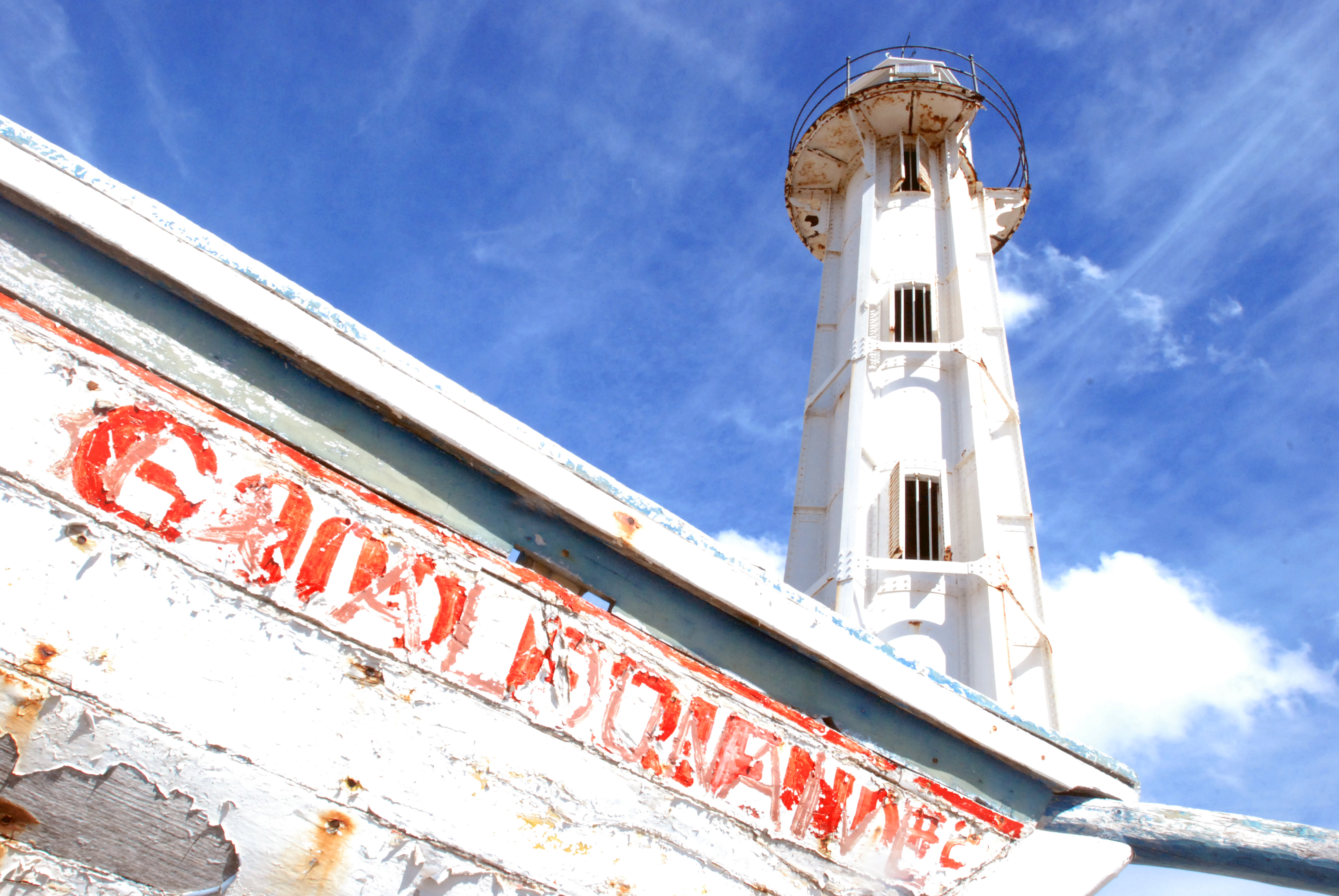
A beacon in disrepair. Photo: SouthCom
The Once and Future NRA
Posted by John Dickson in History in our surroundings, Public Affairs on January 3, 2013
This past July I “liked” on my Facebook page an article by Juan Cole entitled “How Long Will We Let the National Rifle Association and Corrupt Politicians Kill Our Children?” Cole, a history professor at Michigan, wrote his article on the heels of the Aurora, Colorado movie theater shooting. He pointed out the shooter used a semi-automatic rifle to fire off multiple rounds of ammunition, quickly. It was a gun which had been restricted under the assault weapons ban which Congress allowed to lapse in 2004. It turns out it was the same gun used in the elementary school in Newtown, Connecticut.
Back in July, I thought the likely answer to Professor Cole’s question would have been: “At least until after the November elections.” I join the millions of others who reacted in anger and sadness to the Newtown tragedy with a more urgent, direct answer: “No longer.”
On the heels of this tragedy, opinion writers around the country have pounced on the subject of gun control, with comparisons that regulations for ladders are more stringent than for guns , or that it is easier to adopt a pet than to buy a gun, or that even toy guns have regulations.
The obstacle to any form of gun control, as Professor Cole pointed out, has been the NRA, which took a week to respond in any form, and then, when it finally did, it trotted out the same old talking points that had served them so well for so long. Their public relations playbook must read something like: “Hunker down. This too will pass. Don’t give an inch; blame people and the media. Any chink in the right to bear arms could result in the prohibition of all guns, tomorrow.” The face of the NRA was once again Wayne La Pierre, the same man who, in 2000, blamed Bill Clinton for tolerating gun shootings in order to promote gun control.
What’s interesting is that the NRA has only adopted that playbook within the last 30 years. It started out a different organization, in 1871 right after the Civil War, as a response to the poor marksmanship of the urban Northern soldiers. Well into this century, it focused its activities on hunting and the outdoors.
Given the rhetoric from the NRA recently, it is striking to learn that even they once advocated for gun control, as early as the 1930s and as recently as the 1960s. One president of the organization, Karl T. Frederick, developed model legislation for state gun control laws. His testimony during the Congressional deliberations in 1934 to pass the first major national gun control laws reveals the separation between the organization and its current all-out embrace of the Second Amendment. When a congressman asked if he thought the law under consideration “is unconstitutional or that it violates any constitutional provision,” Frederick responded, “I have not given it any study from that point of view. I will be glad to submit in writing my views on that subject, but I do think it is a subject which deserves serious thought.” The National Firearms Act passed in 1934, and four years later the Federal Firearms Act passed. Among other provisions, these limited the ownership of automatic weapons through heavy taxes and licensed firearms sellers. Their target was principally organized crime.
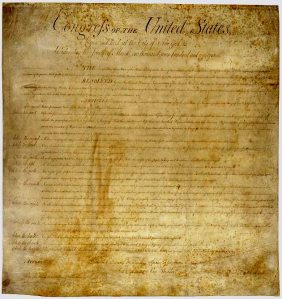
Bill of Rights. Photo: National Archives
The NRA in the 1960s also advocated gun control legislation, first after the nation learned the Lee Harvey Oswald had purchased his rifle by mail order, through an ad in the NRA magazine. Laws were only passed following the assassinations of Martin Luther King and Bobby Kennedy in 1968. Again, the NRA supported the legislation, with its Vice President, Franklin Orth, testifying before Congress in support of the proposed law to ban mail order sales of guns, among other provisions.
Since that time, the NRA has reversed course and consistently assumed its don’t-give-an-inch position, working to prevent passage of the Brady Bill, taking lawsuits all the way to the Supreme Court, and working to remove from office politicians who promote the slightest movement in the direction of safe use of guns in our society.
However, a look backwards shows us that, much like the limits on free speech (yelling “Fire” in a crowded theater,) we have accepted lines drawn to limit any absolute view of our right to bear arms. Even the NRA once supported drawing lines. In fact, if it really wants to protect the right of the people to bear arms, it might want to reconsider its stance, as its absolutism may actually be harming its cause. Imagine an organization which actually knows about arms, leading the way, like it once did, to advocate limits, to prevent the next Newtown, the next Aurora, the next Columbine. It could be an organization that would look back on the past 30 years as an exception, a tarnished period in its own history. Better, it could help avoid having to repeat Professor Cole’s question every few months.
Who is Jenni Rivera?
Posted by John Dickson in History in our surroundings, Immigration, International, Public Affairs, Public History on December 24, 2012
A couple of weeks ago, Jenni Rivera died in a plane crash. If you are at all like me, you wondered who is Jenni Rivera. Then, you may have moved, like me, to a better question: how could I not know of Jenni Rivera?
It’s not age, but certainly there are a slew of boy bands and other pop culture icons who have just passed me by. This one, Jenni Rivera, had to do with our ethnic and racial, perhaps geographic bubbles we live in.
Jenni Rivera turns out to be a Mexican-American singer, and not just any singer, but one who sold upwards of 15 million albums. She started out singing banda and ranchera music, which, when I lived in Mexico, sounded like a form of Mexican country-western distinct from mariachi. She then moved on to greater popularity with her own reality show on Spanish-language cable television. She was due to break out with her own English-language TV series this coming year.
She was American, born, raised and resident in California, right in front of our eyes, but only if we looked in her direction. That direction includes Spanish language television, music, churches, radio, neighborhoods and schools.
It turns out her parents were immigrants, from Mexico. Her story sounds like it fits into the American immigrant pattern. It is a pattern which is not supposed to exist, which is supposed to have changed from the earliest Irish and German immigrants (not counting the early settlers as immigrants.)
Those patterns are changing: language and culture are held on to longer, because it is easier with bilingual education, mass media and telecommunications, and proximity to the border and the native land. School achievement is lower than for previous second generation immigrants, but not in comparison to the first generation of Mexicans who are coming here with barely a primary education. The Jenni Riveras could thrive on her side of the immigrant boundary, unknown to those of us on the other side, in the receiving mainstream.
These changing patterns have caused academics since at least the 1960s to re-think the “melting pot” and assimilation that we once thought characterized our nation of immigrants. Instead, they see segments of some immigrants assimilating and moving up the economic ladder, and others spiraling downwards. They see exclusion and separation, not inclusion and integration. They may be seeing, and trying to explain, the present, before it has a chance to become the past. We are still too close to the current immigrant wave to see it play out.
For example, the ethnic enclaves where Jenni Rivera thrived also existed before. The once dominant French, Polish and Italian churches hold special services in Spanish, Korean and even Khmer. Sports, culture and politics still remain avenues of economic mobility and acculturation; yesterday’s Joe DiMaggio and Jackie Robinson are today’s Alex Rodriguez and Pablo Sandovaal. The 2012 Presidential election saw, for the third straight time, the increasingly important Hispanic vote. And, of course, nativist reaction to immigrants still continues.
Despite the segmentation of our own cultural offerings, with hundreds of cable channels to allow us to stay in our own ethnic and political realms, Jenni Rivera made it, in death, on to both the front and op-ed pages of the New York Times.

Jenni in 2009 Performance. Photo: JEnriquez
Think I’ll go add Jenni Rivera to my playlist, and move the boundaries a little.
After the Greatest Generation Came Us
Posted by John Dickson in History in our surroundings, Personal memory, Public Affairs on August 26, 2012
My reaction to Tom Brokaw’s “Greatest Generation” documentary and book was typical of my approach whenever I read biographies. I stand in awe of these individuals, even when they are young, at their accomplishments, their energy, commitment, drive and talents.
It is not too hard to contemplate the next step, leaping from admiration to introspective evaluation on my own life, or in Tom Brokaw’s case, our own generation. What after all have we in the Baby Boom generation accomplished? What kind of world are we turning over to our children? Quickly, I reach the conclusion that we pale by comparison, that the Greatest Generation handed us on a silver platter a society that we have messed up. A collective selfishness gave way to self-indulgence, not hardship and effort, and leaves our children with challenges we did not endure, like monumental national and personal debt and the prospect of insoluble entitlement programs for the ill and elderly which they may not be able to benefit from. We’ll make sure we get ours, thanks to their contributions and those of our parents. We are handing over the dominant nation we inherited to the next generation as a nation in decline, unable to compete against rising powers in Asia or Latin America. We lost our wars, in Vietnam, and the ones on poverty and in drugs.
Depressing? That is, until I saw the “Madmen” episode of Don and Betty Draper littering on their family picnic. It is a scene which everyone who watches the show remembers, cringed from. Advertising executive Don stands up at the end of the picnic, crunches his beer can and tosses it into the woods. His wife Betty hustles the children into the car and then shakes the picnic blanket full of dirty napkins and empty potato chip bags on to the lawn and leaves. Viewers cringed, repulsed, disbelieving that people actually could commit such an unspeakable act.
Then again, much of “Madmen” is, while hopefully exaggerated for dramatic effect, reenacting a bygone time, when people smoked in public places, men ran the office, took liberties with the secretarial pool, stayed hidden in the closet, kept liquor bottles in their offices and drank heavily throughout the work day, among other things.
“Madmen” has triggered a re-evaluation of contributions of the Baby Boomers. It’s not just litter along the highways and in our parks, which still exists, but not to the same extent, thanks to Keep America Beautiful, the EPA, Lady Byrd Johnson, Earth Days, recycling and much more. It’s expanding fuller participation in broad aspects of society (work, study, voting, athletics) on the basis of gender, race, ethnicity, sexual preference, ability, age and so on. It’s seat belts and car seats for children; it’s awareness of the costs of war; it’s foreign policy based on human rights and development, not just security; it’s decreasing the threat of atomic war.
What’s striking about some of these is that the accomplishments were grass-roots movements or campaigns. Our most significant achievements were not government-run, but government played catch-up to campaigns already underway, such as adversion to tobacco or seat belts. As a result, these changes are deeply ingrained, ensured to elicit the kind of reaction viewers had to Donald Draper throwing a beer can into the woods.
So, maybe we’re not as great as the Greatest, but we didn’t entirely waste our time on this planet either. Give yourselves a break, boomers.
When Video Takes Over History
Posted by John Dickson in History in our surroundings, Personal memory, Public Affairs on March 10, 2012

NYFD Door Panel from 9/11. Photo: Smithsonian Museum
In connection with the tenth anniversary of the attacks on New York City and Washington DC, the Smithsonian Museum of American History put together an exhibit commemorating that history-changing day. My wife and I stood in line for 90 minutes to enter the small room, which contained four tables of artifacts, one each for New York, Washington, Pennsylvania and the Transportation Security Administration. Yes, the last one seemed oddly lacking the parallelism of the first three.
Firefighters’ equipment, a beeper, survivors’ photograph from the stairwell, an ID tag, a firetruck door twisted by heat and , a uniform were among the items I vaguely remember displayed. More clear was the reverent, bordering-on-sacred hushed tones from the long line of people slowly winding their way around the room. We were told of the uniqueness of these displays, on tables with no glass between the viewer and the artifact.
Yet, the most memorable display was a television set, re-running the morning’s news clips, starting with the pointless chatter of Michael Jordan’s comeback to the NBA and winding through to the almost off-handed announcement of a plane crashing into the World Trade Center all the way through the lead anchors getting to the station and taking over the non-stop news through the rest of the day.
This television reel portrayed better than any artifact on the tables our journey that day, passing from our innocence to the emergence of a changed world. It was certainly more emotional, more riveting. We wanted to hit the pause button and reclaim that lost epoch; we wanted the rest of Good Morning America to continue as planned, with stories about new diets or small-town oddities.
What brought this to mind now, six months later, was a recent re-playing on National Geographic of “The Lost JFK Tapes.” Re-watching the motorcade winding its way through Dallas, with Jackie and JFK transported me back to the nine year-old riveted to the television that fall weekend, wishing that the motorcade would make its way to the luncheon where he was to speak before the assembled business elite of Dallas.
It reminded me of my visit last month to Atlanta and the Martin Luther King National Historic Site. The humble wagon which carried King’s casket through Atlanta, the pictures of his childhood, the civil rights walk of fame, the Ebenezer Baptist Church all paled in contrast to two videos – his Dream speech in Washington DC and, especially, his Promised Land speech the night before he died, where he predicted his end.
Do other film moments evoke such instant, emotive history? Perhaps the Challenger liftoff or the first moon landing. Certainly the tsunami disasters are best portrayed by video. And, what does this mean for museums, seeking to tell a story, if visitors could just as easily have stayed at home and watched the moment from their living room flat screen or laptop or mobile phone? Or for historians trying to write the story when the video allows the viewer to see for themselves, not through the words of an interpreter?
-
You are currently browsing the archives for the Public Affairs category.

A memoir in letters. Excerpts from letters that a father wrote his children each week for almost 30 years, full of the mundane and poignant, the witty and wise. Stories from a different time, from a small town in Connecticut.
History Shock
 Pleased to announce the publication of my book in May 2021 by the University Press of Kansas. This collection of “stories with a history” narrates incidents over the course of my career in the Foreign Service when historical understanding – or lack of it – got in the way in the conduct of day-to-day diplomacy.
Berkshire County’s Industrial Heritage

Check out this book on the nineteenth century mills and those who owned and worked in them. Available through Arcadia Press or Amazon.
Slide Show – Getting to Yes, Woman Suffrage in the Berkshires and Beyond
-
Slide Show – Intersections, Pittsfield’s Neighborhoods
-
Slide Show – Turning Points


Slide Show – Preserving the old Berkshire Athenaeum
 Thomas Allen donated $50,000 to build the Athenaeum in 1876.
 A yong architect from New York, William Appleton Potter, had his design selected for the new Athenaeum.
 The original architectural drawing of the front elevation of the Athenaeum
 An early photo of the High Victorian Gothic building, pointed arches, twin gables, multi-color stone patterns,skylight, stained glass windows
 Majestic, quartered oak tresses in the addition built in 1896
 Proposed new library design, in 1944
 Bulging of stonework on from of building required drastic measures to shore up front, in 1979
 A restored skylight is returned to the roof in repairs undertaken in 2001
 Stained glass window on west gable, showing steel tie placed in 1979 stabilization repairs
 Masonry work begins on the Athenaeum in the deep of winter
 Removing the stained glass panels for repair
 Cracks in the masonry
 More cracks in the masonry
 Lifting the capstone off the east gable, the first stone removedd








 History All Around