Archive for category Personal memory
After the Greatest Generation Came Us
Posted by John Dickson in History in our surroundings, Personal memory, Public Affairs on August 26, 2012
My reaction to Tom Brokaw’s “Greatest Generation” documentary and book was typical of my approach whenever I read biographies. I stand in awe of these individuals, even when they are young, at their accomplishments, their energy, commitment, drive and talents.
It is not too hard to contemplate the next step, leaping from admiration to introspective evaluation on my own life, or in Tom Brokaw’s case, our own generation. What after all have we in the Baby Boom generation accomplished? What kind of world are we turning over to our children? Quickly, I reach the conclusion that we pale by comparison, that the Greatest Generation handed us on a silver platter a society that we have messed up. A collective selfishness gave way to self-indulgence, not hardship and effort, and leaves our children with challenges we did not endure, like monumental national and personal debt and the prospect of insoluble entitlement programs for the ill and elderly which they may not be able to benefit from. We’ll make sure we get ours, thanks to their contributions and those of our parents. We are handing over the dominant nation we inherited to the next generation as a nation in decline, unable to compete against rising powers in Asia or Latin America. We lost our wars, in Vietnam, and the ones on poverty and in drugs.
Depressing? That is, until I saw the “Madmen” episode of Don and Betty Draper littering on their family picnic. It is a scene which everyone who watches the show remembers, cringed from. Advertising executive Don stands up at the end of the picnic, crunches his beer can and tosses it into the woods. His wife Betty hustles the children into the car and then shakes the picnic blanket full of dirty napkins and empty potato chip bags on to the lawn and leaves. Viewers cringed, repulsed, disbelieving that people actually could commit such an unspeakable act.
Then again, much of “Madmen” is, while hopefully exaggerated for dramatic effect, reenacting a bygone time, when people smoked in public places, men ran the office, took liberties with the secretarial pool, stayed hidden in the closet, kept liquor bottles in their offices and drank heavily throughout the work day, among other things.
“Madmen” has triggered a re-evaluation of contributions of the Baby Boomers. It’s not just litter along the highways and in our parks, which still exists, but not to the same extent, thanks to Keep America Beautiful, the EPA, Lady Byrd Johnson, Earth Days, recycling and much more. It’s expanding fuller participation in broad aspects of society (work, study, voting, athletics) on the basis of gender, race, ethnicity, sexual preference, ability, age and so on. It’s seat belts and car seats for children; it’s awareness of the costs of war; it’s foreign policy based on human rights and development, not just security; it’s decreasing the threat of atomic war.
What’s striking about some of these is that the accomplishments were grass-roots movements or campaigns. Our most significant achievements were not government-run, but government played catch-up to campaigns already underway, such as adversion to tobacco or seat belts. As a result, these changes are deeply ingrained, ensured to elicit the kind of reaction viewers had to Donald Draper throwing a beer can into the woods.
So, maybe we’re not as great as the Greatest, but we didn’t entirely waste our time on this planet either. Give yourselves a break, boomers.
When Video Takes Over History
Posted by John Dickson in History in our surroundings, Personal memory, Public Affairs on March 10, 2012

NYFD Door Panel from 9/11. Photo: Smithsonian Museum
In connection with the tenth anniversary of the attacks on New York City and Washington DC, the Smithsonian Museum of American History put together an exhibit commemorating that history-changing day. My wife and I stood in line for 90 minutes to enter the small room, which contained four tables of artifacts, one each for New York, Washington, Pennsylvania and the Transportation Security Administration. Yes, the last one seemed oddly lacking the parallelism of the first three.
Firefighters’ equipment, a beeper, survivors’ photograph from the stairwell, an ID tag, a firetruck door twisted by heat and , a uniform were among the items I vaguely remember displayed. More clear was the reverent, bordering-on-sacred hushed tones from the long line of people slowly winding their way around the room. We were told of the uniqueness of these displays, on tables with no glass between the viewer and the artifact.
Yet, the most memorable display was a television set, re-running the morning’s news clips, starting with the pointless chatter of Michael Jordan’s comeback to the NBA and winding through to the almost off-handed announcement of a plane crashing into the World Trade Center all the way through the lead anchors getting to the station and taking over the non-stop news through the rest of the day.
This television reel portrayed better than any artifact on the tables our journey that day, passing from our innocence to the emergence of a changed world. It was certainly more emotional, more riveting. We wanted to hit the pause button and reclaim that lost epoch; we wanted the rest of Good Morning America to continue as planned, with stories about new diets or small-town oddities.
What brought this to mind now, six months later, was a recent re-playing on National Geographic of “The Lost JFK Tapes.” Re-watching the motorcade winding its way through Dallas, with Jackie and JFK transported me back to the nine year-old riveted to the television that fall weekend, wishing that the motorcade would make its way to the luncheon where he was to speak before the assembled business elite of Dallas.
It reminded me of my visit last month to Atlanta and the Martin Luther King National Historic Site. The humble wagon which carried King’s casket through Atlanta, the pictures of his childhood, the civil rights walk of fame, the Ebenezer Baptist Church all paled in contrast to two videos – his Dream speech in Washington DC and, especially, his Promised Land speech the night before he died, where he predicted his end.
Do other film moments evoke such instant, emotive history? Perhaps the Challenger liftoff or the first moon landing. Certainly the tsunami disasters are best portrayed by video. And, what does this mean for museums, seeking to tell a story, if visitors could just as easily have stayed at home and watched the moment from their living room flat screen or laptop or mobile phone? Or for historians trying to write the story when the video allows the viewer to see for themselves, not through the words of an interpreter?
Saving Haiti’s Heritage
Posted by John Dickson in History in our surroundings, International, Personal memory on January 21, 2012
Last week, Haiti marked the second anniversary of the earthquake which devastated an already impoverished nation, resulting in an estimated 300,000 lives lost.
The rebuilding effort has put enormous strains on a government, itself devastated both in terms of physical buildings and human talent in the disaster. It has struggled to lead and coordinate a global army of government and non-government aid organizations.
At the same time, the character of the Haitian people known for their resilience, patience under suffering and independence has largely carried the country through this period.
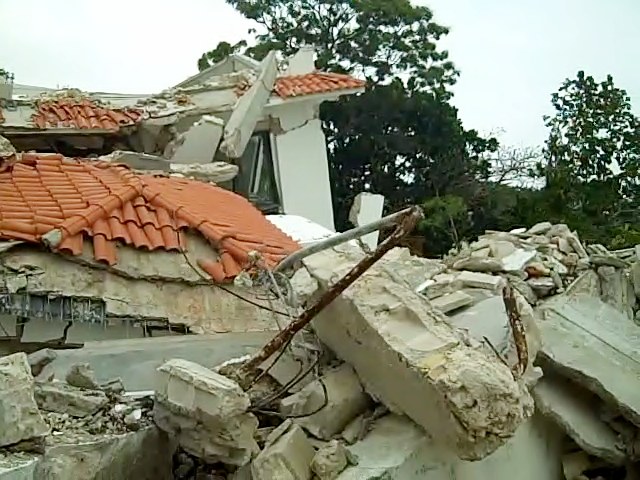
Quisqueya University after the quake. Photo: JDickson
This strength of character is rooted deep in Haiti’s heritage, based on a prolonged, violent struggle against slavery, then for independence and, in this century, against brutal regimes. African religious traditions combine with Christian missionary vestiges to forge a deeply spiritual people. These elements of a unique heritage are depicted in a vast, rich and diverse body of visual and performing arts, of libraries and archives. This art is a significant way of passing along to each generation their story as a nation and hence their identity.
The earthquake also struck these manifestations of Haitian identity. Cathedrals collapsed along with their murals. The national library, archives buildings and universities were destroyed. Art in private collections was lost.
Shortly after the earthquake struck, the image of postwar Iraq with looting and devastation of cultural and historic treasures mobilized an army of cultural experts around the globe. Smithsonian museum officials took the lead in this country to raise awareness. They were greeted with skepticism internationally as the heavy-handed Americans, but amidst the studies, conferences and promises, not much tangible was being done. Someone had to take the lead, and fortunately the Smithsonian, with its international reputation for excellence, persevered.
Not only did officials have to persevere internationally, but also against our own government. Recovery and restoration of cultural buildings and artifacts was not a priority, U.S. leadership in diplomatic, military and aid offices indicated. The Smithsonian led a coalition of concerned organizations to advance a relief and recovery effort for Haiti’s heritage. They put together a smart plan which not only restored and saved murals, paintings and artifacts, but also trained Haitians to do this very work, giving them employment in a wrecked economy.
How do you put a price or a priority on one’s identity? On one’s history? It is easier to attach such concepts to people’s emergency needs of health, food and shelter. Yet, what has really been important in seeing the nation through this crisis, is its heritage, its character of resilience and neighbor helping neighbor, in the absence of government or relief organization.
An interesting footnote to the Haitian anniversary came this week here in Washington following a much milder tremor last summer along the east coast. The only real damage to have taken place was sustained in the National Cathedral and the Washington Monument.
We as a country could not see our way to using public resources to restore our most recognizable feature on our capital landscape. This week, a billionaire equity magnate and lobbyist announced he was putting up the funding to fix the Washington Monument. The new Episcopal Bishop is seeking to raise private funding to restore the cathedral.
The U.S. earthquake proved, perhaps even more starkly, the Haitian and Iraqi experiences that the manifestations of a people’s heritage suffer in such natural and man-made disasters, and yet efforts to protect, preserve and restore evidence of a people’s contributions to human history are held in such low esteem.
Peace Corps is 50
Posted by John Dickson in International, Personal memory on September 22, 2011
This week, Foreign Policy magazine started a feature on its web site called Decline Watch where it asks readers to give examples of American decline. This coming week, the Peace Corps is commemorating its 50th anniversary. Heading back to the heady times at the beginning of the Peace Corps, it’s apparent that we would be unable to pull off that kind of inspiring government initiative today.
A brief review. President Kennedy actually floated the idea of a Peace Corps type organization during the Presidential campaign. He officially started it by Executive Order on March 1, 1961, ordering the State Department to use existing funds to set up a pilot program. Within three months, the Peace Corps had 11,000 applications. By June, training had begun for programs in two countries: Colombia and Tanganyika (Tanzania, now.) By August, the first volunteers had arrived overseas, in Ghana. It wasn’t until September 22 that Congress actually approved legislation to establish and fund the Peace Corps. By December, there were 500 volunteers in nine countries.
It’s not hard to imagine what would happen in 2011 were such a program conceived. What would a timeline look like for such an idea today, with the built-in delays in Congressional obstruction, in interagency bureaucratic wrangling, in media criticism. Imagine a President trying to set up anything under Executive Order, or a government bureaucracy finding funds in its own budget to launch a new program. Or a Congress acting in 6 months to establish a program that quickly. Granted that JFK enjoyed greater majorities in both houses of Congress than President Obama has had. Still, it’s hard to imagine that we could put the same kind of “boots on the ground” within six months for any government initiative now.
The Peace Corps has always been bigger than its actual statistics. It’s been an idea that captivated many, early on and enduring. It’s left an imprint on the 139 countries which had seen Westerners as colonizers only, as militarists or as imperialists making a profit off of their resources. Further, it’s left an imprint on the 200,000 volunteers who have offered two years of service, making them, their families and neighbors more worldly aware. A recent survey said over 90% of former volunteers rated their experience as excellent or very good.
I am one of them. So is my wife!
Is 9/11 History?
Posted by John Dickson in History in our surroundings, Personal memory, Public Affairs on September 6, 2011
As we approach the tenth anniversary of the attacks of September 11, 2001, we find ourselves consumed with remembrances and interpretations of that day, and its impact on our lives since.

Smithsonian 9/11 Exhibit. Photo credit: J Dickson
We are as consumed with these as we were riveted to television that day, watching over and over again the unimaginable images of planes flying into the buildings and of buildings collapsing. So many of us have our own story to tell of that day, where we were, how we found out, and, incredibly, how we knew someone in the buildings, on their way to the buildings, or caught up in the rescue efforts.
My own story is set in an airplane, flying across the Atlantic with my son, landing in London to learn that something terrible had just happened by the mere question of the rental car agent who asked “Are you American?”
I have a family member who was an EMT who was in the area when the towers fell (and survived.) I have a colleague whose son was late to work that morning and never entered the building before it was hit.
We all have our own stories as well of our response to that day, of friends and family in combat missions in Afghanistan and Iraq, of being lied to, and in my case, trying to defend to foreign partners our government’s actions based on this misinformation.
We have lived with and adapted to the heightened security, most evident in our travel but also in and around our monuments and workplaces.
This is still not history, though, as we are still living it. We are still fighting wars as a consequence, we are still in a state of heightened security, and we are still living with the debt run up to fight those wars.
History will come when our soldiers have returned home, when our economy is responding to other challenges, when we are no longer x-rayed and photographed while trying to board planes. Historic understanding tells us that these realities will not endure. Just as the fall of the Berlin Wall signaled the end of the Cold War, this 9/11 chapter will also end, replaced by the next development, hopefully without the horrific or far-reaching consequences that those 20 hijackers unleashed ten years ago.
The Smithsonian Museum of American History has now an exhibit of 9/11. As the repository for all artifacts collected from New York, Washington and Pennsylvania, the museum has put a small sampling on display, on tables out from behind glass cases for people to see and read and experience the short stories of each item. We stood in line for over an hour to enter the small room, with four tables on which lay these artifacts – the cell phone used by New York Mayor Rudy Guiliani, a doll collected from the scene of the two towers, badges of office workers and rescue workers from all three sites or a door from a crushed fire engine.
The most powerful, though, remains the video of the television news, unfolding that morning, with Good Morning America starting off with the breaking news that Michael Jordan was considering a comeback to the NBA that season, followed by the initial reports of an explosion at the World Trade Center, and then the live coverage of the second plane flying into the second tower, the fire at the Pentagon, the crash in the Pentagon and the collapse of the two towers.
The anniversary will focus on the heroes, of the day and since. And there are many, and they deserve our gratitude and admiration. History will also record their actions that day, that year and the decade since. But what history will also have to try to capture was the sheer sense of disbelief, of paralysis as we sat and watched over and over again these images. That was our collective reality.
-
You are currently browsing the archives for the Personal memory category.

A memoir in letters. Excerpts from letters that a father wrote his children each week for almost 30 years, full of the mundane and poignant, the witty and wise. Stories from a different time, from a small town in Connecticut.
History Shock
 Pleased to announce the publication of my book in May 2021 by the University Press of Kansas. This collection of “stories with a history” narrates incidents over the course of my career in the Foreign Service when historical understanding – or lack of it – got in the way in the conduct of day-to-day diplomacy.
Berkshire County’s Industrial Heritage

Check out this book on the nineteenth century mills and those who owned and worked in them. Available through Arcadia Press or Amazon.
Slide Show – Getting to Yes, Woman Suffrage in the Berkshires and Beyond
-
Slide Show – Intersections, Pittsfield’s Neighborhoods
-
Slide Show – Turning Points


Slide Show – Preserving the old Berkshire Athenaeum
 Thomas Allen donated $50,000 to build the Athenaeum in 1876.
 A yong architect from New York, William Appleton Potter, had his design selected for the new Athenaeum.
 The original architectural drawing of the front elevation of the Athenaeum
 An early photo of the High Victorian Gothic building, pointed arches, twin gables, multi-color stone patterns,skylight, stained glass windows
 Majestic, quartered oak tresses in the addition built in 1896
 Proposed new library design, in 1944
 Bulging of stonework on from of building required drastic measures to shore up front, in 1979
 A restored skylight is returned to the roof in repairs undertaken in 2001
 Stained glass window on west gable, showing steel tie placed in 1979 stabilization repairs
 Masonry work begins on the Athenaeum in the deep of winter
 Removing the stained glass panels for repair
 Cracks in the masonry
 More cracks in the masonry
 Lifting the capstone off the east gable, the first stone removedd








 History All Around