Archive for category International
Predicting the future: Pope Francis, President Rouhani, Attorney General Holder
Posted by John Dickson in History ahead, History in our surroundings, International, Public Affairs on September 24, 2013
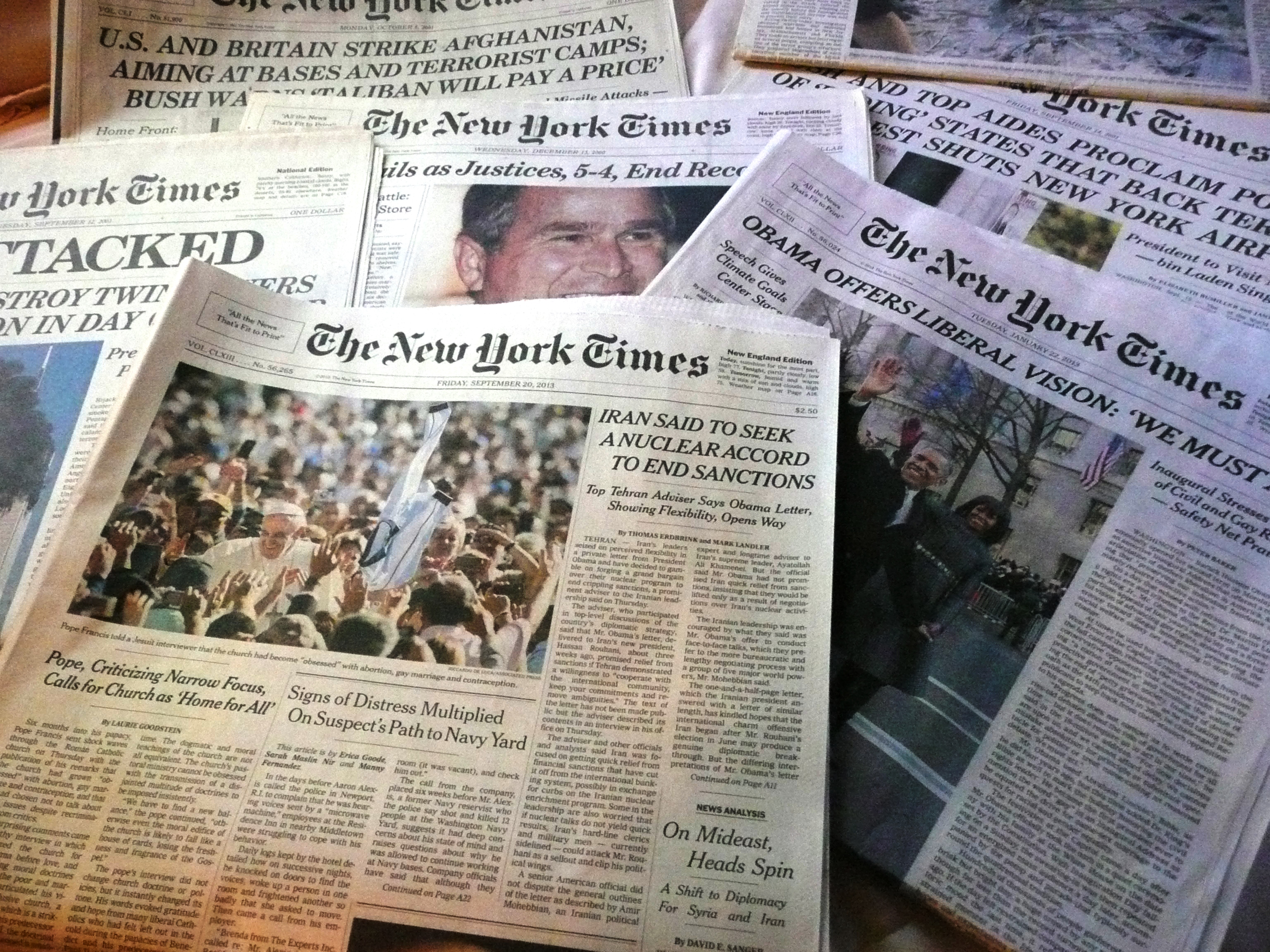 In a small trunk, here in my office are a select group of newspapers, saved because, at the time, they seemed to represent momentous events: 9/11, Bush v. Gore, death of Pope John Paul II, Watergate, impeachment of Clinton, fall of the Berlin Wall. All have across the top, large-print headlines. Today, I am adding to the collection the first which does not have the same bold typeset.
The paper on Friday, September 20, 2013 carried three separate stories, only two of them on the front page, which signaled what could be historic, transformational changes. It may be difficult to predict history, and my experiment here may ultimately fail, but these do seem like shifts which will alter the shape of slices of our history over the last 50 years.
First is what looks like may be a thaw in U.S. relations with Iran. The article, on the right hand columns of the New York Times, may only report the latest in a series of signals since the election in June of Iran’s new president, Rouhani. However, it reveals an exchange of letters between President Obama and President Rouhani exploring the possibility of direct negotiations between the two countries, who have not had diplomatic relations since the 1979 hostage crisis. The official who discussed the exchange of letters was a senior advisor to Iran’s supreme leader, Ayatollah Khamenei, seeming to indicate the latter’s acceptance with an opening.
Next is what looks like a re-direction of the Catholic Church’s social priorities. The new Pope Francis released the content of an interview he had given to a Jesuit Catholic journal in August where he pointed to a need for the church to be a “home for all.” He went on, charting a course for the Church to drop its “obsession” with abortion and contraception. On homosexuality, he asked an open-ended question wondering “when God looks at a gay person does He endorse the existence of this person with love, or reject and condemn this person?” Sounds a little like Jesus answering the efforts of the Pharisees to entrap him.
The third is the reversal of a policy of aggressive prosecution of drug crimes. The Attorney General Eric Holder gave a speech laying out the practical steps to reduce the extended sentencing of lower level drug crimes. Those harsh, often mandatory, sentencing rules have been enacted in various U.S. jurisdictions since the 1970s, the most well-known being California’s “three-strikes” provision in 1994. While changing the 1984 federal anti-drug act would require Congressional approval, Holder has instructed prosecutors to take steps in implementing the law, like not indicating the amount of drugs possessed by the accused. This would avoid triggering the automatic mandatory sentence.
Friday’s paper was not the first indication of any of these transformational shifts: the new Pope had indicated as early as his installment his concern for the poor as a fundamental focus for the church; the Iran’s President Rouhani had been sending signals of accommodation with the West since his election; and Attorney General Holder in August announced his decision to review sentencing guidelines.
Also, despite the important role played by each of the three individuals, pressure had been building for some time in each area to force the decisions each have taken. Sanctions aimed at Iran’s atomic weapons program are hurting the general population. Catholics are leaving the church, and important constituencies in the Democratic Party have latched on to overcrowding and disparate treatment between racial groups in sentencing to push for these changes.
Neither are these three pronouncements yet set on a straight, direct course towards fulfillment. In their infancy, each can be reversed, and it is more than likely that they will proceed on meandering paths in pursuit of the goals elaborated. Some accuse Iran of stalling, of engaging in a public relations campaign, to delay further international condemnation. The articles point to the Pope moving beyond the traditional power structure in the Vatican, and Congress can easily step in and halt any changes in Holder’s sentencing proposals.
Still, they each represent what could be fundamental changes. Comparisons to past historic transformational figures like Gorbachev, Sadat or Pope John Paul II are in the air. It is enough to make me add this front page to my small collection.
But before I do, my eye catches a fourth article, below the fold in Friday’s edition of the New York Times. This one reports on a resurgence of the textile industry in the U.S., one that is heavily automated, with many fewer workers, but one which would reduce the cost of transportation, as well as the potential for terrible tragedies like the collapse of a textile factory in Bangladesh. Maybe, just maybe, it is this one which foretells the most consequential shift, one that would have a greater impact in the daily lives of people around the globe.
Is it August 1914 or March 1999?
Posted by John Dickson in International, Public Affairs, Public History on September 5, 2013
Where are we now? Europe, August 1914? Iraq, March 2003? Afghanistan, August 1998? Rwanda, April 1994 or Yugoslavia, March 1999?

Syrian refugee camp in Jordan. Photo: Department of State
As we lurch hesitatingly towards some form of military action in Syria, pundits and politicians search for the right historic precedent, trying to bolster their political case for a response to the accusations that Syria used saran gas against its own citizens.
Let’s leave aside from the start the political maneuvering by certain politicians who all of a sudden are concerned about the unknown and unpredictable consequences of military action, whenever it happens. These same individuals who so blindly supported the Iraq invasion just ten years ago without credible evidence (despite the volume and confidence of the assertions) are preaching caution now that they have fairly firm evidence of poison gas use by Syria’s President Assad. They might use Iraq in 2003 as their precedent, but then that might also expose their previous support for invasion.
Others preaching caution point to Europe on the verge of the Great War, when a political assassination of a member of the Austrian royal family in Serbia triggered a chain of events that saw nations line up in treaty-bound coalitions to protect and defend each other. They rushed with folly into a war they would surely have sought to avoid had they known the death toll, devastation and brutal violence which ensued. Would such a strike unleash a larger war, in a region so fraught with its own complex web of rivalries and abundance of arms?
You would think in a scenario like either Iraq 2003 or Europe 1914, there would be support for the kind of limited action President Obama is gambling on. Yet, by showing his hand holding only a limited air strike (not only to domestic political opponents, but also to the Syrians who can now prepare,) Obama opens himself up to the comparison with the Clinton airstrikes following the African Embassy bombings in 1998. They were loud and may have felt good in seeking a dose of punishment, but they ended up having not just no practical effect, but may have further aggravated the anger directed at the U.S.
So, we hear those whose guiding principal for use of the largest military force in the history of the world is conditioned on the direct attack on U.S. interests. We don’t want to become the “world’s policeman,” a phrase stemming from Vietnam or Somalia, when in both large and small scale-scale military interventions, questions about our own national interests led to weak withdrawals short of our stated goals.
With unclear U.S. interests, then we may end up watching from the sidelines, as the world allowed an unspeakable genocide to take place in Rwanda. In such a case, should the discussion of U.S. interests extend beyond U.S. physical or economic security to include a moral responsibility? Do our long-term interests include demonstrating to peoples, who in this particular region are still struggling to define the outcome of their Arab Spring, that the U.S. will stand on the side of ordinary citizens? And, if that connection is too fuzzy or moral, can we define our long-term interests in something more practical like long-term security in a region which has held a great share of the global economic and political well-being in its grasp for decades?
The global crises immediately following the world’s paralysis in Rwanda were situated in Bosnia and Kosovo. Determined not to watch from the sidelines another humanitarian disaster brought on by an earlier incarnation of Assad attacking his own citizens, the U.S. and Europe took months to act, but eventually they did. Unable to secure UN Security Council approvals because of the same vetoes by Russia and China who refuse to vote now, NATO forces were brought to bear in a punishing air assault to force the soon-to-be convicted war criminal Slobodan Milosevic to stop the assault on his own non-Serb citizens.
Direct U.S. interests were hard to define in that action. What makes this precedent the most compelling may be the almost exclusive use of air power to bring about the intended result. Fighting from the air meant limited casualties on the NATO side, but tragic unintended civilian loss of life.
Precedents, we know, are never exact. Yugoslavia was not the Middle East; Libya stood farther away from the Lebanon-Israel-Palestine than Syria. Unlike 1914, the world has institutions of varying effectiveness to prevent a global escalation of conflict. And, unlike Iraq, we have greater trust that we are not being lied to.
When did we burn Toronto?
Posted by John Dickson in International, Public History on April 27, 2013
Here’s a history quiz: When did U.S. soldiers raze the city of Toronto?
a) Never
b) I don’t know, or I don’t care
c) April 27, 1813
If you chose the first, you would be right, since without even pointing out that it wasn’t really a city, U.S. soldiers burned a settlement, then known as York. But we did burn it to the ground, nonetheless, and it was re-built and then renamed Toronto 20 years later.
If you chose the second, you might be right as well, possibly shrugging your shoulders out of indifference, but more likely in disbelief that the United States ever burned the capital of what was then Upper Canada (as distinct from, you guessed it, Lower Canada, both named for the geographic location on the St. Lawrence.)
The last answer, though, is the correct one: 200 years ago, on April 27, 1813. I probably would have given either of the first two answers, and I used to teach U.S. history, and specifically the War of 1812, during which this attack occurred.
Sure, I taught the fact that the British burned down the White House and other parts of Washington DC, in 1814. Many remember enough history to know of Dolly Madison saving the portrait of George Washington with the White House in flames. More well-known is the attack weeks later on Ft. McHenry in Baltimore when a young Frances Scott Key saw the flag following a night of bombardment, so moved that he penned what would become our national anthem. Part of the lore from that war was Andrew Jackson’s victory over the British at the Battle of New Orleans, weeks after a peace treaty had been signed in Paris.
But, the fact that the U.S. burned and looted York never came up. It didn’t come up even in the context that the British attack on Washington came a year later was in retaliation for York. We don’t remember, but you know who does.
Canada. In fact, Canada is remembering that war in a national way, with a fair amount of controversy (with the accent over the second syllable up north: con-TRA-ve-see.) Canada wasn’t even a country then, but still part of British Colonial America. It wouldn’t become independent until 1867, and even then it maintained its ties to the British Monarchy, to this day still the head of government in Canada.
The conscious choice to commemorate that war stems not from the fact that it repelled U.S. war aims of extending the northern border (OK maybe a little.) Rather, Canadians see this war more as a critical step in the establishment of their nation. Since there was no rebellion against the British, no Declaration of Independence, Canadians have little in the founding of their nation in 1867 to unify them. So, they have decided that their country might see the bicentennial of this war, as a commemoration to instill national pride, rather than their language, or their province and region, or even their affiliation with the part of the “states” which lay across the border. If you think that doesn’t exist, did you know that the Premier of Nova Scotia had, within hours of the attack on the Boston Marathon, pledged $50,000 to Boston Children’s Hospital?
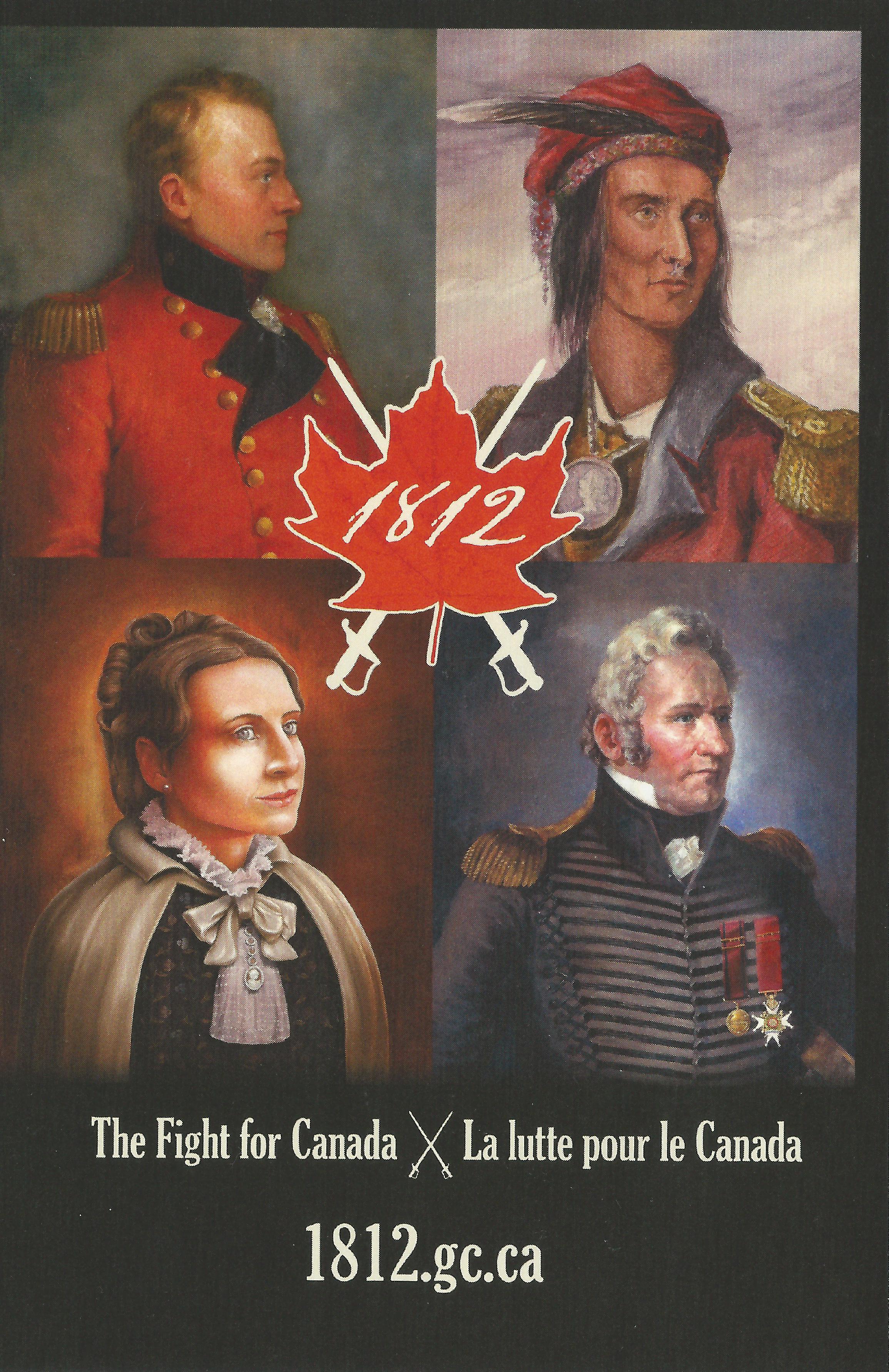
Four Canadian Heroes of War of 1812. Photo: Government of Canada
The controversy with the commemoration lies in the Federal Government setting aside $28 million for public commemorations, a sum deemed too large and even frivolous in a recession. The money has been set aside for commemorative events, for museum exhibitions, for media publicity. The official emblem of the bicentennial speaks to the desire to unify the country. It is a seal with four heroes from the war: a British General, a French-Canadian officer, a woman who warned the British troops of an attack, and a Shawnee chief. (Guess the names; they are listed below.)
What’s striking is the contrast with the commemoration in the U.S. of the War of 1812. What commemoration? New York Governor Andrew Cuomo vetoed any appropriation for marking the bicentennial, but a few states did approve spending, and as is normally done on this side of the border, there is more private than public funding. Still, it would not be surprising if most have seen nothing related the War of 1812 these past two years.
The Canadians are choosing to remember, and we have chosen to forget. The U.S. Consul General in Toronto can’t forget. He will attend the official ceremony marking the bicentennial of the attack on York. Care to join him, facing the Canadians who remember that attack?
(From upper right corner, clockwise: Major General Sir Isaac Brock, French officer Charles de Salaberry, Laura Secord, and Tecumseh)
The Guantánamo Beacon
Posted by John Dickson in International, Personal memory, Public Affairs, Public History on January 11, 2013
This month marks the second inaugural for President Obama. It’s also the fourth anniversary of his executive order requiring the closing of the detention center at Guantánamo within one year. That decision prompted a group of museum professionals and activists to launch a month later the Guantánamo Public Memory Project (GPMP), aimed at preserving the site for historical purposes, and thereby preventing it from being used again as a detention center.
In December, the GPMP hosted a conference in New York City in connection with the opening of an exhibit to explore the issues that the naval base and the prison hold for the U.S., and its place in the world. The exhibit consists of a series of panels in the windows of the Kimmel Center at NYU and an online collection of materials and interviews, collected by the project and its many partner institutions. Much transpired at the conference, including testimonials by Cuban and Haitian refugees from the 1990s, from military officers and lawyers, from historians and students. Most striking, and telling, were two questions posed by students.
The first student, let’s call Jose, stood up in front of the room of 100 people attending the conference to ask his question, stating that he was from the Dominican Republic, and while not enrolled in university, he was studying on his own. He said that where he was from and throughout all of Latin America, the United States stood like “a beacon” on issues of democracy and human rights. “What,” he asked, “happens now after Guantánamo? What can you say to us anymore?” His tone was clearly one of wanting to continue to see the U.S. as that beacon, in a region still struggling with consolidating its own democracies.
Several minutes later, another student called Katie asked what was happening to the lighthouse at Guantánamo Naval Base. “Were there any restoration plans?”
The former naval commander in charge of facilities on the base indicated that the lighthouse was in disrepair, that pieces were falling off it, and that there was no funding to restore or maintain it. In fact, it was closed off, surrounded by chain link fence.
The two questions were asked separately, but became connected metaphorically, since the second student had contributed to the GPMP on-line exhibit a page on the lighthouse, in which she referred to it as “a beacon.”
The physical disrepair of that lighthouse on Guantánamo takes on greater meaning in light of Jose’s question. The symbol of the U.S. as a beacon takes the form of the lighthouse on the naval base, damaged and surrounded by a fence.
The only answer to Jose and people around the region should be, watch our democratic practices take place to find the self-correcting mechanisms. It will take time, and there will be advances and setbacks. The conference and the Guantánamo Public Memory Project are part of that process by seeking
a) to raise awareness about the base and the detention center,
b) to use public history through exhibits, digital spaces and oral history to initiate a dialogue about the trade-offs between national security and human rights and
c) to re-think the use of Guantánamo as a detention center in the future.
For more information on the project, go to: http://hrcolumbia.org/Guantánamo/ . To see the final product go to: http://gitmomemory.org/stories/.
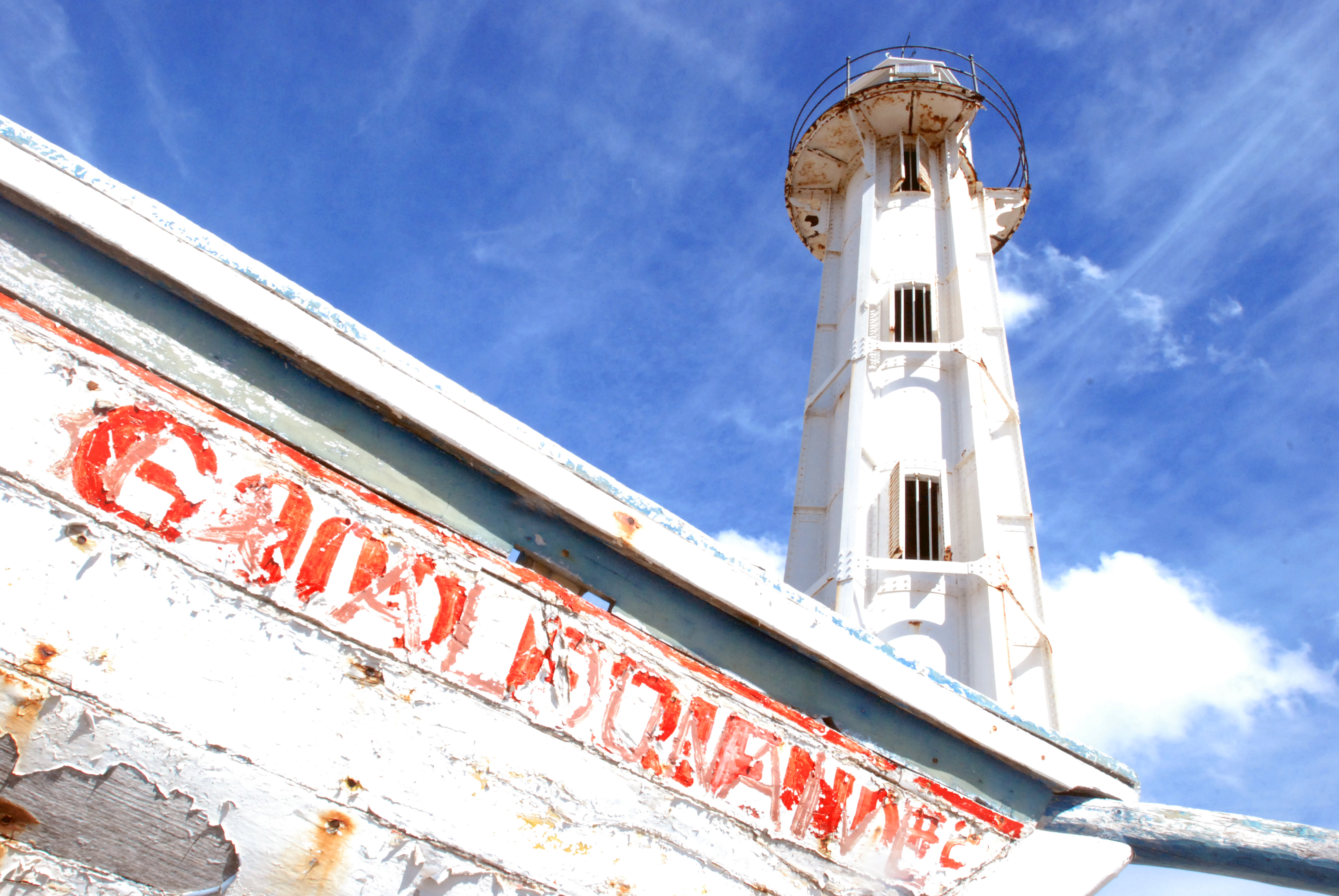
A beacon in disrepair. Photo: SouthCom
Who is Jenni Rivera?
Posted by John Dickson in History in our surroundings, Immigration, International, Public Affairs, Public History on December 24, 2012
A couple of weeks ago, Jenni Rivera died in a plane crash. If you are at all like me, you wondered who is Jenni Rivera. Then, you may have moved, like me, to a better question: how could I not know of Jenni Rivera?
It’s not age, but certainly there are a slew of boy bands and other pop culture icons who have just passed me by. This one, Jenni Rivera, had to do with our ethnic and racial, perhaps geographic bubbles we live in.
Jenni Rivera turns out to be a Mexican-American singer, and not just any singer, but one who sold upwards of 15 million albums. She started out singing banda and ranchera music, which, when I lived in Mexico, sounded like a form of Mexican country-western distinct from mariachi. She then moved on to greater popularity with her own reality show on Spanish-language cable television. She was due to break out with her own English-language TV series this coming year.
She was American, born, raised and resident in California, right in front of our eyes, but only if we looked in her direction. That direction includes Spanish language television, music, churches, radio, neighborhoods and schools.
It turns out her parents were immigrants, from Mexico. Her story sounds like it fits into the American immigrant pattern. It is a pattern which is not supposed to exist, which is supposed to have changed from the earliest Irish and German immigrants (not counting the early settlers as immigrants.)
Those patterns are changing: language and culture are held on to longer, because it is easier with bilingual education, mass media and telecommunications, and proximity to the border and the native land. School achievement is lower than for previous second generation immigrants, but not in comparison to the first generation of Mexicans who are coming here with barely a primary education. The Jenni Riveras could thrive on her side of the immigrant boundary, unknown to those of us on the other side, in the receiving mainstream.
These changing patterns have caused academics since at least the 1960s to re-think the “melting pot” and assimilation that we once thought characterized our nation of immigrants. Instead, they see segments of some immigrants assimilating and moving up the economic ladder, and others spiraling downwards. They see exclusion and separation, not inclusion and integration. They may be seeing, and trying to explain, the present, before it has a chance to become the past. We are still too close to the current immigrant wave to see it play out.
For example, the ethnic enclaves where Jenni Rivera thrived also existed before. The once dominant French, Polish and Italian churches hold special services in Spanish, Korean and even Khmer. Sports, culture and politics still remain avenues of economic mobility and acculturation; yesterday’s Joe DiMaggio and Jackie Robinson are today’s Alex Rodriguez and Pablo Sandovaal. The 2012 Presidential election saw, for the third straight time, the increasingly important Hispanic vote. And, of course, nativist reaction to immigrants still continues.
Despite the segmentation of our own cultural offerings, with hundreds of cable channels to allow us to stay in our own ethnic and political realms, Jenni Rivera made it, in death, on to both the front and op-ed pages of the New York Times.

Jenni in 2009 Performance. Photo: JEnriquez
Think I’ll go add Jenni Rivera to my playlist, and move the boundaries a little.
-
You are currently browsing the archives for the International category.

A memoir in letters. Excerpts from letters that a father wrote his children each week for almost 30 years, full of the mundane and poignant, the witty and wise. Stories from a different time, from a small town in Connecticut.
History Shock
 Pleased to announce the publication of my book in May 2021 by the University Press of Kansas. This collection of “stories with a history” narrates incidents over the course of my career in the Foreign Service when historical understanding – or lack of it – got in the way in the conduct of day-to-day diplomacy.
Berkshire County’s Industrial Heritage

Check out this book on the nineteenth century mills and those who owned and worked in them. Available through Arcadia Press or Amazon.
Slide Show – Getting to Yes, Woman Suffrage in the Berkshires and Beyond
-
Slide Show – Intersections, Pittsfield’s Neighborhoods
-
Slide Show – Turning Points


Slide Show – Preserving the old Berkshire Athenaeum
 Thomas Allen donated $50,000 to build the Athenaeum in 1876.
 A yong architect from New York, William Appleton Potter, had his design selected for the new Athenaeum.
 The original architectural drawing of the front elevation of the Athenaeum
 An early photo of the High Victorian Gothic building, pointed arches, twin gables, multi-color stone patterns,skylight, stained glass windows
 Majestic, quartered oak tresses in the addition built in 1896
 Proposed new library design, in 1944
 Bulging of stonework on from of building required drastic measures to shore up front, in 1979
 A restored skylight is returned to the roof in repairs undertaken in 2001
 Stained glass window on west gable, showing steel tie placed in 1979 stabilization repairs
 Masonry work begins on the Athenaeum in the deep of winter
 Removing the stained glass panels for repair
 Cracks in the masonry
 More cracks in the masonry
 Lifting the capstone off the east gable, the first stone removedd








 History All Around