Archive for category Berkshires
In plain sight
Posted by John Dickson in Berkshires, Civil War, History in our surroundings, Public History on December 18, 2012
It’s an invisible monument, in plain sight. The Soldiers Memorial sits in a prominent position on Park Plaza, the small, central park of Pittsfield, at the crossroads of main thoroughfares in western Massachusetts. Thousands of people pass by it daily, but I wonder how many are like my wife who grew up in Pittsfield but did not know there was a monument in Park Plaza. The last time the memorial appeared in the press was on the 110th anniversary of its dedication, in 1982.

On Park Plaza. Photo: JDickson
On the one hand, it’s hard to miss the 6-foot bronzed color guard soldier holding the flag, atop a 12-foot granite pedestal, dedicated just seven years after the end of the Civil War. Divided into their regiments, the names of 102 Pittsfield soldiers who died during the war are inscribed on plaques on the granite sides. Yet, so many of these statues of soldiers, or generals riding horses, populate our public places that they have lost meaning of memorializing the fallen, blending into the landscape almost like a telephone pole.
Each of the men on the plaque must have his own story worth telling, but lost now. The pamphlet[1] memorializing the dedication ceremony on September 24, 1872 adds a little flavor. The name of the conflict was “The Great Rebellion”, not the Civil War; the artist whose painting served as the model for the sculptor himself survived the Battle of Antietam but lost an arm. The booklet includes the names of the regiments of the Pittsfield volunteers, and their engagements, from the well-known Gettysburg or Chancellorsville to lesser known battles with names like Yellow River, Grim Swamp or Cane River Crossing. Soldiers “died from their wounds,” “killed in action,” “died in Libby Prison,” or simply “died.”
Reading from a 21st century perspective, several other story-lines with gender and racial overtones emerge. The original idea for a monument was floated shortly after the end of the war, studied by several committees, including one of women who went on to raise money when the town delayed pursuing a memorial so that it could pay off its war debts first. With $3000 in the bank, these women stepped aside (or were shunted?) when an all-male town council took over the plan, appropriated public funds, but still drew on the collected monies. In addition, four soldiers from the all-black Massachusetts 54th (highlighted in the film Glory) died during the war, but an additional ten from Pittsfield served, including the chaplain Samuel Harrison, whose names are all included in the booklet. An article from the local paper on September 25, 1872 which lists all the regiments of the 2000 soldiers who marched in the parade did not mention the 54th, leading to speculation on their absence – from the story or the parade?
An orator spoke at the dedication, a professional orator, winner of prizes and contests: a certain George William Curtis, from New York, who speculated on how posterity would interpret the war. Not once mentioning slavery, his reference was implicit but unmistakable: “equal rights of every citizen are the sacred care of the whole people.” Curtis thought to anticipate the day when a youth from Carolina or Georgia would stop at the statue and invoke that these “men died for me as well as for you. They saved Carolina as well as Massachusetts.” We’re not there yet.
How does this statue speak to us today? Hardly at all, unfortunately. This memorial invisible in plain sight, should tell us a lot, about a war which still divides us as it preserved and united, about the sacrifice it took to get to where we are, on race and gender, on patriotism, on loss.
[1] Proceedings of the Dedication of the Soldiers Monument, edited by J.E.A. Smith, Pittsfield MA, Chickering &Axtell, Steam Printers, 1872
- On Park Plaza. Photo: JDickson
If THESE Walls Could Talk
Posted by John Dickson in Berkshires, Colonial, History in our surroundings on October 26, 2011
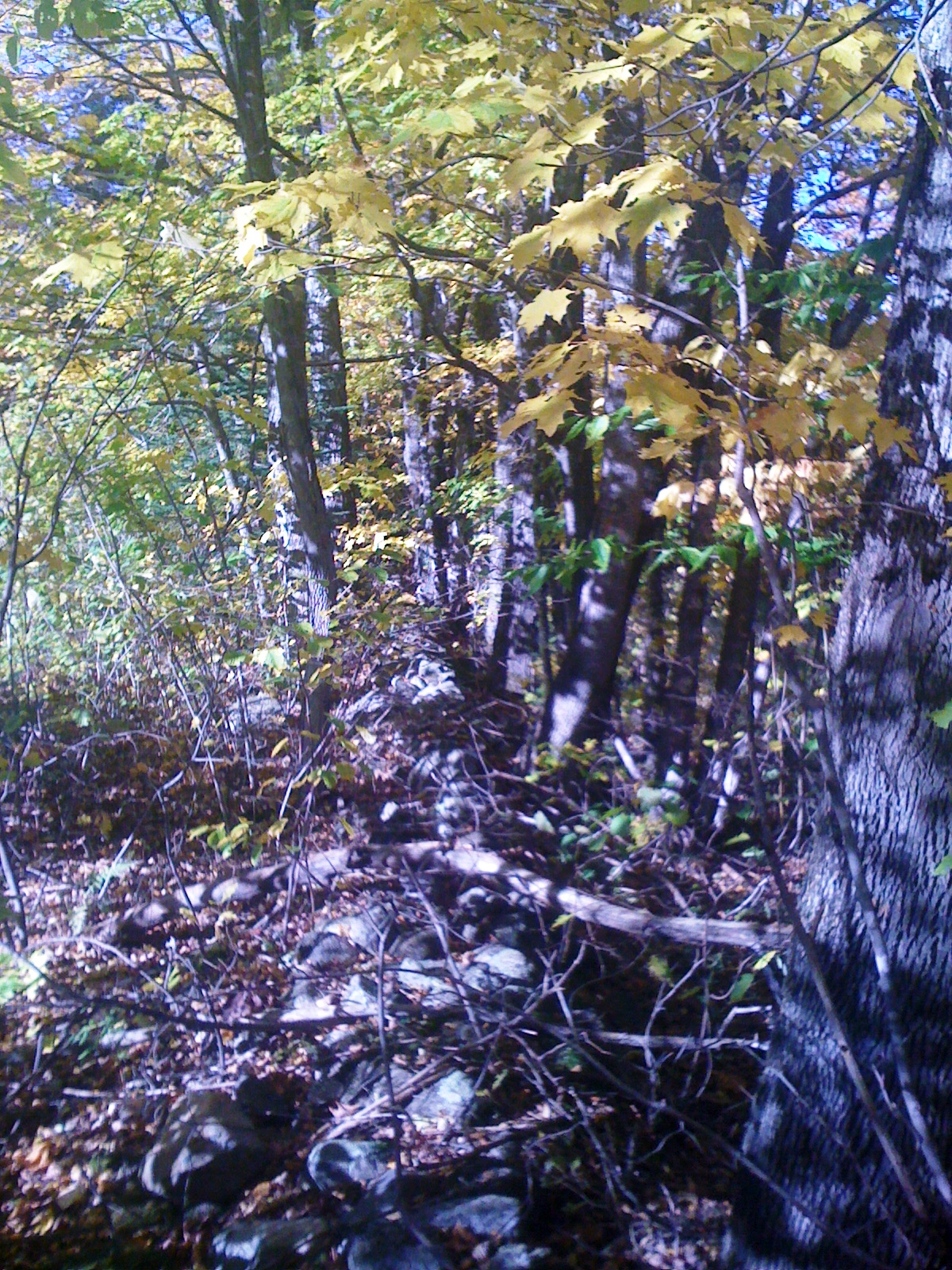
Can you find the stone wall? Photo JDickson
Walk in the woods almost anywhere in New England or drive along almost any road and you are likely to come across a stone wall. We take them for granted. We rarely pause to consider who built these walls, when were they built or even why.
Last summer, I did my own personal stone wall reenactment. I built a stone wall. Really it was just moving rocks which came out of the foundation for an addition on our house. I had the help of an excavator for three very large boulders. Other than that, it was a wheelbarrow and my own feeble arms carrying and placing these rocks. I got about to a length of about 30 feet and a height of 3 feet at most before I realized that I had bit off more than I could chew. While it looks nice, I have no illusions that it will last as long as the stone walls I saw recently walking up Mt. Greylock, or similar ones in the woods around Rangely Maine.
Several things leap to mind immediately on seeing these walls. First, they are now in the middle of woods. When they were built, they were most likely thrown together to demarcate fields and pastures. These thick woods were once pastures. How quickly have they reverted back to their natural state! These are small plots of farmland they mark off, probably accounting for why farming in this region lost out to the much larger, commercial and industrial farms of the MidWest.
Second, the walls go on and on, much longer than my miserable little 30 feet, extending along and breaking up 10 and 20 acre plots. This was a monumental exercise therefore, one which had to take place over many years. If one author estimated that it would take two men to lay 10 feet of stone wall in one day, why did it take me so long to go just 30 feet? Stone wall studies often cite an 1871 report undertaken by the Department of Agriculture, Statistics of Fences in the United States. There, it is estimated that Connecticut had 20,505 miles of walls, Massachusetts perhaps as much as 16,000 miles and New York 95,364 miles!! One author surmised that it would have taken 15,000 men 243 years to construct the stone walls in New York and New England. That may surpass the pyramids.
Next, just how many rocks could a farmer move from a field? He probably had help, in the form of oxen and wooden sliders, his sons, or tenant farmers or even slaves. The earth kept providing stones for the farmers to move, each winter would churn the earth to provide another crops of stones to be moved.
And, did he follow a technique that was widely accepted? The old adage of “one rock covering two and two rocks covering one” probably gave the wall its height, but not its broad width, without mortar? Perhaps, he just threw them in a pile.
These walls do speak. They take us back to a different life, a back-breaking life, of subsistence farming, of years of the same kind of drudgery, work with little change. And then it changed. Our human attempts to control our environment were in the end short-lived.
If These Walls Could Talk
Posted by John Dickson in Berkshires, Brown Signs, History in our surroundings on October 5, 2011
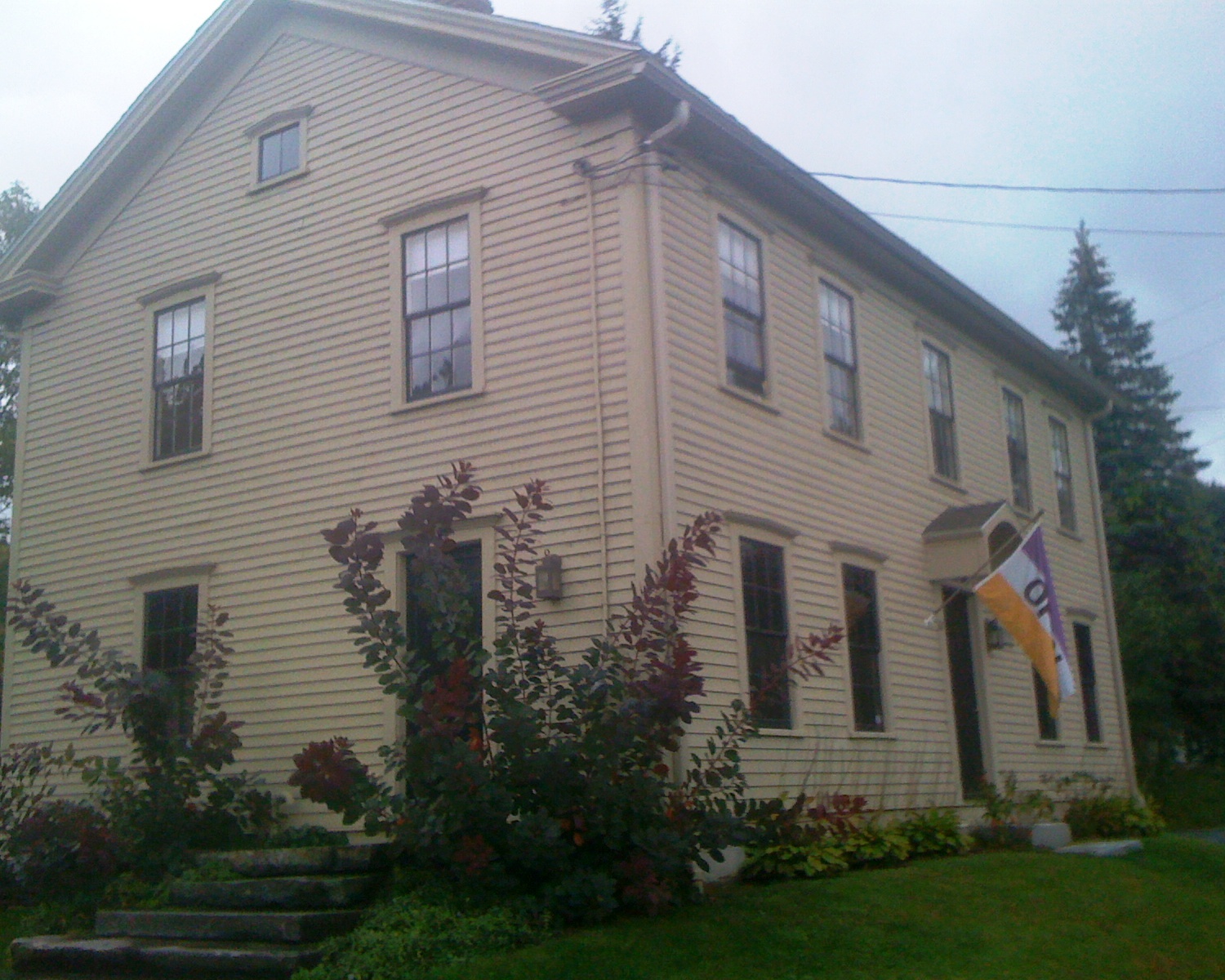
Susan B. Anthony Birthplace Museum. Photo: JDickson
Historic figures are sometimes connected with a place. Lincoln and Illinois. King and Atlanta. Jefferson and Virginia. Capone and Chicago.
Susan B. Anthony’s connection is probably upstate New York, especially as she is tied to the Seneca Falls Woman’s Rights Convention, held in 1848. It was in Adams, Massachusetts where she was born and where her birthplace home is now a small museum.
Anthony lived there until she was 6. The house, built by her father, is now a small museum and has been almost entirely restored, with attempts to make it as authentic to the 1820s period as possible. Wide floor boards; uneven lath and plaster walls. Two rectangular-shaped, small rooms lay adjacent to each side of a stairway up to a second floor with the same pattern of four rooms and a center hallway. Sounds a lot like a house my wife and I own, not 20 miles away, built a few years later.
Walking through Anthony’s birthplace home, visitors must wonder what it was inside those walls that contributed to young Susan developing into a committed, unbending woman’s rights, temperance and abolitionist reformer. Reformer may be too mild, as her newspaper was called “The Revolution.” She even had two brothers who joined anti-slavery crusades prior to the Civil War, traveling to Kansas to join John Brown in his violent activities opposing the expansion of slavery there.
Perhaps, it was her father’s Quaker pacifist, temperance beliefs. One can imagine growing up with family conversations surrounding her father’s decision to marry Lucy Read, a Baptist, and even referring to the injustice of having to apologize for marrying outside the Quaker meeting. (Betsy Ross, 50 years earlier and hundreds of miles further south, saw her sisters and experienced the shame herself as Quakers marrying outside the Meeting.)
Further, it is easy to see a possible impact coming from living with as many as a dozen young women who worked at her father’s mill, across the road. Imagine conversations the child Anthony might have had with or overheard from these young role models and mentors, focused on exhausting work, sharing their wages with families, looking ahead to lives as second-class citizens. Perhaps it was Anthony’s own experiences helping her mother cope with the feeding and care of all these boarders that contributed to her legendary organizing skills. It could have shaped her desire to get an education to avoid that kind of work, only to have a teacher deny her the opportunity to learn.
Still one more family anecdote had Anthony’s father selling liquor in the small store located in the front room of his house. Was his decision to abandon the sale of alcohol from his home at the insistence of his fellow Quakers behind Anthony’s embracing the temperance movement as one of three “causes” to which she devoted her life?
Anthony’s birthplace home is a humble house, compared to the grand-er restored mansions in Berkshire County which some of the country’s wealthiest built as summer escapes and now serve as shrines to the Gilded Age. But, her home serves another, perhaps more important, purpose besides trying to figure out her early influences. This home tells more closely the story of most residents eking out a living in the early 1800s in New England.
-
You are currently browsing the archives for the Berkshires category.

A memoir in letters. Excerpts from letters that a father wrote his children each week for almost 30 years, full of the mundane and poignant, the witty and wise. Stories from a different time, from a small town in Connecticut.
History Shock
 Pleased to announce the publication of my book in May 2021 by the University Press of Kansas. This collection of “stories with a history” narrates incidents over the course of my career in the Foreign Service when historical understanding – or lack of it – got in the way in the conduct of day-to-day diplomacy.
Berkshire County’s Industrial Heritage

Check out this book on the nineteenth century mills and those who owned and worked in them. Available through Arcadia Press or Amazon.
Slide Show – Getting to Yes, Woman Suffrage in the Berkshires and Beyond
-
Slide Show – Intersections, Pittsfield’s Neighborhoods
-
Slide Show – Turning Points


Slide Show – Preserving the old Berkshire Athenaeum
 Thomas Allen donated $50,000 to build the Athenaeum in 1876.
 A yong architect from New York, William Appleton Potter, had his design selected for the new Athenaeum.
 The original architectural drawing of the front elevation of the Athenaeum
 An early photo of the High Victorian Gothic building, pointed arches, twin gables, multi-color stone patterns,skylight, stained glass windows
 Majestic, quartered oak tresses in the addition built in 1896
 Proposed new library design, in 1944
 Bulging of stonework on from of building required drastic measures to shore up front, in 1979
 A restored skylight is returned to the roof in repairs undertaken in 2001
 Stained glass window on west gable, showing steel tie placed in 1979 stabilization repairs
 Masonry work begins on the Athenaeum in the deep of winter
 Removing the stained glass panels for repair
 Cracks in the masonry
 More cracks in the masonry
 Lifting the capstone off the east gable, the first stone removedd








 History All Around