Archive for category History ahead
Michael Brown and the Midterm Elections
Posted by John Dickson in History ahead, Public Affairs on December 4, 2014
What is the connection between the Republican takeover of the Senate in the midterm elections and the grand jury decision in Ferguson, Missouri not to indict the policeman who shot Michael Brown? I would not have made any myself, if I did not happen to be reading Robert Caro’s series on Lyndon Johnson. Reading Caro helps draw lines from the two events back to the 1930s when they intersect with earlier obstructionist Senators blocking efforts to pass anti-lynching legislation, that festered grievances against racial bias in our criminal justice system. This newly strengthened Congress has made clear it will obstruct issues on the national agenda, but which ones will continue to fester for years to come?
In his third volume on Johnson’s Senate years, Master of the Senate, Caro sets up Johnson’s rise to positions of leadership with an extended history of that body, its deliberative function and the slow procedural mechanisms. The author maneuvers through several Senate eras, from its original establishment in the Constitutional as a deliberative body of six-year tenured aristocrats in order to check not only the power of the executive, but also the transitory sentiments of the popular will, as represented in the House of Representatives. The golden age of deliberation and compromise during the Senate of Webster, Calhoun and Clay gave way to an all-out brawl with the executive during reconstruction. Then, the Gilded Age ushered in an extended era of obfuscation and obstruction, broken only by a flurry of progressive bills that passed during Woodrow Wilson’s early years in the White House and then later during FDR’s first term. The rules established in the Senate allowed for a handful of leaders to manipulate parliamentary procedure and prevent bills that might reign in the excesses of business or that would ratify the Treaty of Versailles ending the “Great War,” effectively keeping the U.S. out of the League of Nations.
These precedents of delay and obstruction in the Senate paved the way for the battleground over civil rights. The procedure was the filibuster and the related provisions of cloture to cut off debate. When Congress used these tactics to obstruct a measure to integrate the armed forces following the Second World War, President Harry Truman turned to an executive order in 1948 to accomplish this, much like Obama is using his executive authority in the failure of Congress, in this case the House, to act on immigration reform.
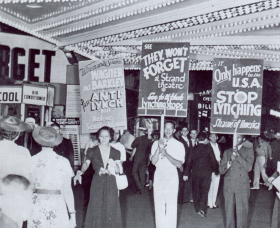
NAACP protest in 1937 against lynching. Photo, Library of Congress
Yet, it was the inability of Congress to outlaw lynching that the connection reaches to Ferguson, Missouri. On its face, the horrifying practice of lynching would seem to be one issue that would be easy to muster up a majority to make illegal. However, during the period between 1882 and 1968 when almost 3500 African-Americans were murdered by lynching, over 200 times bills were introduced in Congress to outlaw the extrajudicial killing. Presidents repeatedly asked Congress to pass a law, but only three times did a bill pass the House. Caro focuses on those three in his book, in 1922, 1935 and 1938, describing the use of the filibuster and the cloture rule to prevent passage of those bills in the Senate. He describes in detail the tactics of Richard Russell, the powerful Democratic Senator from Georgia, whose home town of Winder was the site of several prominent such murders. Russell couched his opposition to the lynching bill in the Constitutional prerogatives of the Senate, including the need to protect the filibuster and cloture as mechanisms to ensure checks and balances. He wanted to ensure no civil rights bill, of any ilk, would pass.
This history of extrajudicial killings weighs heavily on what has transpired in Ferguson, Missouri. While no one is calling the killing of Michael Brown a lynching, the number of protests since his death does seem to make such a link, though, at least into the extended past of unpunished killings of African-Americans. For many, what happened to Michael Brown had more to with a history of bias in the criminal justice system than the actual facts of this individual case, however tragic it was. That past that reaches back even beyond the refusal to outlaw lynchings is not even that distant, certainly well within the lifetimes of many alive today.
It can be debated what the impact on race relations today would have been if Congress had not obstructed efforts to outlaw lynching in 1938, or 1922, or even earlier. What did happen, though, in 2005, was a recognition that more should have been done. That year, the Senate adopted a resolution apologizing for its history of refusing to pass such a law. It was a non-binding resolution to correct “inaction on what were great injustices,” according to then White House Press Secretary Scott McClellan. One of the bill’s sponsors noted that “the Senate failed you and your ancestors and our nation,” in remarks before families of victims. That Senator was Mary Landrieu, a Democrat from Louisiana, who will likely lose her seat this week in a run-off election, on December 6.
The mid-term elections strengthened a Congress that has made clear it will use all its powers and procedures available to obstruct action on any number of issues of national urgency – health care for millions of uninsured, climate change, closing Guantanamo prison, immigration reform. This is not about exceeding its Constitutional authorities. Congress, over 80 years, used its own rules of filibuster and cloture to obstruct anti-lynching legislation. However, as Caro and Landrieu point out, it used its deliberative rules as an excuse for inaction, to protect narrow interests. “Failing the nation,” the Senate kept alive a bias in the criminal justice system that many see played out again in 2014 in Ferguson Missouri. On which issue will its obstruction require an apology for failing to act 50, 80, 100 years from now?
Using History to Resolve a Crisis
Posted by John Dickson in History ahead, International, Public Affairs on July 22, 2014

Streseman, Chamberlain and Briand at Locarno. Photo, German Federal Archive
On this day, 89 years ago, the New York Times carried a story in its far left hand column with the headline “Long Step To Peace Is Seen By Britain in Germany’s Reply.” Absent a banner headline, it recounted the text of a diplomatic note from Germany to Great Britain about ongoing negotiations to resolve several matters growing out of the Versailles Treaty ending the Great War. These included border disputes along Germany’s western border, the inviolability of the Versailles Treaty and Germany’s entry into the League of Nations. These negotiations ultimately ended up settled in the Locarno Peace Treaties several months later, and were the basis for the Nobel Peace Prize that Britain’s Foreign Minister, Austen Chamberlain, won.
Eleven years later, Germany abrogated both the Versailles and the Locarno Treaties with its invasion of the demilitarized zone along the Rhine. The following year, Austen’s half-brother Neville became Prime Minister of Great Britain, and earnestly sought to resolve tensions in Europe by acceding to Hitler’s demands.
This article, 89 years ago today, brought to mind last week’s international crises, a trifecta of problems facing the United States:
— the downing of a Malaysian airlines passenger jet by Russian separatist in Ukraine, with some level of assistance from Russia
— an intensifying conflict in the Middle East with the Israeli ground invasion of Gaza
— the presence of 57,000 undocumented children from Central America in U.S. detention centers
These three issues cloud out other crises that just a few weeks earlier had concentrated the minds of those in charge of U.S. foreign policy: the ongoing civil war in Syria, disputed Presidential elections in Afghanistan and a brazen invasion of Iraq by extremists seeking to establish an Islamic state across territory of Iraq and Syria. Events such as these don’t leave room for truly devastating humanitarian crises that never even make it in the news, like the ongoing refugee crisis in South Sudan where 700,000 people are internally displaced and hunger is affecting millions more.
If Hillary Clinton gave the title “Hard Choices” to her memoir of her tenure as Secretary of State, John Kerry’s sequel from just last week will make her watch look fairly tame.
Each of these three major events – Ukraine, border children, Gaza ground invasion – would carry banner headlines on their own. Any newspaper’s difficult decision last week was which deserved prominence.
They also each have historical precedents that are cited and considered. Match the precedent with the crisis: Iraq’s invasion of Kuwait in 1990; Kosovo’s secession from Serbia in 2008; the Mariel boat lift in 1980 or the Haitian migrant crisis in 1994; the Israeli invasion of Lebanon in 2006 or of Gaza in 2012 or 2009; the downing of a Korean airliner in 1983, or an Iranian passenger jet in 1988. None show the way to a clear cut path to resolving the crisis at hand. History can give a pretty clear map to what transpired, identifying the sequence of events and the conditions that lend a certain air of inevitability to any outcome. History is not as good as showing a way forward, especially when the choices in each of these cases are more than hard – they are messy and unpredictable in the outcomes they yield and the consequences they unknowingly generate.
So, what is the connection between a fairly mundane story 89 years ago and these major events? That ordinariness of those diplomatic negotiations between Germany and Great Britain resurfaced 11 years later. And they re-surfaced in a way that dominated world events for at least the subsequent 11 years as well.
Which of the three major stories of this week has the potential for such long-term consequences? Much of the answer lies in the nature of the resolution. Perhaps, the resolutions would be temporary fixes, only to re-surface in a short period, but enough to remove the crisis from the front pages. Or, perhaps the resolutions are of the muddle-through variety, allowing governments to contain the potential for escalation. Or perhaps, resolution is left untouched, as the crisis benefits specific, narrow self-interests of the parties involved? Rare indeed is the resolution that actually resolves a crisis.
Opposite the German diplomatic note story, on the far right hand side of the paper, 89 years ago, ran a larger headline: “Scopes Guilty, Fined $100.” Well, that certainly resolved the debate over evolution.
Predicting the future: Pope Francis, President Rouhani, Attorney General Holder
Posted by John Dickson in History ahead, History in our surroundings, International, Public Affairs on September 24, 2013
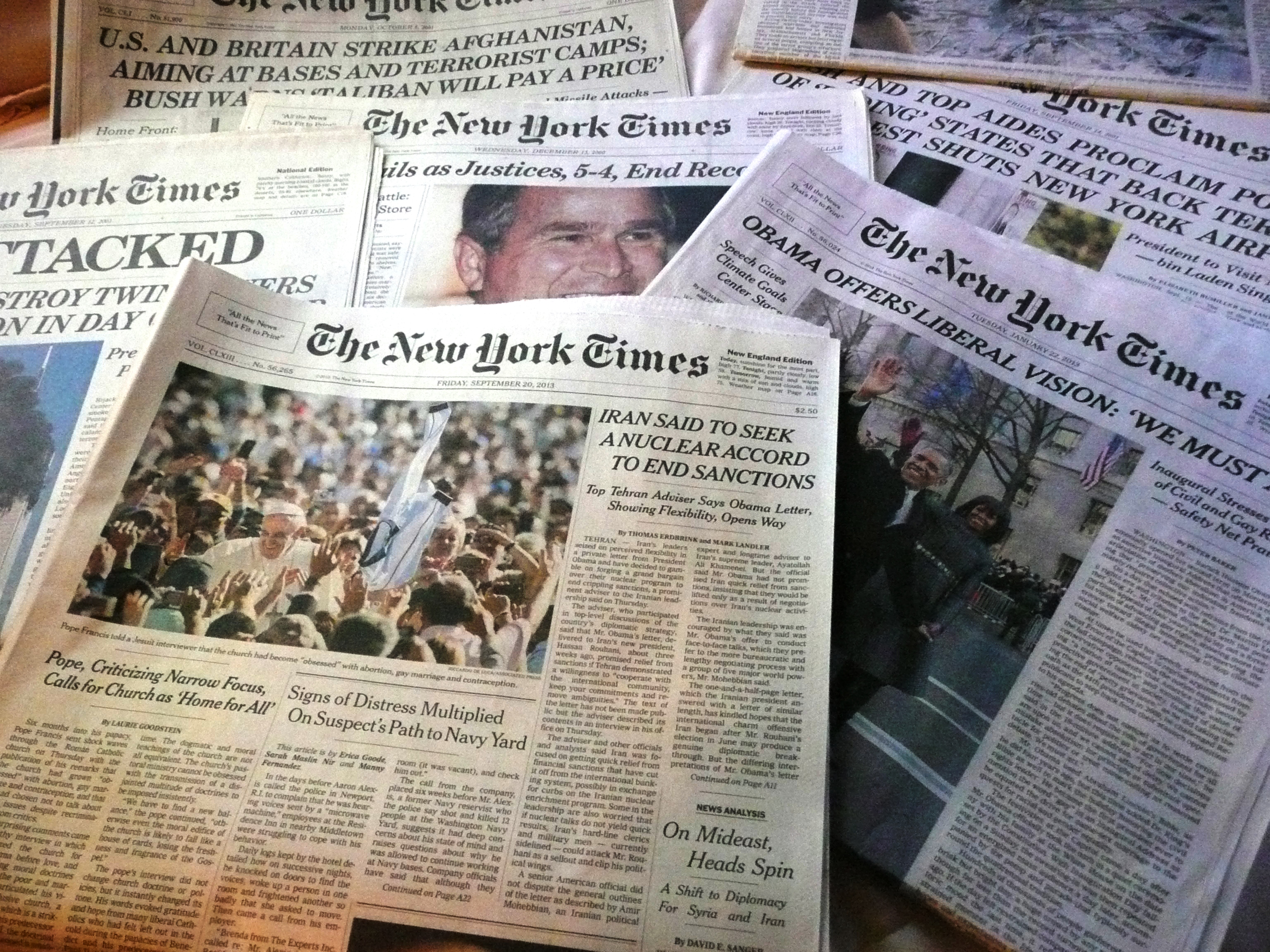 In a small trunk, here in my office are a select group of newspapers, saved because, at the time, they seemed to represent momentous events: 9/11, Bush v. Gore, death of Pope John Paul II, Watergate, impeachment of Clinton, fall of the Berlin Wall. All have across the top, large-print headlines. Today, I am adding to the collection the first which does not have the same bold typeset.
The paper on Friday, September 20, 2013 carried three separate stories, only two of them on the front page, which signaled what could be historic, transformational changes. It may be difficult to predict history, and my experiment here may ultimately fail, but these do seem like shifts which will alter the shape of slices of our history over the last 50 years.
First is what looks like may be a thaw in U.S. relations with Iran. The article, on the right hand columns of the New York Times, may only report the latest in a series of signals since the election in June of Iran’s new president, Rouhani. However, it reveals an exchange of letters between President Obama and President Rouhani exploring the possibility of direct negotiations between the two countries, who have not had diplomatic relations since the 1979 hostage crisis. The official who discussed the exchange of letters was a senior advisor to Iran’s supreme leader, Ayatollah Khamenei, seeming to indicate the latter’s acceptance with an opening.
Next is what looks like a re-direction of the Catholic Church’s social priorities. The new Pope Francis released the content of an interview he had given to a Jesuit Catholic journal in August where he pointed to a need for the church to be a “home for all.” He went on, charting a course for the Church to drop its “obsession” with abortion and contraception. On homosexuality, he asked an open-ended question wondering “when God looks at a gay person does He endorse the existence of this person with love, or reject and condemn this person?” Sounds a little like Jesus answering the efforts of the Pharisees to entrap him.
The third is the reversal of a policy of aggressive prosecution of drug crimes. The Attorney General Eric Holder gave a speech laying out the practical steps to reduce the extended sentencing of lower level drug crimes. Those harsh, often mandatory, sentencing rules have been enacted in various U.S. jurisdictions since the 1970s, the most well-known being California’s “three-strikes” provision in 1994. While changing the 1984 federal anti-drug act would require Congressional approval, Holder has instructed prosecutors to take steps in implementing the law, like not indicating the amount of drugs possessed by the accused. This would avoid triggering the automatic mandatory sentence.
Friday’s paper was not the first indication of any of these transformational shifts: the new Pope had indicated as early as his installment his concern for the poor as a fundamental focus for the church; the Iran’s President Rouhani had been sending signals of accommodation with the West since his election; and Attorney General Holder in August announced his decision to review sentencing guidelines.
Also, despite the important role played by each of the three individuals, pressure had been building for some time in each area to force the decisions each have taken. Sanctions aimed at Iran’s atomic weapons program are hurting the general population. Catholics are leaving the church, and important constituencies in the Democratic Party have latched on to overcrowding and disparate treatment between racial groups in sentencing to push for these changes.
Neither are these three pronouncements yet set on a straight, direct course towards fulfillment. In their infancy, each can be reversed, and it is more than likely that they will proceed on meandering paths in pursuit of the goals elaborated. Some accuse Iran of stalling, of engaging in a public relations campaign, to delay further international condemnation. The articles point to the Pope moving beyond the traditional power structure in the Vatican, and Congress can easily step in and halt any changes in Holder’s sentencing proposals.
Still, they each represent what could be fundamental changes. Comparisons to past historic transformational figures like Gorbachev, Sadat or Pope John Paul II are in the air. It is enough to make me add this front page to my small collection.
But before I do, my eye catches a fourth article, below the fold in Friday’s edition of the New York Times. This one reports on a resurgence of the textile industry in the U.S., one that is heavily automated, with many fewer workers, but one which would reduce the cost of transportation, as well as the potential for terrible tragedies like the collapse of a textile factory in Bangladesh. Maybe, just maybe, it is this one which foretells the most consequential shift, one that would have a greater impact in the daily lives of people around the globe.
The King Memorial
Posted by John Dickson in History ahead on September 19, 2011
News flash. There’s nothing wrong with the Martin Luther King Jr monument on the mall in Washington DC. In fact, there’s a lot that’s right to it.
King emerges in a slice of granite, out of a mountain, looking across the Tidal Basin to the Jefferson Memorial. He stands erect, arms crossed with a look of righteous anger. He’s staring out across the water to Jefferson, with a vigilance on our own progress towards living up to the ideals proposed in the Declaration of Independence. King’s body is only partly sculpted, just like the work of extending civil rights and equal opportunities for all remains unfinished. The plaza is replete with quotes from his speeches and letters, reminders to Americans of his life, and the courageous activism throughout his brief 39 years.
The view across the water gives the site a serenity and a sacredness broken only by the children enjoying the space to run and to line up for pictures at the base of the monument and next to quotes.
The plaza was full of people on the mid-week morning I visited. People of all races and all ages. It’s a short walk from the WWII Memorial and the Lincoln Memorial, a walk also full of people, on their pilgrimage to this site. It’s around the corner from FDR’s memorial, which is more like an outdoor museum, informative, but tucked away, and empty of people.
I’m pretty sure that most visitors were not thinking of the controversies surrounding the monument, issues which have been given too much attention. Yes, King looked a little stern and imposing, a little too much like other statues which the Chinese sculptor may have designed for Mao. Yes, there is an edited quote on the statue base, which could have been cited in its fullness on the wall surrounding the statue.
It’s not as if King avoided controversy in his lifetime. We caught a glimpse of that with the release of Jackie Kennedy’s tapes with her 1964 comments calling him a “phony” and “terrible.” I doubt too that visitors had those comments on their mind.
The monument will endure beyond these little issues, which will undoubtedly fade into obscurity. One hundred years from now, people will continue to pay tribute to King and his ideals. Moreover, his challenge to the nation will, unfortunately, probably also outlast the petty issues that help fill up our instant news cycle.
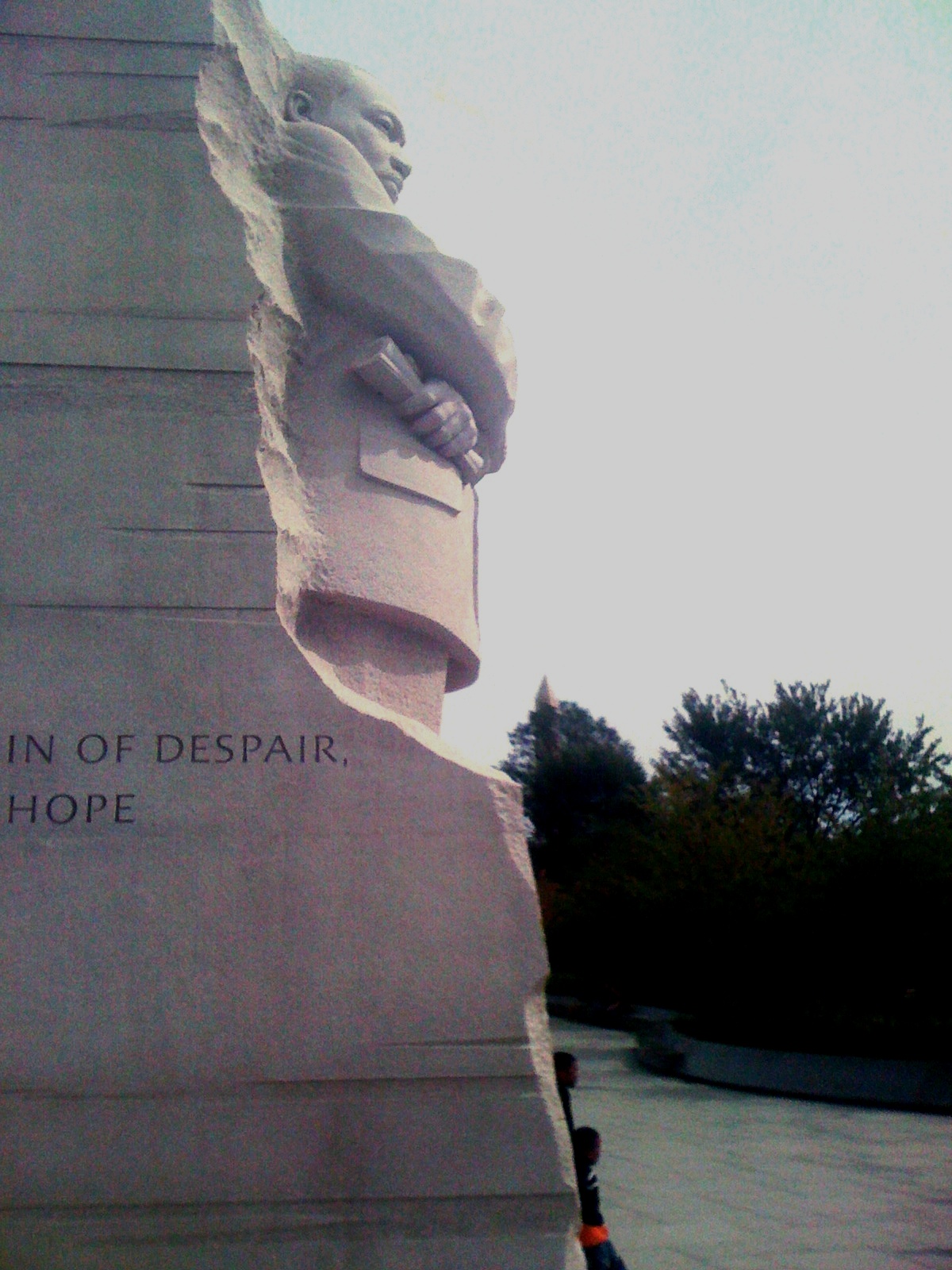
King on the Mall. Photo: JDickson
-
You are currently browsing the archives for the History ahead category.

A memoir in letters. Excerpts from letters that a father wrote his children each week for almost 30 years, full of the mundane and poignant, the witty and wise. Stories from a different time, from a small town in Connecticut.
History Shock
 Pleased to announce the publication of my book in May 2021 by the University Press of Kansas. This collection of “stories with a history” narrates incidents over the course of my career in the Foreign Service when historical understanding – or lack of it – got in the way in the conduct of day-to-day diplomacy.
Berkshire County’s Industrial Heritage

Check out this book on the nineteenth century mills and those who owned and worked in them. Available through Arcadia Press or Amazon.
Slide Show – Getting to Yes, Woman Suffrage in the Berkshires and Beyond
-
Slide Show – Intersections, Pittsfield’s Neighborhoods
-
Slide Show – Turning Points


Slide Show – Preserving the old Berkshire Athenaeum
 Thomas Allen donated $50,000 to build the Athenaeum in 1876.
 A yong architect from New York, William Appleton Potter, had his design selected for the new Athenaeum.
 The original architectural drawing of the front elevation of the Athenaeum
 An early photo of the High Victorian Gothic building, pointed arches, twin gables, multi-color stone patterns,skylight, stained glass windows
 Majestic, quartered oak tresses in the addition built in 1896
 Proposed new library design, in 1944
 Bulging of stonework on from of building required drastic measures to shore up front, in 1979
 A restored skylight is returned to the roof in repairs undertaken in 2001
 Stained glass window on west gable, showing steel tie placed in 1979 stabilization repairs
 Masonry work begins on the Athenaeum in the deep of winter
 Removing the stained glass panels for repair
 Cracks in the masonry
 More cracks in the masonry
 Lifting the capstone off the east gable, the first stone removedd








 History All Around